Breakthrough “Electrical Sutures” Could Revolutionize Wound Healing

Sutures have long been the go-to method for closing large and deep wounds in the skin, promoting faster healing by physically bringing the edges of the wound back together. Without them, injuries heal more slowly, often leave larger scars, and have a higher risk of infection. However, traditional sutures come with their own set of challenges: movement of the affected area can cause the stitches to open up, and they typically need to be removed by a doctor once the healing process is complete. Now, scientists at Donghua University in China have developed a groundbreaking new type of suture that could address these issues and accelerate the healing process.

The innovation lies in a specialized mechanoelectrical fiber that generates electric fields when it is moved. This fiber is designed with two layers: a core and a sheath. When the wound area moves, the contact between the layers changes, creating electrical signals. Research has shown that these electric fields can speed up healing by stimulating cell movement and tissue regeneration.

Continue reading… “Breakthrough “Electrical Sutures” Could Revolutionize Wound Healing”

Surgeons Explore the Future of Medicine with Apple Vision Pro Mixed-Reality Headsets

Over the past month, Dr. Horgan and his colleagues at the University of California, San Diego (UCSD) have conducted over 20 minimally invasive surgeries using Apple’s mixed-reality headset, the Vision Pro. Released to the public in February, the device has largely struggled to make an impact in the commercial market. However, in certain fields like architecture and medicine, professionals are exploring its potential to revolutionize their practices.

Dr. Horgan, who leads the Center for the Future of Surgery at UCSD, believes that incorporating the Vision Pro into surgical procedures could significantly enhance effectiveness while reducing the risk of injury. He sees the technology as a potential game-changer for hospitals, particularly those in underserved areas that lack access to expensive specialty equipment. “This is a revolution that will touch more lives, thanks to broader accessibility,” he says, referencing his own groundbreaking surgical advancements from the early 2000s.

Continue reading… “Surgeons Explore the Future of Medicine with Apple Vision Pro Mixed-Reality Headsets”

The Tiny Water Bear: Could Tardigrade Proteins Hold the Secret to Stopping Aging?

Tardigrades, also known as water bears, are some of the smallest and most resilient organisms on Earth. Despite their microscopic size, these incredible creatures possess a unique set of abilities that have fascinated scientists for years. Tardigrades can survive extreme dehydration, freezing temperatures, radiation, and even the vacuum of outer space. Their remarkable resilience has led researchers to ask a bold question: Could the secret to halting aging lie within these tiny creatures?

Tardigrades have earned their reputation as “nature’s toughest animal” due to their extraordinary survival tactics. They can endure conditions that would be fatal to most other life forms, such as freezing cold, extreme heat, and lethal doses of radiation. What sets them apart is their ability to slow down their metabolism and enter a state called biostasis, essentially putting themselves in a form of suspended animation until environmental conditions improve.

Continue reading… “The Tiny Water Bear: Could Tardigrade Proteins Hold the Secret to Stopping Aging?”

Groundbreaking Solar-Powered Tissues Could Transform Lab-Grown Meat and Organ Production

A team of researchers in Japan has made an astonishing breakthrough that could revolutionize the fields of regenerative medicine and lab-grown meat. In a recent study published in Proceedings of the Japan Academy, Series B, the scientists have successfully created solar-powered tissues, a development that could significantly enhance the production of lab-grown organs and meat.

The groundbreaking research centers on the creation of hybrid plant-animal cells capable of harnessing energy from sunlight, just like plants. While plants use photosynthesis to convert sunlight into energy, animals rely on mitochondria for energy production. By combining plant cells with animal cells—specifically, cells taken from hamsters—the team aimed to create a new type of tissue that could produce energy from sunlight.

Continue reading… “Groundbreaking Solar-Powered Tissues Could Transform Lab-Grown Meat and Organ Production”

Breakthrough Treatment Offers Hope for a Functional Cure of Type 1 Diabetes

In a groundbreaking development, a 25-year-old woman diagnosed with type 1 diabetes has been functionally cured of the disease, remaining insulin-independent for over a year. The treatment involves growing and transplanting new insulin-producing cells derived from the patient’s own stem cells, offering new hope for patients struggling with the condition.

Type 1 diabetes is an autoimmune disorder where the body’s immune system mistakenly attacks the insulin-producing cells in the pancreas, known as beta cells. This leads to an inability to regulate blood sugar levels, necessitating lifelong insulin therapy. Despite advances in managing the disease, no permanent cure has been found—until now.

Continue reading… “Breakthrough Treatment Offers Hope for a Functional Cure of Type 1 Diabetes”

Agentic AI: Revolutionizing the Future of Biological Research and Medicine

Understanding biological systems, particularly human biology, presents an immense challenge due to their staggering complexity. These systems are not only highly intricate but also deeply dynamic and interdependent, making them difficult to decode. A prime example is the immune system, which operates across multiple levels of organization, from individual molecules to entire organs, constantly adapting and responding to various internal and external stimuli in real-time. The complexity of such systems has long posed a significant hurdle for traditional research methods.

While traditional research techniques have made remarkable strides, they struggle to handle the vast volume and interconnectedness of biological data. The immune system alone involves millions of cells, proteins, and signaling pathways, each influencing one another in ways that are difficult to track. Making sense of this tangled web of interactions is a monumental task for human researchers, often requiring years of manual data analysis and experimentation.

Continue reading… “Agentic AI: Revolutionizing the Future of Biological Research and Medicine”

Revolutionary ‘Biocooperative’ Material Created from Blood to Repair Bones and Aid Regeneration

In a groundbreaking development, scientists have created a new “biocooperative” material derived from blood, which has shown great promise in repairing bones and could pave the way for personalized regenerative therapies. Researchers from the University of Nottingham’s Schools of Pharmacy and Chemical Engineering have harnessed the power of peptide molecules to guide key processes in natural tissue healing, creating living materials that enhance tissue regeneration. The research, published in Advanced Materials, marks a significant step forward in regenerative medicine.

Human tissues possess a remarkable ability to regenerate after injuries, especially when the damage is small. This healing process is complex and begins when liquid blood forms a solid regenerative hematoma (RH), a living microenvironment that consists of cells, macromolecules, and growth factors that work together to orchestrate regeneration. However, replicating this process in the laboratory has proven challenging due to its intricate nature.

Continue reading… “Revolutionary ‘Biocooperative’ Material Created from Blood to Repair Bones and Aid Regeneration”

First-Ever Observation of Mini-Tornadoes in Supersolid Quantum Gas: A Breakthrough in Quantum Matter Research

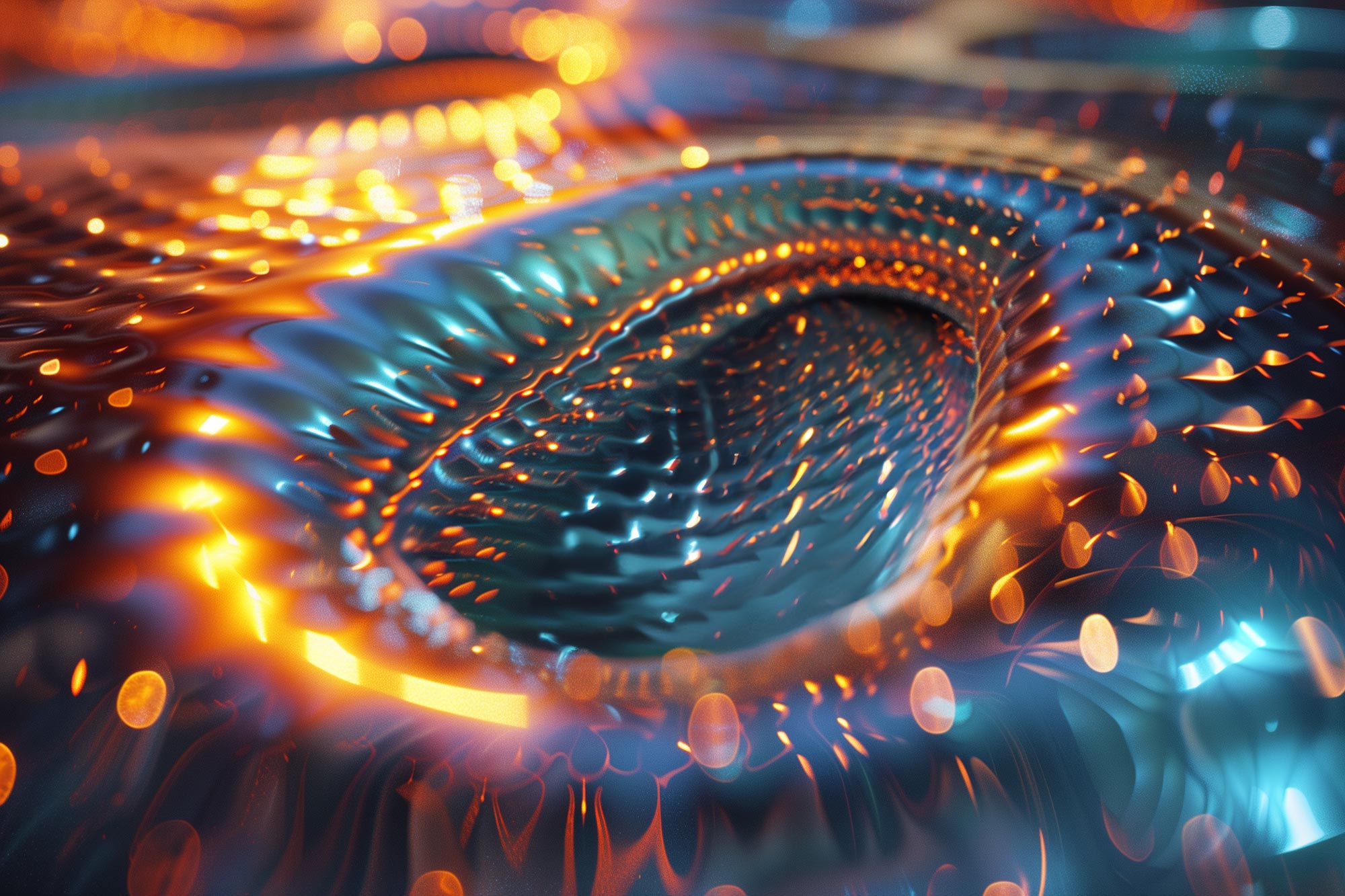
In a groundbreaking experiment, scientists have confirmed the superfluid properties of supersolids by observing the formation of quantized vortices—mini-tornadoes in a quantum gas. This breakthrough offers new insights into the coexistence of solid and fluid characteristics in these exotic states of matter, opening up exciting possibilities for the study of quantum systems and astrophysical phenomena.

The concept of supersolids—materials that simultaneously exhibit the rigidity of solids and the fluidity of superfluids—may seem paradoxical. However, more than 50 years ago, physicists predicted that quantum mechanics could allow such a state. As Francesca Ferlaino, from the University of Innsbruck and the Institute of Quantum Optics and Quantum Information (IQOQI), explains, “A supersolid is both rigid and liquid, much like Schrödinger’s cat, which is both alive and dead.”

Continue reading… “First-Ever Observation of Mini-Tornadoes in Supersolid Quantum Gas: A Breakthrough in Quantum Matter Research”

Unlocking the Secrets of Memory: Non-Brain Cells Can Learn and Remember Too

Traditionally, memory has been understood as a function of the brain, specifically brain cells, which store and process information. However, recent groundbreaking research has revealed that cells outside the brain also play a role in memory, expanding our understanding of how memory works and potentially opening new doors for enhancing learning and treating memory-related disorders.

Nikolay V. Kukushkin, a clinical associate professor of life science at New York University (NYU) and the lead author of the study published in Nature Communications, explains, “Learning and memory are generally associated with brains and brain cells alone, but our study shows that other cells in the body can learn and form memories, too.” This discovery challenges long-held beliefs about memory and introduces new avenues for research in the field.

Continue reading… “Unlocking the Secrets of Memory: Non-Brain Cells Can Learn and Remember Too”

Electro-Biodiesel: A Game-Changing Solution for Decarbonizing Transportation

Vehicles powered by diesel are a significant source of carbon emissions, posing a considerable challenge on the path to decarbonization. In 2022, diesel fuel was responsible for roughly 25% of carbon dioxide emissions from transportation in the U.S. and about 10% of overall energy-related emissions, according to the U.S. Energy Information Administration. To tackle this problem, researchers have developed a groundbreaking method to convert carbon dioxide into a cleaner, more sustainable fuel—electro-biodiesel.

Joshua Yuan, from the Department of Energy, Environmental, and Chemical Engineering at Washington University, and Susie Dai, a professor at the University of Missouri, have pioneered a process that uses electrocatalysis to convert carbon dioxide into electro-biodiesel. This new method is 45 times more efficient and requires 45 times less land compared to traditional soybean-based biodiesel production, offering a more sustainable alternative.

Continue reading… “Electro-Biodiesel: A Game-Changing Solution for Decarbonizing Transportation”

Breakthrough in Noninvasive Brain-Computer Interfaces Paves the Way for Mind-Controlled Devices

Controlling technology with just your mind may have once been the realm of science fiction, but advances in brain-computer interface (BCI) technology have brought it much closer to reality. Researchers at the Johns Hopkins Applied Physics Laboratory (APL) and the Johns Hopkins School of Medicine have made a groundbreaking discovery in noninvasive, high-resolution brain activity recording. In a recent paper published in Scientific Reports, the team revealed that neural tissue deformations could provide a novel signal for brain activity, one that could revolutionize future BCI devices.

Unlike current BCI technologies, which often require invasive surgical implants to record and interpret neural signals, this new approach offers a noninvasive alternative with the potential for broader applications. “Today, the highest impact BCI technologies require invasive surgical implants to record and decode brain activity,” explained Mike Wolmetz, program manager for Human and Machine Intelligence at APL. “Our findings present the foundations for a new approach that could significantly expand the possibilities for nonsurgical BCI.”

Continue reading… “Breakthrough in Noninvasive Brain-Computer Interfaces Paves the Way for Mind-Controlled Devices”

The Costly Fantasy of Sending Earth’s Trash into Space

After Elon Musk’s success in launching thousands of satellites into low-Earth orbit, many might wonder: Why can’t we just send all our trash into space or even throw it straight into the sun? Despite the appeal of removing Earth’s growing waste problem by dumping it elsewhere in the solar system, this idea remains more fantasy than feasible reality, primarily due to the enormous costs and practical limitations involved.

John L. Crassidis, a mechanical and aerospace engineering professor at the State University of New York at Buffalo, explains that sending garbage into space would require vast amounts of thrust and fuel, making it “not cost-feasible at all.” The challenge isn’t just launching the trash—it’s about where to put it. Unlike Earth’s pollution, which can be dumped into oceans or landfills, space is unforgiving. To avoid collisions with existing satellites or risk bringing debris back to Earth, waste would have to be moved at least 22,000 miles away, out of the Earth’s gravitational influence.

Continue reading… “The Costly Fantasy of Sending Earth’s Trash into Space”
Discover the Hidden Patterns of Tomorrow with Futurist Thomas Frey
Unlock Your Potential, Ignite Your Success.

By delving into the futuring techniques of Futurist Thomas Frey, you’ll embark on an enlightening journey.

Learn More about this exciting program.