
Where visitors watch the shift from studying life to programming it
By Futurist Thomas Frey
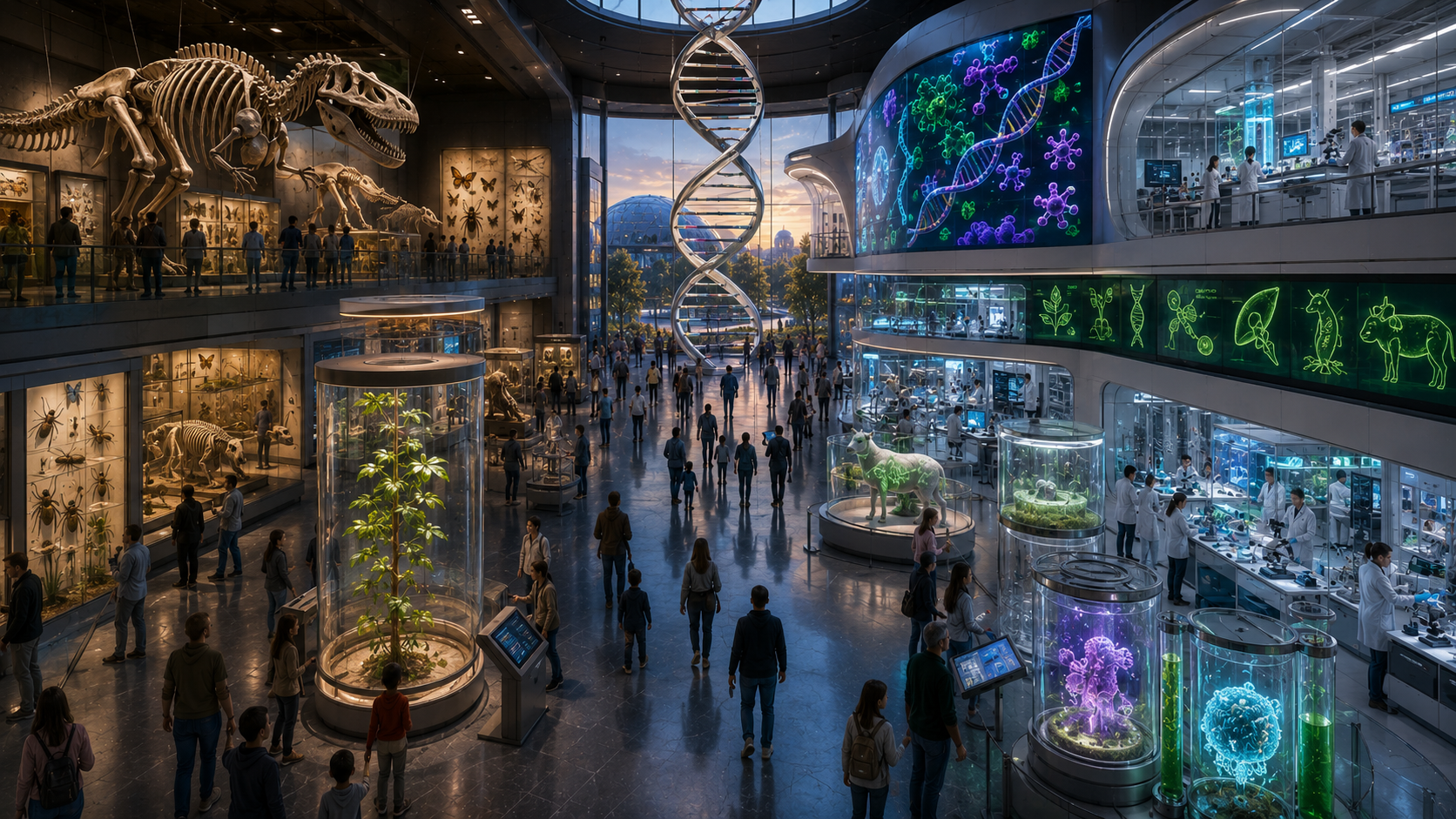
For most of human history, biology was a spectator sport. We watched. We categorized. We dissected what nature already built and wrote very detailed notes about it. Every natural history museum on Earth is a monument to that instinct — carefully preserved specimens, pinned insects, skeletons arranged by species, all telling the same underlying story: here is what life already made, and here is how well we understand it.
That era of pure observation is ending. We’re entering an era where biology isn’t just something we study — it’s something we write. Genetic code is becoming as editable as software, and the organisms built from it are starting to look less like discoveries and more like inventions. The next great science museum needs to tell that story, and it needs an entirely different kind of room to do it. Welcome to the Synthetic Biology Museum.
From Discovery to Design
Here’s the shift in one sentence: for 300 years, biology asked “what is this organism, and how does it work?” Synthetic biology asks a completely different question: “what do we want an organism to do, and how do we write the code to make it happen?”
That’s not a small philosophical distinction — it’s a total reorganization of what a museum about life should even look like. A traditional biology museum shows you the past tense of nature: this is what evolution already produced. A synthetic biology museum shows you the present tense, in real time: this is what a research team programmed a microbe to produce this month, in a lab not much bigger than your kitchen.
The field backing this up isn’t speculative. It’s already a full-blown industry with its own annual conferences, drawing researchers from pathway engineering, enzyme design, and AI-driven biological engineering to compare notes on how fast the toolkit is advancing. What used to take a PhD lab a decade to hand-engineer, computational design tools are now compressing into weeks. A museum built around this field wouldn’t be documenting ancient history. It would be documenting something closer to breaking news.
Seven Product Categories, One Underlying Idea
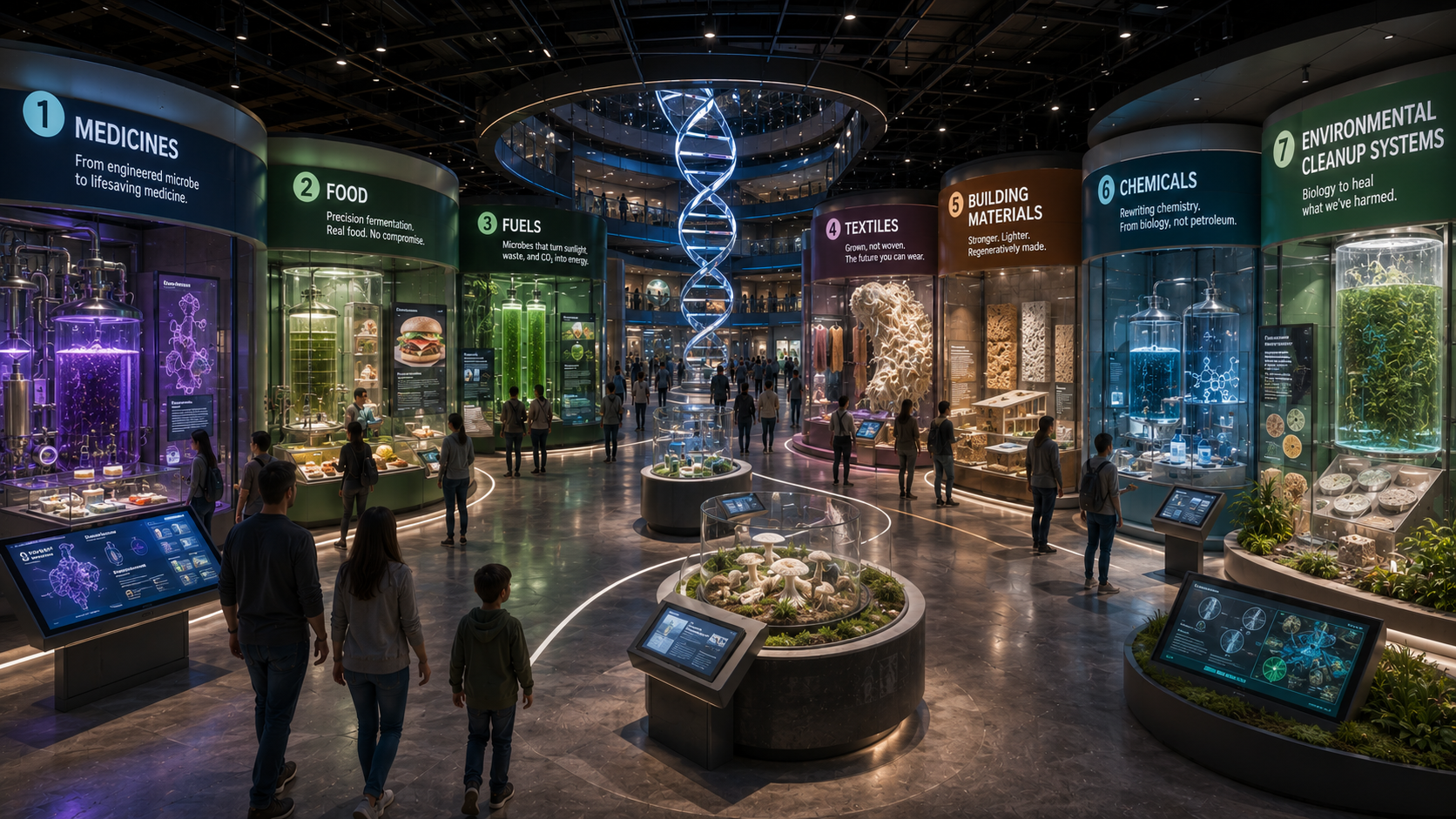
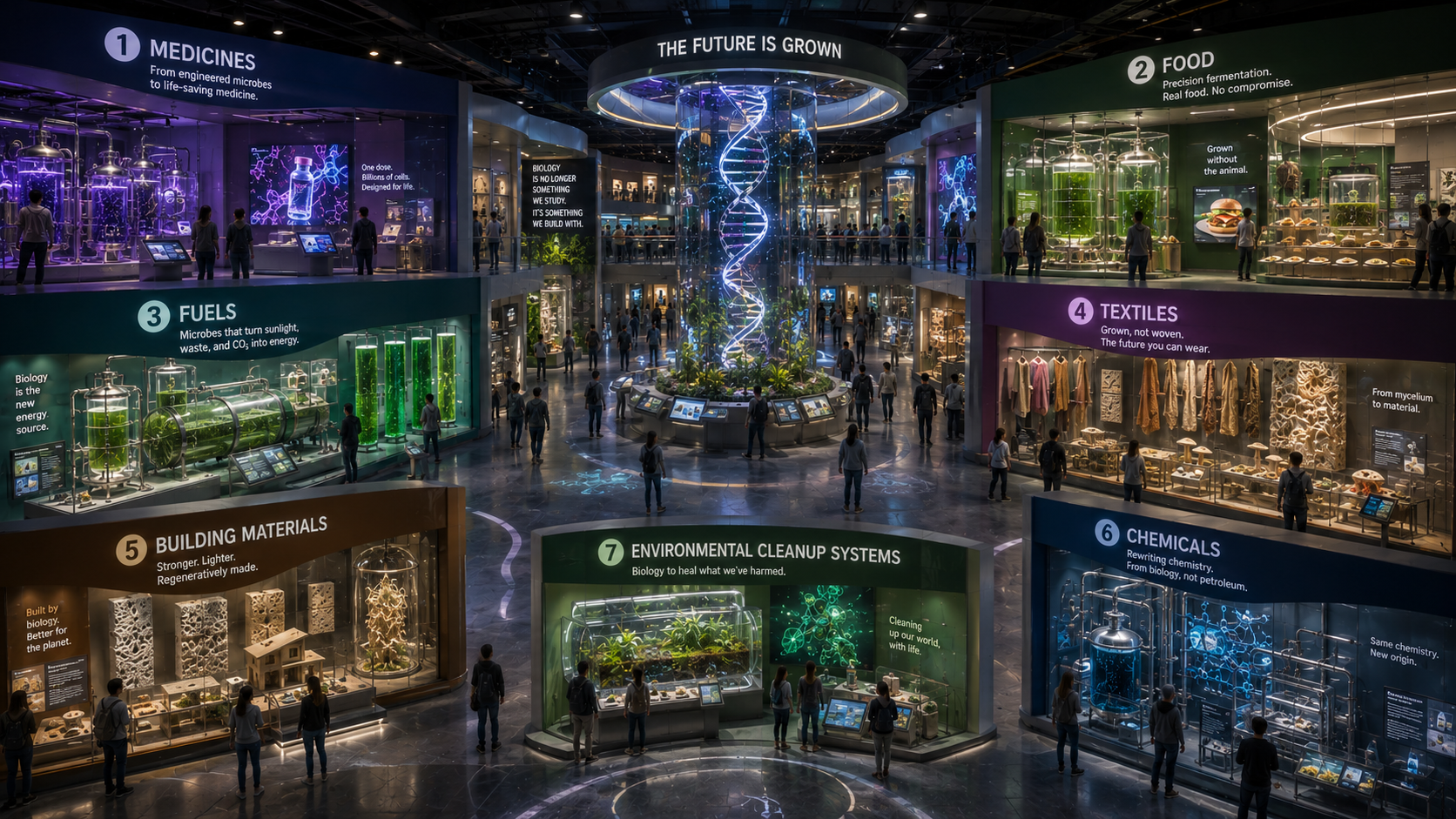
Walk through the museum’s main wing and you’d move through seven galleries, each built around a different category of product — and each making the same underlying point: the raw material for tomorrow’s economy might not come from a mine, a well, or a farm. It might come from a vat.
Medicines. Engineered microbes already produce insulin, vaccines, and increasingly complex therapeutic proteins that would be brutally expensive or outright impossible to synthesize through traditional chemistry. This gallery would trace a single dose of medicine back to the organism programmed to make it.
Food. Precision-fermented proteins and lab-cultured ingredients that mimic — or genuinely replicate — animal products without the animal. Visitors could watch a fermentation tank produce something that ends up on a plate in the museum café that same afternoon.
Fuels. Engineered algae and bacteria designed to convert sunlight, waste, or carbon dioxide directly into usable fuel — bypassing millions of years of geological “processing” that fossil fuels normally require.
Textiles. Mycelium-based leather alternatives are no longer a lab curiosity; an entire cluster of companies is already producing mushroom-based leather substitutes, biodegradable packaging, and mycelium foams at commercial scale. This gallery would let visitors touch fabric that was, quite literally, grown rather than woven.
Building materials. Mycelium composites are being engineered as sustainable insulation and structural panels, with thermal performance already competitive with synthetic foam — except this version decomposes instead of polluting a landfill for centuries.
Chemicals. Industrial compounds traditionally derived from petroleum, increasingly re-engineered to come from programmed microbial pathways instead — the same chemical, a completely different, far less extractive origin story.
Environmental cleanup systems. Organisms engineered specifically to break down pollutants, absorb heavy metals, or digest plastic waste — biology deployed not to produce a new product, but to undo the damage of the old ones.
Seven galleries, seven industries, one message: the line between “biological” and “industrial” is dissolving, and most visitors have no idea it’s already happening in commercial facilities right now.
The Signature Exhibit: A Living Materials Laboratory
Every great museum needs one exhibit that makes the abstract concept impossible to forget, and this museum’s answer is obvious: a living materials laboratory, visible through glass, where fungi, algae, bacteria, and cultured cells are actively growing usable products in real time, on public display.
This isn’t a fantasy — the underlying science already exists. Researchers are now 3D-printing mycelium hydrogels into complex living structures, precisely shaping fungal growth by combining biological self-assembly with engineered structural control, effectively directing a living organism to build itself into a specific, useful form. Other labs are functionalizing mycelium with embedded nanoparticles as it grows, creating materials that are biological and engineered at the same time.
Picture visitors watching a wall-sized panel of mycelium foam thicken over the course of their visit, a vat of engineered algae shift color as it produces compounds for the textile gallery next door, or a bioreactor of cultured cells slowly assembling into something closer to a material sample than a science experiment. Time-lapse displays could compress weeks of growth into minutes, letting a visitor watch a literal chunk of building insulation grow itself from a fungal spore. Nothing sitting behind that glass would be a metaphor. It would be commercial-grade biomanufacturing, happening on a timeline slow enough for a school group to actually witness the process rather than just read about it.
Why This Museum Matters Right Now
There’s a real risk hiding underneath all of this promise, and a good museum should be honest about it rather than gloss over it: synthetic biology raises legitimate questions about safety, containment, and unintended consequences that deserve serious public engagement, not just a highlight reel of finished products. A museum built around living organisms actively producing things onsite has a natural obligation — and a natural opportunity — to walk visitors through exactly how researchers manage those risks: containment protocols, kill switches, and the regulatory review these products already go through before reaching a shelf.
That honesty is precisely why this museum matters. Public trust in any emerging technology is built through understanding, not through marketing, and right now most people encounter synthetic biology only through headlines about lab-grown meat controversies or gene-editing ethics debates — without ever seeing the actual, unglamorous, promising work happening in the labs producing sustainable leather, biodegradable insulation, or engineered organisms cleaning up plastic waste. A museum that shows the process, not just the pitch, does more for public understanding than a decade of press releases could.
A Museum for the Century of Programmable Life
The Exploratorium taught a generation that science becomes real the moment you can touch it. The Synthetic Biology Museum extends that idea into genuinely new territory: watching something alive grow into something useful, in front of your eyes, on a timeline short enough to witness.
We are entering a century where the factories that clothe us, feed us, medicate us, and clean up after us may increasingly be biological rather than mechanical — grown rather than assembled. A museum built to make that transition visible, honest, and touchable wouldn’t just be educational. It would be one of the most important translation projects of the next fifty years: turning a scientific revolution most people don’t yet understand into something they’ve watched happen, right in front of them, one growing panel of mycelium at a time.
Related Articles
- MDPI (Journal of Fungi) — Fungal Innovations—Advancing Sustainable Materials, Genetics, and Applications for Industry
- Advanced Functional Materials (Wiley) — Shaping of Biohybrid Functional Living Materials
- PMC (National Library of Medicine) — Unlocking the magic in mycelium: Using synthetic biology to optimize filamentous fungi for biomanufacturing and sustainability