Futurist Thomas Frey: Recently I returned from a trip to Seoul, Korea where I was asked to speak at the Global Sports Marketing Forum on the “future of sports.” This event was part of a series being planned to draw attention to the 2018 Winter Olympics in Pyeongchang, Korea.
I wish I’d had the courage to live a life true to myself.
In a book called “The Top Five Regrets of The Dying,” a palliative nurse recorded the most common regrets of the dying. It’s not surprising to see what made the list as they are all things that touch each of our lives as we struggle to pay attention to and make time for things that we truly love.
Facebook’s 2013 Year in Review looks back at the stories, trends, and events that were shared most across the social network this last year. The year in review details the most talked about topics globally and for individual countries. It also shows the life events people felt most compelled to share.
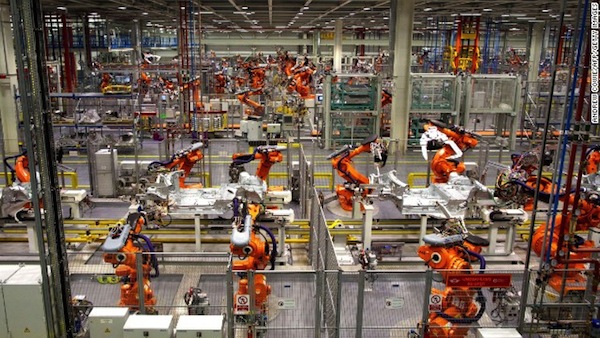
Automation could do away with hundreds of millions of “simple” jobs.
By Gerd Leonhard: Over the next ten years the Web is set to change our lives dramatically. This will also raise questions about the use of personal data and the need to balance new powers with ethics.
There are two eye drugs that have been declared equivalently miraculous. Tested side by side in six major trials, both prevent blindness in a common old-age affliction. Biologically, they are cousins. They’re even made by the same company.
Since introducing the idea of 30-minute drone deliveries, Amazon has caught a lot of flack about it. Since its announcement, everyone has been concerned about all of the little details like the severing of hands as the drone tries to deliver goods and whether or not the drones will crash and destroy their cargo. These are valid concerns, and yes people would like to receive their goods without being maimed, but one rapid shipping enthusiast wants Amazon to go even farther.
Favorite technologies and online behavior of teenagers has a way of predicting the entire country’s favorite technologies and online behavior. From Facebook, to mobile-phone addiction and Snapchat, the habits we dismissed yesterday as silly and childish have a way of going national.
Lumus, a transparent display specialist and military head-up screen supplier, is wading into the wearable computing market, revealing a new developer kit that, unlike Google’s Glass, offers full augmented reality support. Set to debut at CES 2014 next month, the Lumus DK-40 monocular dev kit may look ostensibly like Glass at first glance, but where Google’s headset has a small display-block suspended in the corner, the entire right lens of the Lumus wearable is in fact a 640 x 480 display. That means developers building apps for the Android-powered headset can overlay graphics directly on top of the real-world view, rather than simply sliding in separate notifications as Glass does.
Will cloud seeding work to wash the smog out of the air?
China has a severe air pollution problem. Smog has done everything from grounding planes at major airports to closing schools across the country. China’s smog is so dense that it’s even crept over to Japan and across other parts of Asia. China is working on putting measures into place to combat pollution, but they still need a more immediate solution for clearing up the heavy smog. According to the China Meteorological Administration, he country is putting its hopes on artificial rain.
Student debt is a national problem that affects all 50 states (51, if you count D.C.). The amount and frequency with which undergraduates borrow varies vastly from state to state, some of which are far better at providing an affordable education than others.
Piper Jaffray got this when he last surveyed teenagers to learn how they spend money.
Nobody ever said it was easy being a teenager but, this make it look fun. Clothes (including shoes), electronics, movies, music, video games, concerts, accessories, food: That is the life. And together, it makes up about 70 percent of the teen budget.
After the start of the worst six months for the U.S. labor market since the Great Depression five years ago, we learned last week that 203,000 new jobs were created in November and the unemployment rate dropped to 7%. Discussion in the immediate aftermath of the news centered on whether the report marked more of the ho-hum same or a sign that, after three years of puttering along, the economy might finally be preparing for a return to something approaching prosperity.