Ray Kurzweil predicts computers will be as smart as humans in 12 years

12 years.

That’s how long Google’s Director of Engineering Ray Kurzweil thinks it will take for computers to reach human levels of intelligence.

Singularity Is Coming

“By 2029, computers will have human-level intelligence,” Kurzweil said in an interview at the SXSW Conference with Shira Lazar and Amy Kurzweil Comix.

Known as the Singularity, the event is oft discussed by scientists, futurists, technology stalwarts and others as a time when artificial intelligence will cause machines to become smarter than human beings.

Continue reading… “Ray Kurzweil predicts computers will be as smart as humans in 12 years”

This Is Flight in the World of Tomorrow

Vision of the Future

A sleek new helicopter design was unveiled by Bell Helicopter at the Heli-Expo in Dallas, Texas.

Called the FCX-001, the next-generation machine will be built from sustainable materials and run on a hybrid power system. It will come equipped with augmented reality (AR), an artificial intelligence (AI) co-pilot, and rotor blades that morph depending on flight conditions.

Continue reading… “This Is Flight in the World of Tomorrow”

How to Upgrade Judges with Machine Learning

When should a criminal defendant be required to await trial in jail rather than at home? Software could significantly improve judges’ ability to make that call—reducing crime or the number of people stuck waiting in jail.

In a new study from the National Bureau of Economic Research, economists and computer scientists trained an algorithm to predict whether defendants were a flight risk from their rap sheet and court records using data from hundreds of thousands of cases in New York City. When tested on over a hundred thousand more cases that it hadn’t seen before, the algorithm proved better at predicting what defendants will do after release than judges.

Continue reading… “How to Upgrade Judges with Machine Learning”

AImotive aims to convert regular cars into driverless ones inexpensively

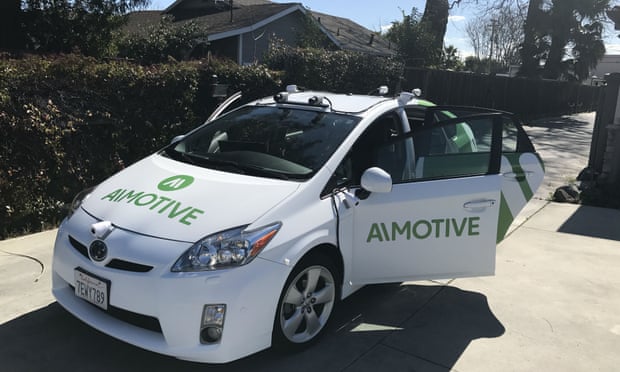
The AImotive office is in a small converted house at the end of a quiet residential street in sunny Mountain View, spitting distance from Google’s headquarters. Outside is a branded Toyota Prius covered in cameras, one of three autonomous cars the Hungarian company is testing in the sleepy neighborhood. It’s a popular testing ground: one of Google’s driverless cars, now operating under spin-out company Waymo, zips past the office each lunchtime.

Continue reading… “AImotive aims to convert regular cars into driverless ones inexpensively”

Robots won’t just take our jobs – they’ll make the rich even richer

Should robots pay taxes?

It may sound strange, but a number of prominent people have been asking this question lately. As fears about the impact of automation grow, calls for a “robot tax” are gaining momentum. Earlier this month, the European parliament considered one for the EU. Benoît Hamon, the French Socialist party presidential candidate who is often described as his country’s Bernie Sanders, has put a robot tax in his platform. Even Bill Gates recently endorsed the idea.

Continue reading… “Robots won’t just take our jobs – they’ll make the rich even richer”

Why we must teach morality to robots

Every week comes a new warning that robots are taking over our jobs. People have become troubled by the question of how robots will learn ethics, if they do take over our work and our planet.

As early on as the 1960s Isaac Asimov came up with the ‘Three Laws of Robotics’ outlining moral rules they should abide by. More recently there has been official guidance from the British Standards Institute advising designers how to create ethical robots, which is meant to avoid them taking over the world.

Continue reading… “Why we must teach morality to robots”

Wikipedia bots act more like humans than expected

Benevolent bots

‘Benevolent bots’ or software robots designed to improve articles on Wikipedia sometimes have online ‘fights’ over content that can continue for years, say scientists who warn that artificial intelligence systems may behave more like humans than expected.

Editing bots on Wikipedia undo vandalism, enforce bans, check spelling, create links and import content automatically, whereas other bots (which are non-editing) can mine data, identify data or identify copyright infringements.

Continue reading… “Wikipedia bots act more like humans than expected”

AI learns to write its own code by stealing from other programs

OUT of the way, human, I’ve got this covered. A machine learning system has gained the ability to write its own code.

Created by researchers at Microsoft and the University of Cambridge, the system, called DeepCoder, solved basic challenges of the kind set by programming competitions. This kind of approach could make it much easier for people to build simple programs without knowing how to write code.

Continue reading… “AI learns to write its own code by stealing from other programs”

Artificial synapse bridges the gap to brainier computers

The human brain is nature’s most powerful processor, so it’s not surprising that developing computers that mimic it has been a long-term goal. Neural networks, the artificial intelligence systems that learn in a very human-like way, are the closest models we have, and now Stanford scientists have developed an organic artificial synapse, inching us closer to making computers more efficient learners.

Continue reading… “Artificial synapse bridges the gap to brainier computers”

Do Robots and AI Deserve Rights?

When it comes to robot-human relations, the conversation typically centers on the welfare of the sentient. Science fiction paints us as petrified by our own creations; fears of a bot planet have influenced everything from Asimov’s “Laws of Robotics” to HAL 9000’s homicidal impulses to Skynet’s global genocide.

These human-centric anxieties are understandable. However, as our assorted bots and bits gain skills and personalities, should they be afforded some form of protection from us? It’s a question people are starting to seriously ponder.

Continue reading… “Do Robots and AI Deserve Rights?”

The Data-Driven Transformation of Intelligence

When “little green men” invaded Crimea in early 2014, they left a data trail that went largely unnoticed by the U.S. Intelligence Community (IC).  Distracted by a large Russian exercise to the west, the IC did not connect the digital dots that indicated the impending invasion.  In the Information Age, the “dots” are more plentiful and glaring as everyone now leaves a data trail.  Given that, how can intelligence analysts better gather, share, organize, and view data to reveal intent, more accurately predict behavior, and make better decisions with limited resources?

Continue reading… “The Data-Driven Transformation of Intelligence”

Robots will replace over 250,000 government jobs — and that’s just the beginning

c

Automation could replace 250,000 jobs in government over the next 10 to 15 years — with potentially one million more under threat. The UK’s public sector workforce stood at around 5.3 million in the middle of last year, and has been falling since 2009, when it stood at 6.4 million. But that could be slashed significantly if the public sector adopts a policy of automating predictable jobs, according to a report from thinktank Reform.

Continue reading… “Robots will replace over 250,000 government jobs — and that’s just the beginning”

Discover the Hidden Patterns of Tomorrow with Futurist Thomas Frey
Unlock Your Potential, Ignite Your Success.

By delving into the futuring techniques of Futurist Thomas Frey, you’ll embark on an enlightening journey.

Learn More about this exciting program.