The “Uber for everything” boom in tech has led to plenty of on-demand solutions for everyday life, but one problem we didn’t even know existed is apparently mobile hotel rooms. A new concept for a rolling room just won an award for its forward thinking, but will it ever become a reality? We have out doubts.
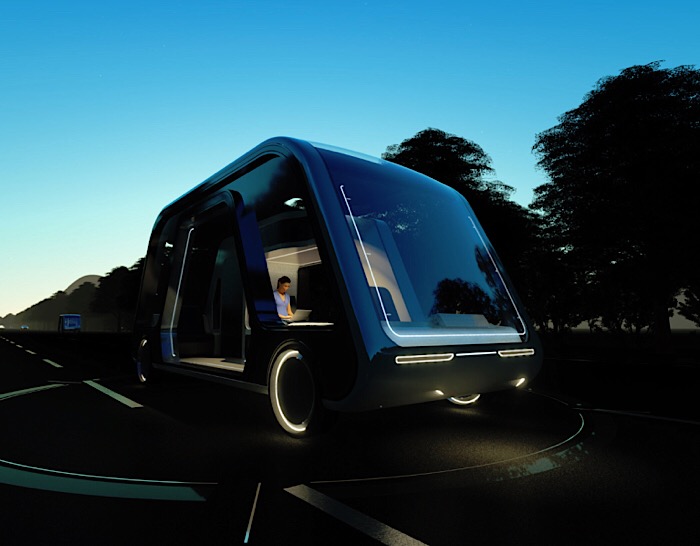
The concept is called the Autonomous Travel Suite, or ATS for short. It comes from the mind of Steve Lee of the Aprilli Design Studio and it’s largely based on the self-driving vehicle technology of the future. The idea here is that instead of riding along in a car-like seat while a computer takes you to your destination, you’re actually free to move around the over-sized cabin.
A poll shows the plain truth: The youth of today is much more willing to get behind the wheel (but not use the wheel) of a driverless car than any other age group.
In a poll featured on Statista and conducted by iAccenture and Harris Interactive of 21,000 respondents ages 14 and up, people were asked if they were willing to be passengers in a so-called self-driving vehicle—a.k.a. an autonomous car.
Road-legal delivery vehicles don’t even have space for a human driver.
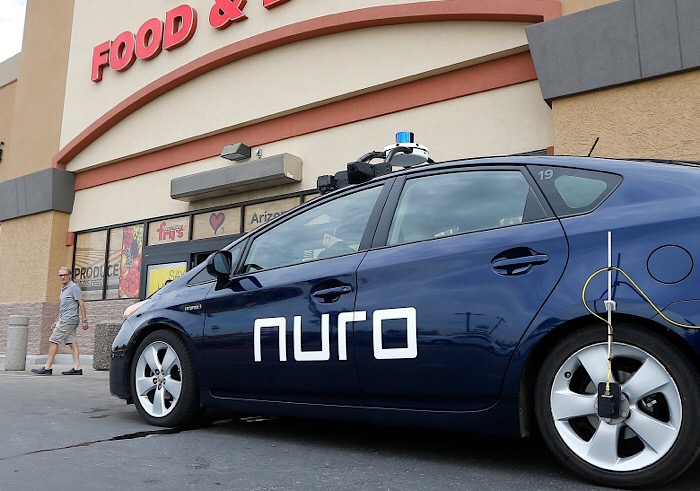
Nuro, a startup founded by two veterans of Google’s self-driving car project, has reached an important milestone: it has started making fully autonomous grocery deliveries on public streets.
Fry’s Food, a brand owned by grocery giant Kroger, launched a self-driving grocery delivery program back in August in partnership with Nuro. Fry’s has been using Nuro cars to deliver groceries to customers near one of its stores on East McDowell Road in Scottsdale, Arizona.
Imagine taking a road trip and never having to stop for a food or bathroom break.
Steve Lee, a designer at Toronto-based Aprilli Design Studio, has come up with an idea that could make that happen: The Autonomous Travel Suite.
Think of it as a hotel room on wheels. The driverless mobile suite would have a sleeping area with mattresses, washroom facilities with a toilet and sitting shower, a space for working or entertaining, and a small kitchen. It could fit up to five people.
“It’s basically a hotel room so it has everything inside it,” he says. “Whether it’s six hours or 10 hours, you’ll feel comfortable inside it.”
Alphabet’s self-driving car unit Waymo today took a huge step toward launching its first public self-driving taxi service.
Waymo has been testing a driverless car service in Phoenix for a while already, but today the company officially lifted the lid on its first commercial service that riders can actually pay for.
Waymo One, as the service is called, will work much like Uber and other popular ride-hailing apps. After Waymo One gives you a price estimate based on your starting and end points, you can beckon a car that will transport you from A to B.
However, Waymo One isn’t yet available for everyone. Initially, only riders who were involved in the early stages of the trial program will have access, though plans are afoot to extend the service to more people in the future.
Traffic accidents are an unfortunate reality, and what may be most frustrating about these sometimes fatal incidents is that they can often be avoided. Honda has a plan to help cut down on accidents in one specific and common road feature: intersections.
The Japanese auto manufacturer is introducing, in a limited capacity, its “Smart Intersection” technology, that could help cut down on accidents that take place where roads cross paths. The company is launching a test run of the technology in partnership with the city of Marysville, Ohio, as part of its 33 Smart Mobility Corridor project.
Unlike any other autonomous semi trucks concepts out there – from Daimler Trucks, Tesla or California startup Thor – Volvo’s Vera has no driver’s cabin and looks like a flat Tesla S with space for just the powertrain and the battery pack.VOLVO
Volvo Trucks, the world’s second-biggest heavy-duty truck maker behind Daimler Trucks, unveiled Wednesday its first all-electric driverless freight truck, dubbed Vera.
Unlike any other semi trucks concepts out there – from Daimler Trucks, Tesla or California startup Thor – Volvo’s Vera has no driver’s cabin and looks like a semi-truck tractor pod or a flat Tesla S with space for just the drivetrain and the 300 kW lithium-ion battery pack that gives it a range of up to 187 miles (300 kilometers).
“It’s designed to be safe, it’s quiet and totally predictable, down to cost savings,” said Michael Karlsson, vice-president of Autonomous Solutions at Volvo Trucks. “Nothing similar to what you’ve seen from us before. In fact, it’s impossible to drive.”
Whether or not your grocery delivery arrives in a van with a driver behind the wheel may not matter much to you, but an increasing number of companies are nevertheless investing heavily in autonomous delivery vehicles in the belief that they’ll improve efficiency and create significant cost benefits in the long term. Yes, you’ll have to wait and see if those savings will be passed on to you, the customer.
Udelv, a San Francisco-based startup that has already used its autonomous vans to make more than 700 driverless deliveries in the San Francisco Bay area, recently inked what it claims is the world’s largest deal for a grocery delivery service using self-driving vehicles.
Its battery-electric platform can be used for a wide variety of purposes.
The advent of battery-electric “skateboards,” powertrain platforms that can accommodate a bunch of different bodies on top, means that vehicles can become even more versatile than they already are. Mercedes-Benz has applied this thinking to its vans to create the wild Vision Urbanetic concept.
Mercedes-Benz today unveiled the Vision Urbanetic, a battery-electric, autonomous van that Mercedes believes will contribute to a whole new segment of mobility that’s efficient, comfortable and sustainable — and, of course, capacious, being a part-time van and all.
The Germany-based automation company, Siemens, is set to unveil the world’s first autonomous tram through its division Siemens Mobility, Global Rail News reports.
Siemens, alongside its development partner Verkehrsbetrieb Potsdam (ViP), will present their findings at InnoTrans 2018 to show how a tram will drive autonomously in real traffic on 18-21 September.
Without a combustion engine or a steering wheel, Volvo reimagines the car as a short-haul flight replacement.
“In our striving for efficiency, have we lost empathy for the traveler?” These words, from Volvo’s launch video for its new 360c fully autonomous concept car, hit home with me. I fly a lot, so I’m fully familiar with efficient but unsympathetic forms of travel, and Volvo’s idea is to help people like me through the design of its future cars. The Volvo 360c is, like most concepts of our time, all-electric, fully autonomous, and covered by a big sweeping glass dome. What distinguishes it, though, is Volvo’s vision of how it fits into the broader scheme of city infrastructure, short-haul flights, working commutes, and environmental concerns.
Volvo’s product strategy chief Marten Levenstam says this car is “a conversation starter, with more ideas and answers to come as we learn more.” That leaves a lot of specifics yet to be determined, but Volvo does envision four basic usage scenarios for a car like its 360c. It can serve as a mobile bedroom, replacing red-eye flights with a smoother, calmer, quicker, and more environmentally friendly travel option. It can turn your work commute into a much more productive time, offering the connectivity and space of a mobile office. Or it can be your living room and entertainment space. A modular interior with relevant information projected onto the windows makes flexibility the overriding characteristic of the 360c’s functionality.
SCOTTSDALE, Ariz. — At a time when big-box retailers are trying to offer the same conveniences as their online competitors, the biggest U.S. grocery chain is testing the use of driverless cars to deliver groceries in a Phoenix suburb.
Kroger’s pilot program launched Thursday morning with a robotic vehicle parked outside one of its own Fry’s supermarkets in Scottsdale. A store clerk loaded the back seat with full grocery bags. A man was in the driver’s seat and another was in the front passenger seat with a laptop. Both were there to monitor the car’s performance.