The Germany-based automation company, Siemens, is set to unveil the world’s first autonomous tram through its division Siemens Mobility, Global Rail News reports.
Siemens, alongside its development partner Verkehrsbetrieb Potsdam (ViP), will present their findings at InnoTrans 2018 to show how a tram will drive autonomously in real traffic on 18-21 September.
Without a combustion engine or a steering wheel, Volvo reimagines the car as a short-haul flight replacement.
“In our striving for efficiency, have we lost empathy for the traveler?” These words, from Volvo’s launch video for its new 360c fully autonomous concept car, hit home with me. I fly a lot, so I’m fully familiar with efficient but unsympathetic forms of travel, and Volvo’s idea is to help people like me through the design of its future cars. The Volvo 360c is, like most concepts of our time, all-electric, fully autonomous, and covered by a big sweeping glass dome. What distinguishes it, though, is Volvo’s vision of how it fits into the broader scheme of city infrastructure, short-haul flights, working commutes, and environmental concerns.
Volvo’s product strategy chief Marten Levenstam says this car is “a conversation starter, with more ideas and answers to come as we learn more.” That leaves a lot of specifics yet to be determined, but Volvo does envision four basic usage scenarios for a car like its 360c. It can serve as a mobile bedroom, replacing red-eye flights with a smoother, calmer, quicker, and more environmentally friendly travel option. It can turn your work commute into a much more productive time, offering the connectivity and space of a mobile office. Or it can be your living room and entertainment space. A modular interior with relevant information projected onto the windows makes flexibility the overriding characteristic of the 360c’s functionality.
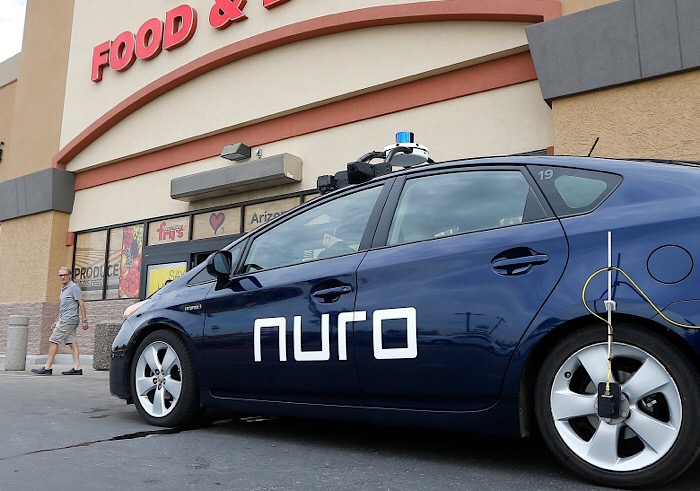
SCOTTSDALE, Ariz. — At a time when big-box retailers are trying to offer the same conveniences as their online competitors, the biggest U.S. grocery chain is testing the use of driverless cars to deliver groceries in a Phoenix suburb.
Kroger’s pilot program launched Thursday morning with a robotic vehicle parked outside one of its own Fry’s supermarkets in Scottsdale. A store clerk loaded the back seat with full grocery bags. A man was in the driver’s seat and another was in the front passenger seat with a laptop. Both were there to monitor the car’s performance.
From election-rigging bots to potentially lethal autonomous cars, artificial intelligence is straining legal boundaries. Here’s what we need to keep it in check.
THE car’s computer saw Elaine Herzberg pushing her bicycle across the highway a full six seconds before it struck her. Travelling at just under 70 kilometres per hour, it had more than enough time to stop or swerve. But it did neither, hitting her head on. Herzberg died in hospital, the first pedestrian to be killed by an autonomous vehicle.
Since the invention of air travel, the world has felt like a smaller place – it’s now possible for pretty much anyone to fly around the globe, learning about different countries and cultures. It’s pretty amazing.
But some companies aren’t satisfied with this – they want to make the world seem even smaller, with faster, more efficient and more comfortable methods of transport.
Ever dreamed of exploring the Australian Outback but been put off by the long flight? A Virgin Galactic flight from London to Sydney might take two hours within the next decade.
Here are four methods of futuristic transportation that are going to change how we travel around the world.
Our transport modes and infrastructure will transform the way we work and do business in the next 20 to 30 years. From the office to the movement of goods, retail and advertising, we will see fundamental and fascinating changes.
Thomas Frey, senior futurist at the Da Vinci Institute in Colorado, says the haulage and shipping industry will see the biggest change. “Because we will consume more things we will need to move more freight, need more trucks and have to build extra lanes on our highways,” he says. “The trucks will be driverless or driven remotely from the office. They will be electrically powered and without those noisy diesel engines will radically change the sounds of our towns and cities. Rolls-Royce is currently working on a crewless ship, so we will see more of those. They will also be electrically powered. Because we will be using 3D printing manufacturing on location, we will be moving not finished goods across the globe but raw materials.”
Engineer and adventurer Richard Jenkins has made oceangoing robots that could revolutionize fishing, drilling, and environmental science. His aim: a thousand of them.
Every spring, thousands of great white sharks begin a mysterious migration. From up and down America’s West Coast, they head straight for a Colorado-size patch of the Pacific about halfway between San Diego and Hawaii. Once there, they hang for months at what marine biologists call the White Shark Cafe, frolicking and diving 1,500 feet or more. For decades, we didn’t know much more about what they do there—or why. This year, we should get some answers, thanks to a pair of saildrones.
A fleet of driverless street cleaning vehicles has begun trial operations at an industrial park in Shanghai, according to the Shanghai-based news portal The Paper on Friday.
The convoy, which includes a 6m-long truck and a 3m-long minibus, has been designed and developed by Autowise.ai, a Shanghai technology company, for different road widths.
The autonomous boats offer high maneuverability and precise control. They can be built using low-cost printer, making mass manufacturing more feasible.
MIT scientists have designed a fleet of 3D-printed, driverless boats that could ferry goods and people, helping clear up road congestion in waterway-rich cities such as Amsterdam, Bangkok and Venice – where canals run alongside and under bustling streets and bridges.
Major companies are bringing together new machine learning algorithms, better and cheaper sensors, and increased computing power in hopes of addressing growing global demand for food and agriculture’s diminishing labor force.
The big picture: Alphabet’s X and John Deere, startups and universities are looking to AI-based agriculture to address these problems. But farming presents hard problems for AI that, if solved, could ultimately help it be deployed in more structured places (think: homes).
Tesla is shaking up logistics world with its semiautonomous truck.
Thanks in part to Tesla, the logistics industry is on the road to a transportation transformation.
In November 2017, Tesla rolled out the heavy-duty Semi, an electric-powered, semiautonomous truck that’s already been pre-ordered by the likes of DHL, Anheuser-Busch, J.B. Hunt and Walmart. If all goes as planned, those companies will be among the first to transport goods aboard these sleek, modern vehicles in the not-too-distant future.