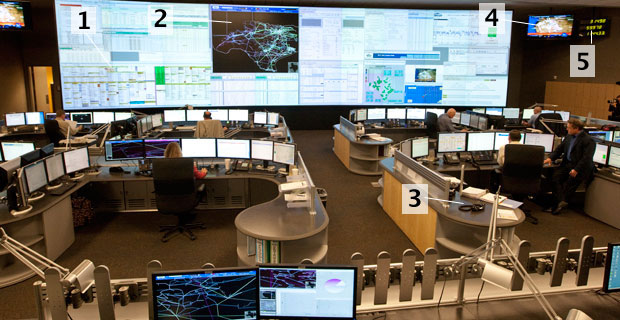
Electricity is generated at power plants. You know that already. But to really understand how it gets to your house—and why you can count on it getting there reliably—you have to understand that our electric system is more complicated than it looks. The electric grid isn’t just about you and your connection to a power plant. There are lots of thing that have to happen behind the scenes to make sure your refrigerator stays cold and your lights turn on…
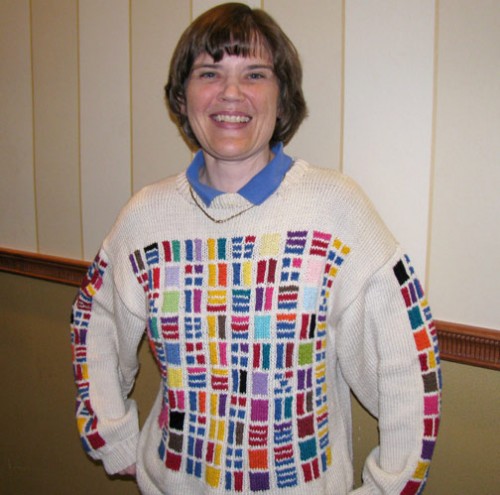
Sondra Eklund, a knitter, mathematician, and YA librarian, designed and crafted this sweater. It shows, in colors, the prime factorization of every number between 2 and 100…
Meet Steve Schutz. Some might say he’s very dedicated to his work. But others would call him downright crazy. You see Steve works in an insectarium, a place where mosquitos are born and raised. And to ensure its residents are well-fed and propagate, he serves up his bare arm once a week for dinner.
As a result, after a feeding the 50 red welts on his lower arm barely even register as a slight tingle since Steve has built up an immunity to the mosquito’s saliva…
This googly eyed gentleman is named Dan Considine, and he’d like to take you on a tour of accents from across the globe, starting with the Land of Blarney and ending in the good ol’ U.S. of A…
The Higgs Boson is kind of a big deal. If it does exist, it could provide a key to unifying the standard and quantum models of physics. But what is a Higgs Boson, what does it do, and how does it work? With the help of this animated short, UCI physics professor Daniel Whiteson breaks down the basics of this mysterious particle (or is it a field?) in a way even your parents can understand.
Back in 2002, psychologist Daniel Kahneman won the economics Nobel Prize for showing that human beings don’t have a really good intuitive grasp of risk. Basically, the decisions we make when faced with a risky proposition depend more on how the question is framed than on what the actual outcome might be.
The classic example is to tell a subject that there’s going to be a disaster. Out of 600 people, she has a chance of saving 200 if she takes x risk. If she doesn’t take the risk, everybody dies. Most people will take the risk in that scenario, but if you present the same situation and frame it differently—”If you take this risk, 400 people will die”—the decisions suddenly flip in the other direction. Nothing has changed about the outcome. But everything has changed in terms of how people feel about the decision they have to make. This is the kind of thing that matters a lot to economics because it helps to explain why economic behavior in the real world isn’t always as rational and self-interested as it is in theory…
Libraries have acted as community cornerstones for millennia.
Every April marks School Library Month. Libraries celebrate how they promote education and awareness in an open, nurturing space. What makes them such lasting institutions, though, isn’t the mere act of preserving books and promoting knowledge. Rather, it’s the almost uncanny ability to consistently adapt to the changing demands of the local populace and emerging technology alike. The library system probably won’t disappear anytime soon, but rather, see itself blossoming into something new and exciting in congruence with today’s myriad informational demands.
How much time do you have to read the privacy policies you encounter?
In The Cost of Reading Privacy Policies, by Aleecia M. McDonald and Lorrie Faith Cranor, the authors calculate that the average Internet user would have to spend one full working month per year in order to skim all the Internet privacy policies she encounters in a year. Mike Masnick reports on Techdirt…
From left: physicists Luis Delgado-Aparicio and David Gates.
Physicists have discovered a possible solution to a mystery that has long baffled researchers working to harness fusion. If confirmed by experiment, the finding could help scientists eliminate a major impediment to the development of fusion as a clean and abundant source of energy for producing electric power… Continue reading… “Scientists see solution to critical barrier to fusion”
Futurist Thomas Frey took time out of his busy speaking schedule for a short interview with Larry Nelson at W3W3 radio. This time Mr. Frey conversed with Larry about DaVinci Coders, the new beginner based Ruby On Rails program that he is putting together at DaVinci Institute…
Graduates with bachelor’s degrees are increasingly scraping by in lower-wage jobs.
The 2012 graduating classes in U.S. colleges are in for a rude awakening to the world of work.
The weak labor market has left half of young college graduates either jobless or underemployed in positions that don’t fully use their skills and knowledge.
If you were ever curious as to how much body parts can fetch on the black market,Medical Transcription created a snazzy infographic to show you. Some parts are shockingly cheap! Like would you want a new shoulder or a new iPad? Both cost 500 bucks.
Other organs are prohibitively expensive, like a kidney. That little sucker costs $262,000 in the US (other countries have it for cheaper)! Here’s the full list of body parts and their cost…