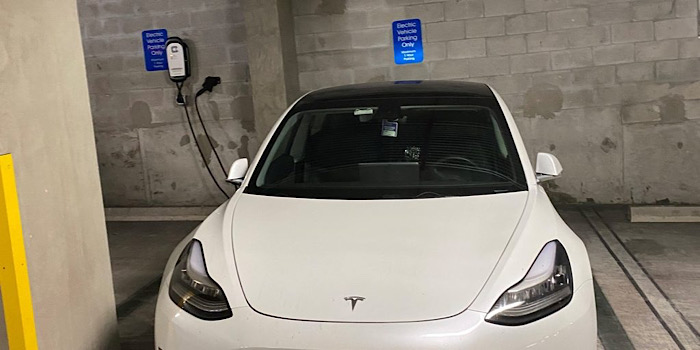
Los Angeles-based EV charging startup Xeal, which uses predictive AI software to maximize the profits of charging stations, will boost passive income for commercial and residential building owners. It’s just successfully closed its seed investment round.
If Nikola (NKLA) founder Trevor Milton has his way, the garbage trucks emitting black smoke that troll the streets will eventually be a thing of the past.
Milton and his team at Nikola took a giant step in that mission on Monday.
The upstart electric- and hydrogen-powered truck maker announced a deal with waste management giant Republic Services for 2,500 electric, zero emission garbage trucks. A dollar amount for the contract wasn’t disclosed. The deal is expandable up to 5,000 trucks. Full production deliveries are expected to begin in 2023 — road testing is set to commence in late 2021 and early 2022.
EHANG 184 AAV Manned Flight Test by EHANG CEO Mr. Hu Huazhi
A new forecast for passenger drones and the eVTOL aircraft market predicts dramatic growth over the next 10 years.
According to the new market research report from MarketsandMarkets on the “eVTOL Aircraft Market … Global Forecast to 2030”, the eVTOL aircraft market is projected to grow from USD 162 million in 2025 to USD 411 million by 2030, at a CAGR of 20.42% from 2025 to 2030.
Investments we make today in urban EV infrastructure must take into account future requirements for ride sharing, transit and utilities
As the world’s population grows increasingly urban — it’s expected that by 2050, 70 per cent of individuals will live in urban areas — it’s critical for these regions to have the infrastructure in place to support quick, convenient and electric mobility. From autonomous vehicles, to electric urban transit, to effective energy management by utilities, successful deployment depends on cities investing in the proper accompanying charging infrastructure. To that end, there’s a good case to be made that investing in wireless charging is critical for the prosperity of urban areas.
This PNNL study could help the U.S. power system keep ahead of the EV adoption curve.
Getting the world to work without oil will not be easy. Apart from increasing EV adoption, we have to make sure the world can cope with them. Think about it: would the power grid stand too many electric cars demanding a charge at the same time? PNNL – Pacific Northwest National Laboratory – answered that question with a study saying the current US power grid can handle 24 million EVs until 2028. If the demand increases, we’ll need improvements.
It may seem far-fetched considering the entire US now has 1.5 million EVs on the roads, but that is just the tip of the iceberg. Demand for EVs tends to grow, especially when electric pickup trucks such as the Tesla Cybertruck and Rivian R1T are available.
The automotive industry is knee deep in the vast transition to electric, but one place where gas is still going strong is out on the water. Seattle startup Zin Boats wants to start what you might call a sea change by showing, as Tesla did with cars, that an electric boat can be not just better for the planet, but better in almost every other way as well.
With a minimalist design like a silver bullet, built almost entirely from carbon fiber, the 20-foot Z2R is less than half the weight of comparable craft, letting it take off like a shot and handle easily, while also traveling a hundred miles on a charge — and you can fill the “tank” for about five bucks in an hour or so.
Waiting for the other shoe to drop? Well, it ain’t cheap. But then, few boats are.
Piotr Zin, the company’s namesake, has been designing racing sailboats for 20 years, while working in industrial design at BMW, GM and other major companies. Soon after settling down on a houseboat on Seattle’s Lake Union, he realized that the waterways he had enjoyed his whole life might not exist for the next generation.
Fuel Cell Electric Vehicles (FCEVs) and Battery Electric Vehicles (BEVs) are considered by the most, as two competing technologies. Although both technologies power an electric motor, they have different properties and each of them is well suited for some uses more than others.
BEVs market is increasing, with the major automotive companies, like BMW, and Mercedes, starting to introduce into the market an increasing number of electric battery vehicles, in parallel to the main BEVs company like Tesla, and Toyota. FCEVs on the other hand are still at the demonstration stage.
In April 2019 Daimler stepped back from the development of the GLC F-Cell, after many years of investigation of fuel cells technologies. Besides this decision, Daimler did not completely abandon the hydrogen powertrain, but mostly shifted its focus to a different application. In fact, a collaboration with Volvo to develop fuel cell heavy-duty vehicles will possibly begin in September 2020, which will define a new chapter for the hydrogen technologies.
A FlashBattery-packin’ drone lifts off from the StoreDot charging stationStoreDot
Most multicopter drones can only fly for about 30 minutes, after which their battery has to be recharged for one to two hours – this limits their practical use. According to Israeli company StoreDot, though, its FlashBattery tech delivers a full charge in just five minutes.
We last heard from StoreDot three years ago. At that time, the startup reportedly used a higher-capacity version of the FlashBattery system to recharge an electric car’s battery pack in five minutes.
A group of Formula One and Formula E drivers are starting a new racing series that will pit competitors against each other on ultra-fast custom-built electric scooters. The series — dubbed “Electric Scooter Championship,” or “eSkootr” — is set to launch in 2021, and the launch video shows riders whizzing through city streets on Tron-style vehicles and wearing matching neon-accented gear.
There are, unfortunately, few other details about the series, like how it’s being funded or who the competitors will be. All the organizers say is that the “category’s affordability removes the high barrier to entry seen in most other motorsport series, and its versatility means the series can recruit from a truly diverse cross-section of competitors – including racing drivers, cyclists, skaters, snowboarders, motorcyclists, and even esports racers.”
Whoever does compete will be putting themselves in a remarkably risky position, though, as the scooters are allegedly going to be capable of outrageous top speeds of around 100 kilometers per hour (about 62 miles per hour). They will feature large platforms, fat tires, and full suspensions in order to handle going that fast — at least, according to the launch video. But those kinds of speeds carry great risk even with a purpose-built vehicle and top-tier protective gear. As for where the scooters will come from, organizers say they have “already partnered with a recognized high-technology provider” to build them and will “reveal the prototype later this year,” though they don’t name the company.
The science channel got access to Tesla’s Gigafactory Nevada for their new show ‘Super Factories’ – giving us a rare new look inside the plant.
Tesla Gigafactory Nevada was the first major step in Tesla’s effort to secure battery cell supply for its ambitious growth.
The automaker partnered with Panasonic to deploy new battery cell production capacity at the facility and Tesla used those cells to build battery packs for its vehicles and energy storage products.
When originally announcing the plan for the factory, Tesla was talking about the plant producing 105 GWh of battery cells per year and 150 GWh of battery packs per year once completed.
Electric vehicles can help keep the air clean in our cities – as we’ve seen recently with the reduction of traffic through COVID-19 lockdowns – but they face two obstacles.
In the short term they’re still expensive. In the long term charging millions of vehicles from the electricity grid presents challenges.
I’m part of a new project, launched today, that tackles both of these obstacles head-on, and it could mean owners earn more money than they’re likely to pay for charging their electric vehicles.
Cities across Latin America are cleaning their transport networks with Chinese electric buses – some quicker than others
If 2019 was a watershed year for Chinese electric buses in Latin America, in 2020 they became mainstream.
Latin American countries are moving towards cleaner public transport in their most populated cities. In the process, they have overcome existing entry barriers to the widespread rollout of the technology – driven globally by China – including scarcities of national financing models, charging points and trained personnel.
Manufacturers of Chinese electric buses stand out as the largest providers to the region. Adalberto Maluf, president of the Brazilian Association of Electric Vehicles and marketing director of Chinese maker BYD, said: “BYD sold 1045 buses last year in Latin America. This shows that the market is growing. It is not the size of the European market, or the US, but it’s already very close.”
In total, Latin America has 1229 electric buses in operation in 10 countries, including 563 ordinary buses, 624 trolleybuses and 41 midi e-buses, according to the new E-Bus Radar project led by the Sustainable Mobility Laboratory at the Federal University of Rio de Janeiro.