Money can’t buy you love, but it can buy a lot of important things. Which is why it’s interesting that a recent Employment Confidence Survey by Glassdoor named some of the other things that employees would actually rather have over a pay raise.
Yes, we’re talking about perks–but not, perhaps, the ones you might think.
People have long been nervous about robots and artificial intelligence taking over human jobs – but the next decade will see the process shoot into overdrive.
During the next decade, machines will displace 20 million manufacturing jobs, a report by analyst firm Oxford Economics suggests.
That amounts to 8.5% of the global manufacturing workforce, with each robot displacing 1.6 workers on average.
The report says that robotisation is accelerating due to falling costs, with the average unit price of a robot falling 11% between 2011 and 2016, CNN reported.
The lure of remote work is obvious. You can save on the costs of a formal work wardrobe, lunches out and commuting.
Until now, you might have been limited in your choice of jobs. That’s changing. Some fields had an increase of more than 50% in remote jobs in the past year, according to FlexJobs.
More than 4 million employees — slightly more than 3% of the U.S. workforce — work from home at least half the time, according to Global Workplace Analytics, a telecommuting research site.
Certain careers offer more remote jobs than others. FlexJobs found that seven fields had high rates — more than 50% — of remote career opportunities over the last year.
Look around the space where you are sitting. How many of the things you see were not available to you as a child? Perhaps you note a laptop, smart phone or Wi-Fi connection? Now imagine these things vanished. What would your life be like? Think back to when you were a child. Could you have imagined the items you now can’t live without?
This same dynamic may soon be on the horizon for jobs on Mars—we may one day wonder how we ever confined our human activities to Earth.
Advancing technology continues to create more unique and interesting jobs—for now, all of them based on planet Earth. But change may be upon us.
Artificial Intelligence hype is only going to increase.
We know what blue collar jobs are, but what are “new collar” jobs? We are in the midst of the Fourth Industrial Revolution and artificial intelligence, analytics and automation is radically changing jobs.
The age of the specialist is giving way to the age of the Renaissance person.
It was only a matter of time before a precocious set of tweens came along and broke the damn spelling bee. And lo, after a 14-hour contest, the 2019 Scripps National Spelling Bee was forced to crown eight co-winners after running out of hard words.
“We’ll soon run out of words that will challenge you,” Jacques Bailly told the contestants, according to the New York Times account. “We’re throwing the dictionary at you. And so far, you are showing this dictionary who is boss.”
The eight-hour workday is an outdated and ineffective approach to work. If you want to be as productive as possible, you need to let go of this relic and find a new approach.
The eight-hour workday was created during the industrial revolution as an effort to cut down on the number of hours of manual labor that workers were forced to endure on the factory floor. This breakthrough was a more humane approach to work 200 years ago, yet it possesses little relevance for us today.
Compensation software company Payscale presented new research in a white paper about the top reasons employees leave and you may be surprised.
That coworker of yours who just handed in his resignation and is striding towards the exit with his belongings in an old printer-paper box could be leaving the building for any number of reasons. Especially in this economic climate – a tight labor market makes people bolder, and more willing to take risks to get the job they really want. Compensation software company Payscale presented new research in a white paper about the top reasons employees leave.
Everyone works remotely at software-development company GitLab, even its CEO
As collaboration tools improve, letting distant teammates work together seamlessly, some are questioning whether an office is necessary.
GitLab Inc. is extreme, even for Silicon Valley: It has no headquarters and everyone works remotely, even the CEO.
The software-development startup, which has more than 600 employees in 54 countries, plans to raise its headcount to about 1,000 by year-end. Its far-flung workers rely on internal tools and cloud-based services to collaborate, communicate and contribute to projects.
The idea is to remain headquarters-free even after GitLab’s initial public offering, planned for late 2020, giving it flexibility to cut costs and hire people world-wide as opposed to relying on expensive talent hubs and office space, said Sid Sijbrandij, the company’s chief executive and co-founder.
Job seekers check out employment ads at a recruitment fair in Qingdao, eastern China. (STR / AFP/Getty Images)
Life as one of China’s industrial worker ants did not suit Liu Xu: waking up early in factory accommodation, working for 11 hours operating a machine in the tool-making factory, eating all his meals in the factory canteen and going to bed, only to wake up and do it again.
His parents spent most of their lives in deadening jobs — his father on construction sites and his mother in factories — but 23-year-old Liu Xu lasted just a year in a factory in the southern China city of Dongguan. Half of that was the time his company invested in training him to work the machine before he up and quit.
Like Liu, a generation of young Chinese is turning its back on the factory jobs that once fueled China’s growth — and they are helping to transform the economy by doing it.
“Life in the factory was really boring and repetitive,” Liu said. “Every day I walked into the factory, I felt like this was all there was to my life. I was going to end up in that factory forever.
As more freelancers enter the job force, managing them is an art form in and of itself. Here are the secrets to managing independent workers.
I’ve been a freelancer for more than 15 years. Here’s what all clients should know
For the past several years, there has been a steady stream of research indicating that companies are increasingly turning to freelance labor to fill talent gaps and create more flexible teams. Recent research from freelance website Upwork found reports that more than one in three Americans freelanced in 2018, and the freelance workforce grew 7% from 53 million to 56.7 million in five years. Full-time freelancers make up more than one-quarter (28%) of freelancers—up 11% since 2014.
And while hiring specific, on-demand talent may seem like a perfect solution to gaps in your workforce, learning how to manage freelancers and independent contractors well is essential to making the relationship the most fruitful it can be.
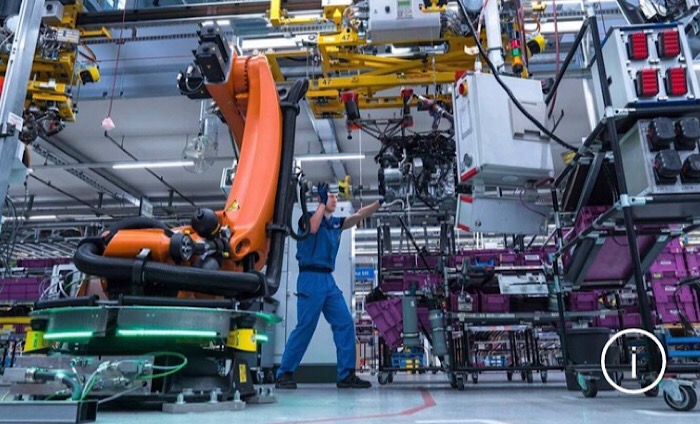
A worker leads a large industrial robot at the BMW Group Plant Regensburg, Germany.
Any minute now, some speculate, workers around the world will be asked to make way for robots.
Their arrival may be welcome in some cases. Our latest research suggests that when robots—or automated manufacturing technology—take over jobs that are oriented around repetitive tasks, operators are able to move onto more exciting and productive work.
This was the case at 16 “lighthouses of manufacturing,” which were identified as part of a joint McKinsey and World Economic Forum project presented at Davos.