‘Like having billions of tiny 3D printers’: Scientists train BACTERIA to build complex microscopic structures

 35E6A4DF-C420-4004-8624-6BCB2EAE0CA3

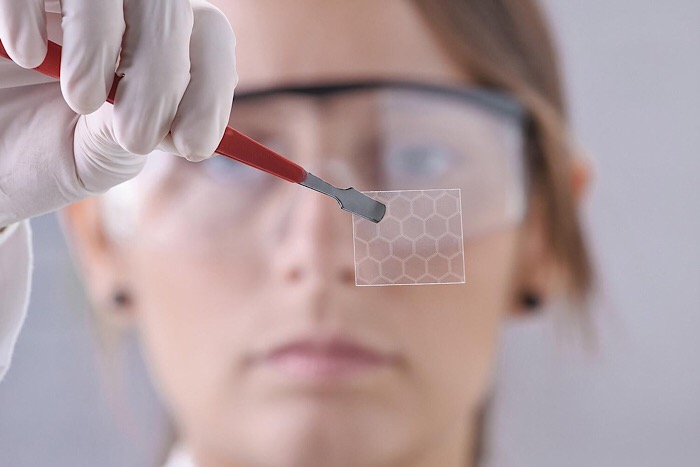
Researchers at Finland’s Aalto University have successfully turned bacteria into a microscopic workforce of nanobots, using molds made of hydrophobic material to create incredibly intricate three-dimensional objects.

The researchers placed the Komagataeibacter medellinensis bacteria in a mould with water and the requisite amount of nutrients like sugar, proteins and air. Once sufficiently fuelled-up, the bacteria begin to produce nano cellulose structures, in line with the hydrophobic (water repellant) mold in which they were placed.

Cellulose is the main component found in the cell walls of plants and substances like wood and cotton.

This type of guided growth through the use of superhydrophobic materials, which also minimize the accumulation of dust and microorganisms, could soon be used for extremely intricate tissue regeneration and organ repair in the human body.

Continue reading… “‘Like having billions of tiny 3D printers’: Scientists train BACTERIA to build complex microscopic structures”

Researchers create a single-molecule switch

 4D23A03E-B2A3-4139-ADE1-31DF8541CAB1

A team of researchers has demonstrated for the first time a single-molecule electret—a device that could be one of the keys to molecular computers.

 Smaller electronics are crucial to developing more advanced computers and other devices. This has led to a push in the field toward finding a way to replace silicon chips with molecules, an effort that includes creating single-molecule electret—a switching device that could serve as a platform for extremely small non-volatile storage devices. Because it seemed that such a device would be so unstable, however, many in the field wondered whether one could ever exist.

Along with colleagues at Nanjing University, Renmin University, Xiamen University, and Rensselaer Polytechnic Institute, Mark Reed, the Harold Hodgkinson Professor of Electrical Engineering & Applied Physics demonstrated a single-molecule electret with a functional memory. The results were published Oct. 12 in Nature Nanotechnology.

Continue reading… “Researchers create a single-molecule switch”

Biochip innovation combines AI and nanoparticles to analyze tumors

C51E21CB-60ED-4F33-9C90-ED2D38264F65

Electrical engineers, computer scientists and biomedical engineers at the University of California, Irvine have created a new lab-on-a-chip that can help study tumor heterogeneity to reduce resistance to cancer therapies.

In a paper published today in Advanced Biosystems, the researchers describe how they combined artificial intelligence, microfluidics and nanoparticle inkjet printing in a device that enables the examination and differentiation of cancers and healthy tissues at the single-cell level.

“Cancer cell and tumor heterogeneity can lead to increased therapeutic resistance and inconsistent outcomes for different patients,” said lead author Kushal Joshi, a former UCI graduate student in biomedical engineering. The team’s novel biochip addresses this problem by allowing precise characterization of a variety of cancer cells from a sample.

Continue reading… “Biochip innovation combines AI and nanoparticles to analyze tumors”

Experimental cancer treatment destroys cancer cells without using any drugs

AB0A30DC-8060-4F4D-BFBC-A261FCBBE416

One of the latest methods pioneered by scientists to treat cancer uses a Trojan horse sneak attack to prompt cancer cells to self-destruct – all without using any drugs.

Key to the technique is the use of a nanoparticle coated in a specific amino acid called L-phenylalanine, one of several such acids that cancer cells rely on to grow. L-phenylalanine isn’t made by the body, but absorbed from meat and dairy products.

In tests on mice, the nanoparticle – called Nano-pPAAM or Nanoscopic phenylalanine Porous Amino Acid Mimic – killed cancer cells specifically and effectively, posing as a friendly amino acid before causing the cells to destroy themselves.

The self-destruction mode is triggered as the nanoparticle puts production of certain chemicals known as reactive oxygen species (ROS) into overdrive. It’s enough to bring down the cancer cells while leaving neighbouring, healthy cells intact.

Continue reading… “Experimental cancer treatment destroys cancer cells without using any drugs”

Self-learning robot autonomously moves molecules, setting stage for molecular 3D printing

ABD88B38-38DE-4901-808E-DF959081FC31

If you know even just a little bit about science, you probably already know that molecules are often referred to as “the building blocks of life.” Made of a group of atoms that have bonded together, molecules make up all kinds of materials, but behave totally differently in regards to macroscopic objects than atoms do. Picture how a LEGO model is made of many teeny tiny bricks—it’s easy for us to move these bricks around, but if you think of molecules as these bricks, it’s much more difficult to do so, as each one basically requires its own separate set of instructions.

Continue reading… “Self-learning robot autonomously moves molecules, setting stage for molecular 3D printing”

Scientists create a robot made entirely of living cells

CB5C8483-EA0D-4143-8D92-38A181198D63

A Xenobot, 650-750 microns in diameter. The “legs” help it shuffle around in the petri dish.

 ‘Xenobots’ could be used to clean up microplastics or deliver medication in the body

Scientists have unveiled the first ever “living robot,” an organism made up of living cells, which can move around, carry payloads, and even heal itself.

“All of the computational people on the project, myself included, were flabbergasted,” said Joshua Bongard, a computer scientist at the University of Vermont.

“We didn’t realize that this was possible.”

Teams from the University of Vermont and Tufts University worked together to build what they’re calling “xenobots,” which are about the size of a grain of salt and are made up of the heart and skin cells from frogs.

Continue reading… “Scientists create a robot made entirely of living cells”

Army of a million microscopic robots created to explore on tiny scale

BC737CBC-5605-4ADB-8467-7CF1B61A165E

Artist’s rendition of an array of microscopic robots

 A troop of a million walking robots could enable scientific exploration at a microscopic level.

Researchers have developed microscopic robots before, but they weren’t able to move by themselves, says Marc Miskin at the University of Pennsylvania. That is partly because of a lack of micrometre-scale actuators – components required for movement, such as the bending of a robot’s legs.

Miskin and his colleagues overcame this by developing a new type of actuator made of an extremely thin layer of platinum. Each robot uses four of these tiny actuators as legs, connected to solar cells on its back that enable the legs to bend in response to laser light and propel their square metallic bodies forwards.

Continue reading… “Army of a million microscopic robots created to explore on tiny scale”

Atom-by-atom assembly makes for cheap, tuneable graphene nanoribbons

607326A8-FA3A-44F4-A9CD-0CFD18649410

Graphene nanoribbons could serve a variety of purposes, and a new way to produce then could help unleash this potential

The wonder material graphene can take many forms for many different purposes, from transparent films that repel mosquitoes to crumpled balls that could boost the safety of batteries. One that has scientists particularly excited is nanoribbons for applications in energy storage and computing, but producing these ultra-thin strips of graphene has proven a difficult undertaking. Scientists are claiming a breakthrough in this area, devising a method that has enabled them to efficiently produce graphene nanoribbons directly on the surface of semiconductors for the first time.

The wonder material graphene can take many forms for many different purposes, from transparent films that repel mosquitoes to crumpled balls that could boost the safety of batteries. One that has scientists particularly excited is nanoribbons for applications in energy storage and computing, but producing these ultra-thin strips of graphene has proven a difficult undertaking. Scientists are claiming a breakthrough in this area, devising a method that has enabled them to efficiently produce graphene nanoribbons directly on the surface of semiconductors for the first time.

As opposed to the sheets of carbon atoms arranged in honeycomb patterns that make up traditional graphene, graphene nanoribbons consist of thin strips just a handful of atoms wide. This material has great potential as a cheaper and smaller alternative to silicon transistors that would also run faster and use less power, or as electrodes for batteries that can charge in as little as five minutes.

Continue reading… “Atom-by-atom assembly makes for cheap, tuneable graphene nanoribbons”

New graphene battery recharges blazingly fast, and it’s already on the market

B6AAEC73-5640-4BFE-A077-4CB559A215BA

Faster charging, longer lasting, and lower temperatures. These are the three major benefits from a lithium battery that has been infused with wonder-material graphene. Thing is, we’ve all heard about the benefits of graphene before, but despite all the hype, we’ve yet to really see it used in devices and products that you can actually buy.

That’s about to change according to Real Graphene, a Los Angeles-based technology company working on graphene-enhanced battery cells. Digital Trends spoke to CEO Samuel Gong about what benefits integrating graphene into a lithium battery will bring, and they’re extremely compelling. Even better news is that the tech is almost ready for mainstream use.

Continue reading… “New graphene battery recharges blazingly fast, and it’s already on the market”

Researchers demonstrate chip-to-chip quantum teleportation

D97B454B-4CCF-4543-BEFE-A99EBB43A9A8

Llewellyn et al realize an array of microring resonators (MRRs) to generate multiple high-quality single photons, which are monolithically integrated with linear-optic circuits that process multiple qubits with high fidelity and low noise.

A research team led by University of Bristol scientists has successfully demonstrated quantum teleportation of information between two programmable micrometer-scale silicon chips. The team’s work, published in the journal Nature Physics, lays the groundwork for large-scale integrated photonic quantum technologies for communications and computations.

Quantum teleportation offers quantum state transfer of a quantum particle from one place to another by utilizing entanglement.

Continue reading… “Researchers demonstrate chip-to-chip quantum teleportation”

A nanotube material conducts heat in just one direction

0F8A9EC0-C764-4BBD-A6D9-9C1C96A76A13

Photograph of nanotubes being created

 Asymmetric conductors could revolutionize cooling systems for computers and other devices.

Heat is something of a nuisance for electrical engineers. It reduces the reliability of electronic devices and even causes them to fail completely. That’s why computer components are liberally smeared with thermal paste and connected to heat pipes, fans, and even water cooling systems.

The goal is to channel the heat away from sensitive components so that it can dissipate into the environment. But as devices get smaller, the challenge becomes more acute—and modern transistors, for example, are measured in nanometers.

Continue reading… “A nanotube material conducts heat in just one direction”

The world’s most advanced nanotube computer may keep Moore’s Law alive

F59A716D-4A1C-43C3-B22A-9C6BB6820FA3

Up close photograph of nanotube

 MIT researchers have found new ways to cure headaches in manufacturing carbon nanotube processors, which are faster and less power hungry than silicon chips.

A team of academics at MIT has unveiled the world’s most advanced chip yet that’s made from carbon nanotubes—cylinders with walls the width of a single carbon atom. The new microprocessor, which is capable of running a conventional software program, could be an important milestone on the road to finding silicon alternatives.

The electronics industry is struggling with a slowdown in Moore’s Law, which holds that the number of transistors that can be packed on a silicon processor doubles roughly every couple of years. This trend is facing its physical limits: as the sizes of the devices shrink to a few atoms, electrical current is starting to leak from the metallic channels that shuttle it through transistors. The heat that’s released saps semiconductors’ energy efficiency—and may even cause them to fail.

Continue reading… “The world’s most advanced nanotube computer may keep Moore’s Law alive”

Discover the Hidden Patterns of Tomorrow with Futurist Thomas Frey
Unlock Your Potential, Ignite Your Success.

By delving into the futuring techniques of Futurist Thomas Frey, you’ll embark on an enlightening journey.

Learn More about this exciting program.