The Higgs Boson is kind of a big deal. If it does exist, it could provide a key to unifying the standard and quantum models of physics. But what is a Higgs Boson, what does it do, and how does it work? With the help of this animated short, UCI physics professor Daniel Whiteson breaks down the basics of this mysterious particle (or is it a field?) in a way even your parents can understand.
Back in 2002, psychologist Daniel Kahneman won the economics Nobel Prize for showing that human beings don’t have a really good intuitive grasp of risk. Basically, the decisions we make when faced with a risky proposition depend more on how the question is framed than on what the actual outcome might be.
The classic example is to tell a subject that there’s going to be a disaster. Out of 600 people, she has a chance of saving 200 if she takes x risk. If she doesn’t take the risk, everybody dies. Most people will take the risk in that scenario, but if you present the same situation and frame it differently—”If you take this risk, 400 people will die”—the decisions suddenly flip in the other direction. Nothing has changed about the outcome. But everything has changed in terms of how people feel about the decision they have to make. This is the kind of thing that matters a lot to economics because it helps to explain why economic behavior in the real world isn’t always as rational and self-interested as it is in theory…
How much time do you have to read the privacy policies you encounter?
In The Cost of Reading Privacy Policies, by Aleecia M. McDonald and Lorrie Faith Cranor, the authors calculate that the average Internet user would have to spend one full working month per year in order to skim all the Internet privacy policies she encounters in a year. Mike Masnick reports on Techdirt…
From left: physicists Luis Delgado-Aparicio and David Gates.
Physicists have discovered a possible solution to a mystery that has long baffled researchers working to harness fusion. If confirmed by experiment, the finding could help scientists eliminate a major impediment to the development of fusion as a clean and abundant source of energy for producing electric power… Continue reading… “Scientists see solution to critical barrier to fusion”
Futurist Thomas Frey took time out of his busy speaking schedule for a short interview with Larry Nelson at W3W3 radio. This time Mr. Frey conversed with Larry about DaVinci Coders, the new beginner based Ruby On Rails program that he is putting together at DaVinci Institute…
In an article in today’s New York Times, “A sharp rise in retractions prompts calls for reform,” Carl Zimmer documents and analyzes the sharp increase in the proportion of papers retracted in the scientific literature. From 2000-2009 the trend is disturbing (pictured above).
The article notes:
In October 2011, for example, the journal Nature reported that published retractions had increased tenfold over the past decade, while the number of published papers had increased by just 44 percent. In 2010 The Journal of Medical Ethics published a study finding the new raft of recent retractions was a mix of misconduct and honest scientific mistakes… Continue reading… “Scientific retractions increasing exponentially”
If you happen to be curious about what the future home of your grandchildren might look like, take a glance at Remistudio’s concept hotel called The Ark. Russian architect, Alexander Remizov, is the mastermind behind the project, he believes that his floating “slinky,” which can hold up to 10,000 people can have multiple uses, including a safe house for disaster relief. The prototype’s main materials are timber, steel ,and high-strength ETFE plastic and it is built to handle land and/or water…
Population density map with more than 5 people per square mile.
Derek Watkins created a fun interactive map showing population density across the world. You can use a sliding bar to change the display. The above screenshot shows the parts of the world with more than five people per square mile. Slide the bar up to five hundred people per square mile and watch the world almost vanish…
Fixing a hole in a road should be easy—but the fact that our nation’s highways are littered with potholes is testament to the fact that it’s not quite as straightforward as it sounds. But a new solution, inspired by silly putty, could make our streets much smoother in the future.
In fact, the idea—developed by students from Case Western Reserve University in Cleveland—has won an engineering contest, reports Science. But prize-winning or not, the idea of mending a road with something like silly putty sounds like madness, right?
Grand Challenges create a new vision of the future.
Tom Kalil of the White House’s Office of Science and Technology Policy gave a presentation today about Grand Challenges, such as the ones proposed by futurist Thomas Frey HERE. Kalil called them “ambitious yet achievable goals that capture the public’s imagination and that require innovation and breakthroughs in science and technology to achieve,” like NASA’s Green Flight Challenge and the Gates Foundation’s Grand Challenges in Global Health. I think Tom’s speech, delivered to the Information Technology and Innovation Foundation, does a terrific job showing why the grand challenge approach is a powerful way to tackle some pretty daunting problems. He also puts grand challenges in the context of President Obama’s Strategy for American Innovation. (By the way, it must be nice to be authorized to use the Presidential PowerPoint template.) From Tom’s speech
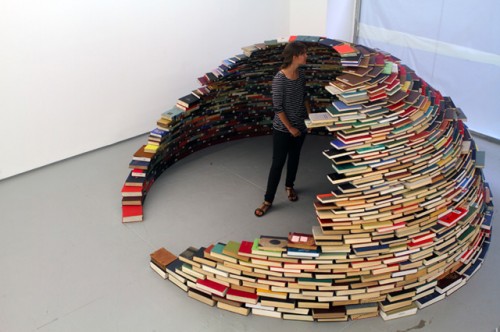
Miler Lagos’s installation at the MagnanMetz Gallery in New York City is entitled simply “Home”. After he finished it, the dome was completely enclosed and self-supporting. Just imagine if you had one of these, consisting entirely of the books that you have read over the course of your life…
When it comes to terraforming, the Universe makes man’s puny efforts to be king of the hill look pretty pathetic. Not only are we completely at the mercy of a constantly changing planet, but we’re careening through space totally vulnerable to a sea of objects and cosmic influences beyond our wildest imagination.
Yet intuitively we have the peace that all is under control in some magnificent way.
The decades long assertion that our solar system would soon enter an electrically charged life altering photon belt around the Sirius star system has been regularly dismissed as pseudo science–NASA speak for “conspiracy theory”. Despite periodical scientific validation it has been continually pushed aside by mainstream science.