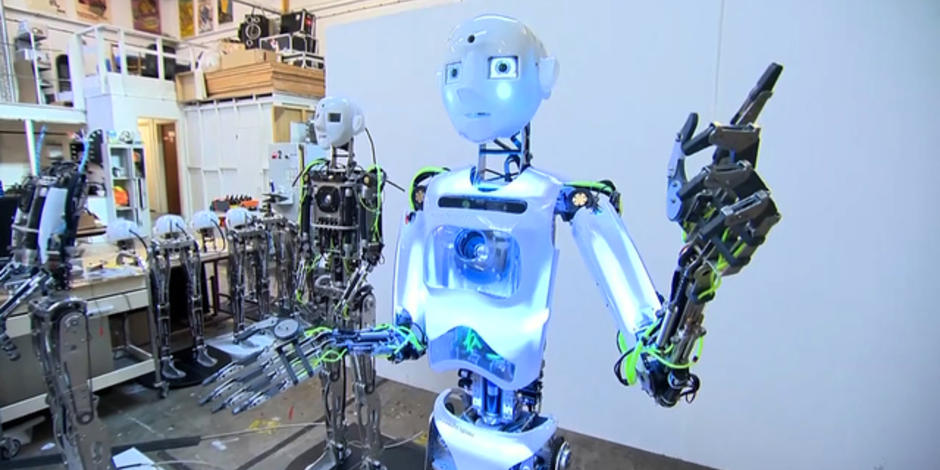
Microsoft head of research Eric Horvitz says, in contrast to what others, such as Elon Musk and Stephen Hawking have said, that even though machines will likely achieve a human-like consciousness but do not pose a threat to the survival of mankind. Continue reading… “Microsoft’s Eric Horvitz contradicts Musk, Hawking, Gates, says artificial intelligence not a threat”
The Associated Press wrote 10X more articles using robots
If you thought that journalist was not on the list of professions replaceable by robots, think again. The Associated Press, America’s oldest 24-hour news agency, produced roughly 3,000 articles on company earnings last quarter, 10 times more than it used to, by using automated technology. Continue reading… “The Associated Press wrote 10X more articles using robots”
Foxconn wants to use robots to lower cost of smartphones
Foxconn, one of the largest private employers in the world with 1.3 million workers, makes many of the smartphones and tablets used today, including Apple iPhones and iPads, and some android smartphones. The CEO of Foxconn has indicated that he wants to reduce the workforce by using robots. Continue reading… “Foxconn wants to use robots to lower cost of smartphones”
Drones to help you find a parking spot
Need help finding a parking spot? Just ask the drone flying overhead. Continue reading… “Drones to help you find a parking spot”
Elon Musk donates $10 million toward research of AI safety
Elon Musk, CEO of Tesla and SpaceX
Elon Musk, the CEO of Tesla and SpaceX, has donated $10 million for research of artificial intelligence safety. Musk has said that AI is “potentially more dangerous than nukes” and that something similar to what happens in the movie The Terminator is plausible. Continue reading… “Elon Musk donates $10 million toward research of AI safety”
Stanford to Research the effects of Artificial Intelligence
What will intelligent machines mean for society and the economy in 30, 50 or even 100 years from now?
That’s the question that Stanford University scientists are hoping to take on with a new project, the One Hundred Year Study on Artificial Intelligence (AI100).
Continue reading… “Stanford to Research the effects of Artificial Intelligence”
Technological Automation of Jobs Debate
The topic of job displacement has, throughout US history, ignited frustration over technological advances and their tendency to make traditional jobs obsolete; artisans protested textile mills in the early 19th century, for example. In recent years, start-ups and the high-tech industry have become the focus of this discussion. A recent Pew Research Center study found that technology experts are almost evenly split on whether robots and artificial intelligence will displace a significant number of jobs over the next decade, so there is plenty of room for debate.
Continue reading… “Technological Automation of Jobs Debate”
10 Ways the Next 10 Years will be Awesome!
It’s hard to wait for the future to get here and give us all the amazing things we’ve dreamed up in our countless sci-fi books and movies (I’m still waiting for the hover-boards Back to the Future promised me). Though much of what we’ve seen on the big screen is still decades or millennia away… or straight up impossible by our current understanding of the universe, there are several sci-fi level technological and scientific advances we’re likely to see in just the next decade.
Blogger Jordan Lejuwaan over at High Existence has compiled a list of ten such advances to look forward to in the not-to-distant future:
Continue reading… “10 Ways the Next 10 Years will be Awesome!”
The Rise of Technological Unemployment
A machine that administers sedatives recently began treating patients at a Seattle hospital. At a Silicon Valley hotel, a bellhop robot delivers items to people’s rooms. Last spring, a software algorithm wrote a breaking news article about an earthquake that The Los Angeles Times published.
Although fears that technology will displace jobs are at least as old as the Luddites, there are signs that this time may really be different. The technological breakthroughs of recent years — allowing machines to mimic the human mind — are enabling machines to do knowledge jobs and service jobs, in addition to factory and clerical work.
Continue reading… “The Rise of Technological Unemployment”
FAA Drags Feet on Drone Rulings
Many new drones are now making their debut – Image by media.salon.com
In August, the Federal Aviation Administration missed a key deadline for developing rules for small commercial drones. That failure has infuriated businesses that want to test and use drones for delivering goods, monitoring crops and doing other awesome things. Some have even threatened to move their drone research overseas if they can’t get permission to operate in the United States.
Continue reading… “FAA Drags Feet on Drone Rulings”
What changes should we expect when robots replace workers?
How long will it be before we see the first worker fired by a robot manager?
It is rather significant that economists are shifting their belief. Up until now, economists have believed that new jobs will replace lost jobs. Now the numbers suggest that is changing for the first time in history, and the trend is accelerating.
It’s also interesting to note the term, second economy. Defined as transactions between computers. That is measurable. It can be compared to the first economy. When the second passes the first, people matter less, in real numbers.
Continue reading… “What changes should we expect when robots replace workers?”
The Rise of Smart Skin
Stretchable smart skin
South Korean and U.S. researchers have developed a stretchable material that senses touch, pressure, and moisture, and could be used to give artificial limbs feeling.
By David Talbot on December 9, 2014
Continue reading… “The Rise of Smart Skin”