Elon Musk’s Tesla Inc. arguably has one of the most affordable lines of electric vehicle, but that all could change as a Chinese company just unveiled what is now dubbed as the “World’s Cheapest Electric Car.”
Great Wall Motors, an automotive company based in Baoding, China, pulled the veil on its cheapest electric vehicle called the ORA R1, which is being marketed with a price of $8,680 according to the company, Express reported.
“As a new market entrant, ORA R1 delivers an unprecedented experience to drivers,” general manager of the Ora line and vice president of Great Wall Motors, Ning Shuyong, said in a statement.
The Bell Nexus hybrid electric air taxi concept is on display at the Bell booth at CES International
From a one-person flying car to a luxurious five seater, companies are racing to launch the first flying car.
LAS VEGAS — While CES attendees are still quite a few years away from being able to hop in a flying car and travel to the annual technology show, several concepts displayed at the 2019 event this week provided a glimpse of what the future could look like.
That starts with hailing an Uber copter — possibly as soon as the mid 2020s. At CES, Textron’s Bell division, a partner in the Uber Elevate flying car initiative, showed off its new air taxi concept called the Nexus.
While it may fly, make no mistake, the Nexus looks more like a car than an airplane. The concept uses six tilted fans to aid in takeoffs and landings, which are powered by a hybrid-electric propulsion system. Inside the vehicle, four passengers and a pilot can see their flight path projected onto a screen.
Uber has said it’s planning to roll out its air vehicles by 2023 in certain cities, targeting the Dallas-Fort Worth area and Los Angeles as its first domestic markets.
SHENZHEN, China (AP) — One of China’s major cities has reached an environmental milestone: an almost entirely electric-powered taxi fleet.
The high-tech hub of Shenzhen in southern China announced at the start of this year that 99 percent of the 21,689 taxis operating in the city were electric. Last year, it still had 7,500 gasoline-powered taxis on the roads. A few can still be found, but electric ones far outnumber them.
All the ways the self-driving future won’t come to pass.
Self-driving cars are coming. Tech giants such as Uber and Alphabet have bet on it, as have old-school car manufacturers such as Ford and General Motors. But even as Google’s sister company Waymo prepares to launch its self-driving-car service and automakers prototype vehicles with various levels of artificial intelligence, there are some who believe that the autonomous future has been oversold—that even if driverless cars are coming, it won’t be as fast, or as smooth, as we’ve been led to think. The skeptics come from different disciplines inside and out of the technology and automotive industries, and each has a different bear case against self-driving cars. Add them up and you have a guide to all the ways our autonomous future might not materialize.
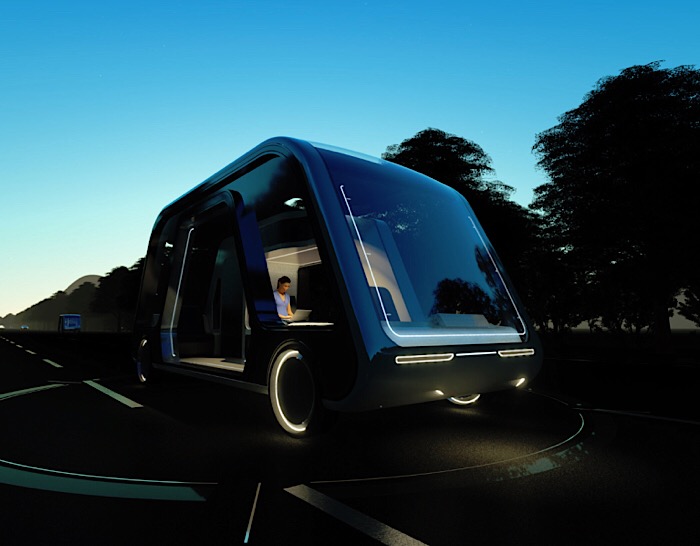
The “Uber for everything” boom in tech has led to plenty of on-demand solutions for everyday life, but one problem we didn’t even know existed is apparently mobile hotel rooms. A new concept for a rolling room just won an award for its forward thinking, but will it ever become a reality? We have out doubts.
The concept is called the Autonomous Travel Suite, or ATS for short. It comes from the mind of Steve Lee of the Aprilli Design Studio and it’s largely based on the self-driving vehicle technology of the future. The idea here is that instead of riding along in a car-like seat while a computer takes you to your destination, you’re actually free to move around the over-sized cabin.
For the first time in more than a decade, palladium is rivaling gold in value. A key component in pollution-control devices for cars and trucks, the metal’s price has surged as much as 50 percent in about four months, making it at times more expensive than gold. The rally shows few signs of fizzling.
A poll shows the plain truth: The youth of today is much more willing to get behind the wheel (but not use the wheel) of a driverless car than any other age group.
In a poll featured on Statista and conducted by iAccenture and Harris Interactive of 21,000 respondents ages 14 and up, people were asked if they were willing to be passengers in a so-called self-driving vehicle—a.k.a. an autonomous car.
More recent designs closely resemble high-speed trains.
The Hyperloop One’s recent speed record of 308 kmh (192 mph) is an important step (however small) toward surpassing the first goal of the Hyperloop: to achieve quicker transit than other alternatives. But, while the hyperloop was initially designed to achieve 1,200 km/h (750 mph) with a chic micro-craft built for three passengers, it is developing into something quite different.
In his original outline, Musk illuminated some glaring problems at the conceptual stage of several other “high speed” rail systems — namely the high expense per mile, the cost of operation, and that other propositions were less safe than flying by two orders of magnitude.
No one thought the proposal would come so far a mere four years after Elon Musk released his initial plans for Hyperloop system. But with tubes 3.3 meters (11 feet) in diameter, the craft looks more like the cargo version from Musk’s original concept. Instead of a bobsled, we’re seeing something more like an ordinary train. Additionally, the thin concrete pylons planned for minimal terrestrial footprint will be significantly larger. Since this is more on the scale of a train or highway, the disruptive potential of compact tubes would seem, alas, reneged.
It was a game of Dots that pushed Erik Coelingh to rethink his entire approach to self-driving cars. Coelingh, Volvo’s head of safety and driver assist technologies, was in a simulator, iPad in hand, swiping this way and that as the “car” drove itself, when he hear an alert telling him to take the wheel. He found the timing less than opportune.
“They gave the message when I was close to getting a high score,” he says. Jolted away from the absorbing task, he had no idea of what was happening on the “road,” or how to handle it. “I just realized,” he says, “it’s not so easy to put the game away.”
The experience helped confirm a thesis Coelingh and Volvo had been testing: A car with any level of autonomy that relies upon a human to save the day in an emergency poses almost insurmountable engineering, design, and safety challenges, simply because humans are for the most part horrible backups. They are inattentive, easily distracted, and slow to respond. “That problem’s just too difficult,” Coelingh says.
And so Volvo, and a growing number of automakers, are taking you out of the equation entirely. Instead of developing autonomous vehicles that do their thing under most circumstances but rely upon you take the wheel in an emergency—something regulators call Level 3 autonomous capability—they’re going straight to full autonomy where you’re simply along the ride.
A number of innovative small business aircraft are on the drawing board, but the future of these projects depends on investors and their propensity for risk
We’re on the cusp of the genesis of a new category of business travel, the ultra-short-haul market. Urban congestion is driving innovators to reach for the stars or at least as high as the layer of underutilised airspace sandwiched between the rooftops and the altitude beneath commercial airline traffic.
Imagine taking a road trip and never having to stop for a food or bathroom break.
Steve Lee, a designer at Toronto-based Aprilli Design Studio, has come up with an idea that could make that happen: The Autonomous Travel Suite.
Think of it as a hotel room on wheels. The driverless mobile suite would have a sleeping area with mattresses, washroom facilities with a toilet and sitting shower, a space for working or entertaining, and a small kitchen. It could fit up to five people.
“It’s basically a hotel room so it has everything inside it,” he says. “Whether it’s six hours or 10 hours, you’ll feel comfortable inside it.”