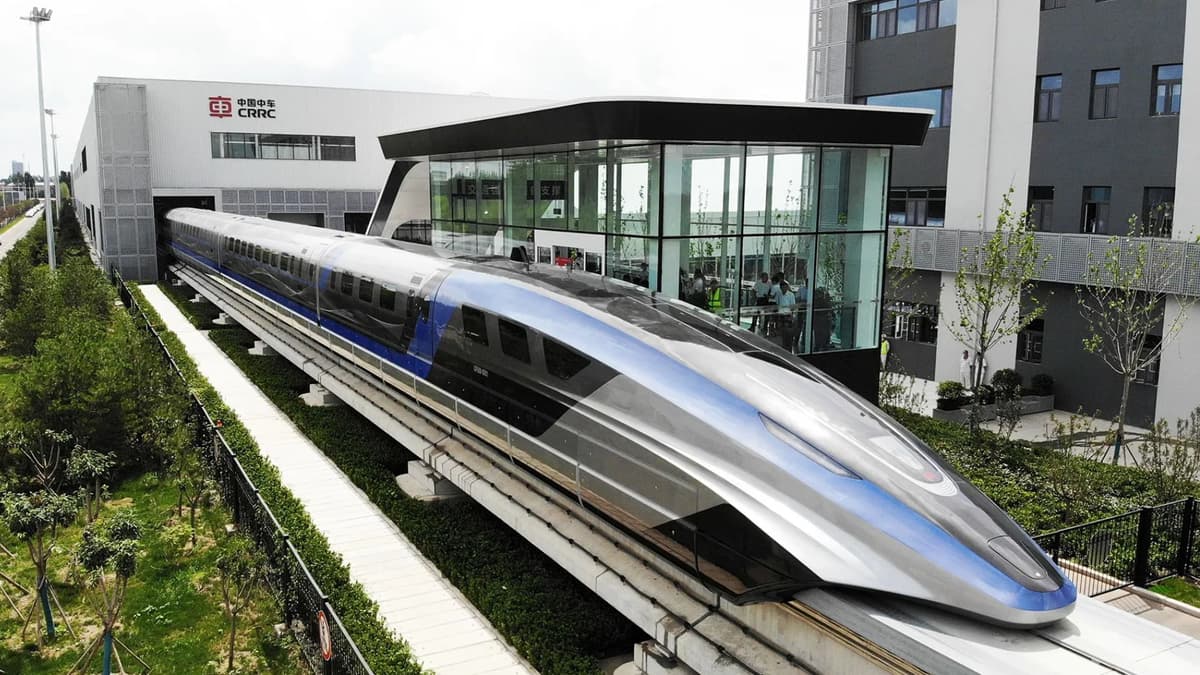
When a train pushes past 200 miles per hour, it stops being just a train. It becomes a battle with the air itself. At these speeds, aerodynamic drag is no longer a minor nuisance—it is the single largest force standing in the way of efficiency, safety, and speed. Now, a team of engineers in China has made a breakthrough that could reshape the future of high-speed rail: a 22% reduction in aerodynamic drag at 248 mph (400 km/h).
That number may not sound dramatic at first glance, but in the world of transportation engineering, it is staggering. At 248 mph, drag increases by nearly 30% compared with trains running at the more common 217 mph. Every bit of resistance translates into massive amounts of wasted energy, higher operating costs, and limits on how fast and far these machines can run. Reducing drag by 22% is like unlocking a secret door into the future of rail travel.
The dream of supersonic travel didn’t die with the Concorde—it just went quiet. Literally. A Boston-based aerospace firm, Spike Aerospace, claims its upcoming S-512 Diplomat business jet will fly from New York to Paris in under four hours—without shattering windows or rattling eardrums along the way.
That’s the breakthrough. Since 1973, supersonic flight over U.S. territory has been banned because of the disruptive sonic booms that rattled cities and outraged regulators. If Spike delivers on its promise of a “low-boom” jet, it won’t just shrink the map—it will reopen airspace that’s been locked down for half a century.
For decades, high-speed rail engineers have been wrestling with an invisible troublemaker—compressed air. When a train explodes out of a tunnel at blistering speed, it unleashes a low-frequency “tunnel boom” that can rattle windows, startle wildlife, and irritate entire neighborhoods. The faster the train, the louder the boom. At the extreme speeds planned for next-generation magnetic levitation trains, the problem threatened to derail progress.
Now, China’s railway engineers claim they’ve cracked the code. Their solution? A 328-foot (100-meter) sound-absorbing buffer at the tunnel mouth, acting like a silencer for the world’s fastest trains. Made from lightweight, porous material with a matching porous coating along the tunnel’s interior, this barrier lets compressed air bleed off gradually rather than explode outward in a sonic punch. Early tests show it slashes pressure fluctuations by up to 96%—nearly eliminating the boom altogether.
Airports aren’t famed for being peaceful spaces – but they do give us the rush we all associate with going on holiday.
Noise and crowds are to be expected. Children are screaming, wheely luggage is reverberating across the floors and announcements can be heard every few minutes, alerting new customers to their boarding gate.
Imagine if you could mute that all out – as if you had put on noise-cancelling headphones and everything became quiet.
That’s now a reality in a select few airports around the world which have declared themselves ‘silent airports’.
Drone pilots don’t need to be told about the wonders of electric flight. But Scientific American believes electric aviation for passengers may be here sooner than we think as the industry struggles to decarbonize.
It’s one of the top ten emerging technologies the magazine highlights in its most recent issue.
In an article co-written by Katherine Hamilton and Tammy Ma, the authors point out that air travel accounted for 2.5 percent of global carbon emissions in 2019. And that number could triple by 2050. Electric airplanes could be one solution.
(CNN) — Researchers have conducted a successful maiden flight of the Flying-V, a futuristic and fuel efficient airplane that could one day carry passengers in its wings.
The Flying-V’s unique design places the passenger cabin, the cargo hold and the fuel tanks in the wings, and experts hope that the plane’s aerodynamic shape will cut fuel consumption by 20% compared to today’s aircrafts.
Experts tested a 22.5 kg and 3-meter scale model of the futuristic airplane, developed by researchers at Delft University of Technology in the Netherlands and partner Dutch airline KLM, to take the highly anticipated aircraft along its next developmental steps.
With many ships poised to return, operators are making hundreds of changes to improve the safety of sailing.
Big-name cruise companies have been on pause since mid-March, after they voluntarily ceased operations a day before the CDC issued a “No Sail Order” for any ships carrying more than 250 passengers. In the months since, smaller ocean and river lines have developed new pandemic-era health and safety guidelines aimed at restoring traveler confidence in cruising.
And travelers are interested, says Rob Clabbers, president of Q Cruise & Travel in Chicago and a member of T+L’s Travel Advisory Board. “We have some clients who literally can’t wait to get back on a ship,” he explains. When they do eventually board, vacationers will find a new routine — at least in the near term.
I know treehouses were a thing of our childhoods but it doesn’t have to be! Get ready to take a beautiful virtual tour of the O2 Treehouse by Treewalkers that blend the best of our childhood imagination with glamping reality while keeping it all an eco-friendly experience! Treewalkers is one of the leading players in the world of treetop construction – they actually make treehouses that adults cannot reason out of.
The treehouses have unique geodesic domes and can be connected to create entire villages. The houses are modular so it enables franchisees to start their own village setups with one or more units – this can be a sustainable hotel, unusual Airbnb getaway, or simply a camping site that offers a different kind of stay. The innovative modular lattice design is what makes this a flexible accommodation — while catering to the individual’s needs and it also allows them to customize details. The units come with a standard a bug-proof outer socket, interior furniture, and canvas canopy roofing. As part of the franchise program, hosts have the option to open up their Treewalker to other hosts in exchange for points that can be used towards other stays – sustainable community tourism! There are many intriguing shapes but the most iconic one has to be the A-shaped floating tent because that is something we have all tried to create with a blanket in our living rooms. The interiors are warm + woody and have a plush bed with a seating area. As you can imagine there will be plenty of natural light and ventilation. While there is no clear indication of the bathroom being in-unit, I assume that will be a separate pod in itself or have other arrangements like porta-potty if its a campsite.
The California-based design studio has extended its realm with a franchise-hospitality brand to make it possible for anyone to own one of the O2 Treehouses. “Treewalkers is a franchise-based treehouse hospitality brand that lends homeowners a way to launch into the home-sharing market with low risk and a high ROI, and lends travelers an easily accessible network of eco experiences,” says founder Dustin Feider. Finally, O2 Treehouse estimates a 1-3 year return on investment based on a rate of $150 per night, occupied for 30-60% of the year and they have broken down the math for you on their website should you decide to go that route. The ultimate mission of the brand is to design architectural structures that heal the bond between humans and nature so they can coexist peacefully!
Bullet-shaped plane that can travel at 460mph for more than 4,500 miles, costs just $328 per hour to operate and is set to revolutionize private air travel is unveiled
The first official information and images of the Celera 500L were revealed by Otto Aviation Wednesday.
The ‘bullet’ aircraft is predicted to revolutionize private air travel
It can travel at a cruising speed of 460mph for more than 4,500 miles
Yet it uses eight times less fuel bringing hourly operating costs down to at $328
It is hoped the the lower costs will make it a competitor for commercial travel
The plan is powered by a RED A03 engine
Otto Aviation plans for first commercial deliveries by 2025 but a price for the aircraft is not yet known
The much-anticipated Celera 500L ‘bullet’ plane which is set to revolutionize private air travel has been revealed.
Impact of virus threatens industry’s engine of sales, profit
Road warriors turn to video conferences while CEOs eye budgets.
U.S. passenger totals plummeted more than 95% at the peak of the pandemic-related travel collapse.
U.S. airlines hammered by the catastrophic loss of passengers during the pandemic are confronting a once-unthinkable scenario: that this crisis will obliterate much of the corporate flying they’ve relied on for decades to prop up profits.
“It is likely that business travel will never return to pre-Covid levels,” said Adam Pilarski, senior vice president at Avitas, an aviation consultant. “It is one of those unfortunate cases where the industry will be permanently impaired and what we lost now is gone, never to come back.”
(CNN) — They have their own governments, passports, citizens and even currency in some cases.
But for various complicated reasons, a number of countries around the world do not officially exist — some are even left off maps.
That didn’t stop Guilherme Canever trying to visit them. The Brazilian author traveled to 16 unrecognized nations between 2009 and 2014 and recounts his experiences in his latest book “Unrecognized Nations: Travels To Countries That Do Not Exist,” which is released this month.
Competition in the space tourism industry is heating up, and a new company is taking a unique approach to near-space exploration.
The prospect of space travel has long-since enchanted humanity. Now, as competition heats up across the burgeoning spaceflight industry, this sci-fi fantasy may soon become reality. The company Space Perspective is offering a unique transport twist on the standard spacefaring business model. Rather than harnessing the latest propulsion technology or rocket busters, the company is using a pressurized cabin and a high-altitude balloon to chauffeur tourists to the cusp of the final frontier. But how much will it cost? Also, why balloons?
Space Perspective was founded by co-CEOs Jane Poynter and Taber MacCallum. While a balloon may not immediately strike some as the ideal mode of transport for such an undertaking, the “serial entrepreneurs” behind the company have a rich history of lofty ideas tethered to these buoyant instruments.