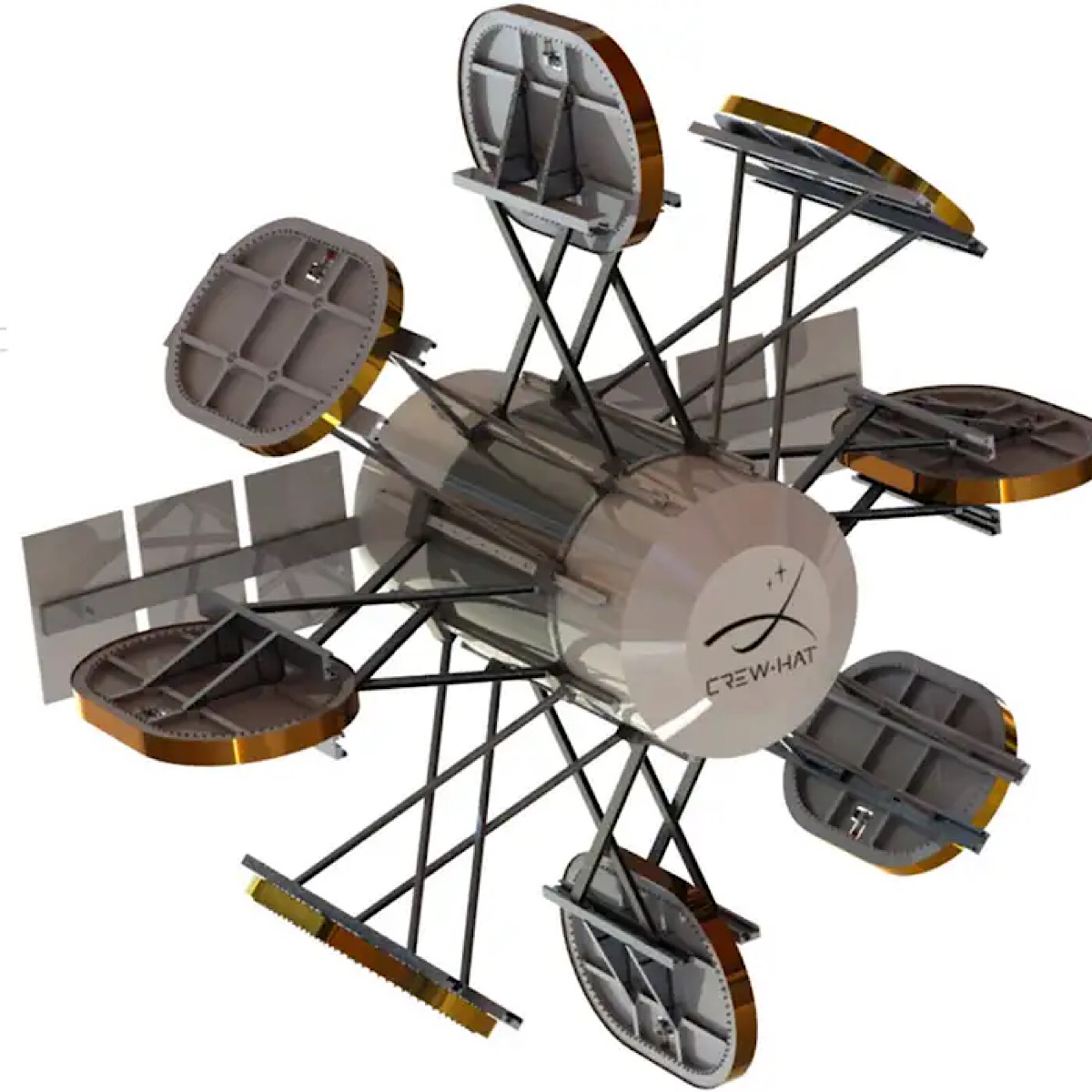
Not rocket science: SpinLaunch hurls payloads into orbit

Besides offering an incredibly cool way to get stuff into space, SpinLaunch promises to reduce the cost of a launch by 20-fold. 

KEY TAKEAWAYS

  • Rockets are so big because they require enormous amounts of fuel. 
  • SpinLaunch’s method does away with much of that fuel by hurling payloads into space using a giant centrifuge. 
  • The machine generates wicked g-forces: around 10,000 times the force of gravity, enough to tear the skin and muscle off a human being.  

For the last 70 years, we have been punching our way into space. Using massive rockets the size of skyscrapers, we have relied on high explosives to blast our way out of Earth’s gravity well. While riding into space on a pillar of flame is certainly an impressive way to reach orbit, it is incredibly expensive, which limits our access to the potential of the high frontier. But what if there was a better, cheaper way to get payloads into orbit? What if, rather than blasting our way into space, we simply hurled them up there like a stone from a catapult? If that sounds like an insane idea, then it is time that you were introduced to SpinLaunch, a company that has already taken its first steps in turning that crazy idea into a reality.

The problem with rockets is summed up in what is called the rocket equation. This neat little piece of physics says that, since the chemical energy locked in fuel is what is needed to get a payload into space, you need to haul all that fuel along for the ride and burn it up as you climb skyward. That is why rockets are so big. They must carry fuel to launch the rest of the fuel. SpinLaunch’s method is to do away with the need for most of that fuel.

Continue reading… “Not rocket science: SpinLaunch hurls payloads into orbit”

This drone flies using da Vinci’s 530-year-old helicopter design

Leonardo’s aerial screws actually can work when built with modern materials, University of Maryland engineers find with a drone called Crimson Spin.

By Stephen Shankland

In the late 1480s, Leonardo da Vinci sketched out a clever design for a one-person helicopter propelled by an “aerial screw.” You may have seen his drawings and wondered whether one of the choppers could ever take flight. 

Now we know the answer. The Italian genius was right. 

Starting in 2019, a University of Maryland engineering team designed and tested the underlying technology as part of a design contest. Then over the last year and a half, team member Austin Prete built Crimson Spin, an unmanned quadcopter drone using da Vinci’s screwlike design, and flew it on several brief journeys.

Continue reading… “This drone flies using da Vinci’s 530-year-old helicopter design”

Next Industries Tactigon SKIN wearable 3D mouse recognizes your voice and gestures

This mouse makes presentations and games much more interactive.

Have more fun working with the Next Industries Tactigon SKIN wearable 3D mouse.

This workspace and gaming gadget adds gesture and voice control to your PC, games, PowerPoint, robotics projects, and more.

That’s right; it responds to hand movements and recognizes 48 different gestures. Then, with its voice control, you can zoom, open and close programs and much more via voice command.

Continue reading… “Next Industries Tactigon SKIN wearable 3D mouse recognizes your voice and gestures”

Futurati Podcast with Jeff Booth

Watch our interview with Jeff on Youtube.

Jeff Booth is a visionary leader who has lived at the forefront of technology change for 20 years. In January 2020, Jeff released his first book titled “The Price of Tomorrow – Why Deflation is Key to an Abundant Future”, in which he offers his provocative thesis about the current state of our economies and what must happen to enable a brighter future.

Related 

Continue reading… “Futurati Podcast with Jeff Booth”

‘The Jet’ to fly across Dubai waters as world’s first hydrogen-powered boat is set for UAE launch

The vehicle will be able to carry up to 12 passengers and cruise at a speed of 40 knots

Swiss-based start-up THE JET ZeroEmission announced that it has inked an agreement with Zenith Marine Services LLC, a UAE based company; and DWYN LLC to manufacture and operate ‘THE JET’ – the first clean-energy, hydrogen-powered flying boat. Featuring an iconic design, the boat’s world premiere will be held in Dubai.https://640311b1a08327713afc3fa42ce45ffc.safeframe.googlesyndication.com/safeframe/1-0-38/html/container.html

The announcement reflects Dubai’s leading position as a global hub for future industries. Dubai’s robust infrastructure and supportive investment environment has made it an ideal launchpad for innovative companies to reach their global ambitions.

‘THE JET’ features cutting-edge characteristics and technologies, making it capable of flying in silence over the waters at a cruising speed of 40 knots. The luxurious boat has a capacity of 8 to 12 passengers, and is equipped with two fuel cells and an air conditioner as well as other clean-tech, environmentally friendly technologies that help reduce carbon emissions.

Continue reading… “‘The Jet’ to fly across Dubai waters as world’s first hydrogen-powered boat is set for UAE launch”

FedEx launches AI-powered Sorting Robot, DoraSorter

DoraSorter will be used by FedEx to increase operational efficiency and construct agile logistic infrastructure. 

By Dipayan Mitra

Global transportation and eCommerce service providing company FedEx launches its new AI-powered sorting robot. FedEx collaborated with artificial intelligence-enabled robotic firm Dorabot to develop the new sorting robot named DoraSorter. 

This new development is FedEx’s step towards modernizing and automating the logistic network. In recent years, a considerable boom has been witnessed in the eCommerce industries leading to a vast number of shipments worldwide. 

DoraSorter will aid FedEx in meeting the demand of an ever-increasing number of shipments quickly, minimizing the need for human intervention in the sorting process involved in eCommerce transportation. 

According to FedEx, the AI-powered sporting robot will be initially deployed at the 5,200m2 FedEx South China E-Commerce Shipment Sorting Center in Guangzhou. The robot is already capable of handling multiple tasks, including managing small quantities of inbound and outbound shipments from customers. However, both the companies are still working to further increase and fine-tune the capabilities of DoraSorter. 

Continue reading… “FedEx launches AI-powered Sorting Robot, DoraSorter”

THIS COMPANY SAYS IT’S DEVELOPING A SYSTEM THAT CAN RECOGNIZE YOUR FACE FROM JUST YOUR DNA

Though it almost certainly won’t work, it is a telling sign of where the field is heading

By Tate Ryan-Mosley

A police officer is at the scene of a murder. No witnesses. No camera footage. No obvious suspects or motives. Just a bit of hair on the sleeve of the victim’s jacket. DNA from the cells of one strand is copied and compared against a database. No match comes back, and the case goes cold. 

Corsight AI, a facial recognition subsidiary of the Israeli AI company Cortica, purports to be devising a solution for that sort of situation by using DNA to create a model of a face that can then be run through a facial recognition system. It is a task that experts in the field regard as scientifically untenable. 

Corsight unveiled its “DNA to Face” product in a presentation by chief executive officer Robert Watts and executive vice president Ofer Ronen intended to court financiers at the Imperial Capital Investors Conference in New York City on December 15. It was part of the company’s overall product road map, which also included movement and voice recognition. The tool “constructs a physical profile by analyzing genetic material collected in a DNA sample,” according to a company slide deck viewed by surveillance research group IPVM and shared with MIT Technology Review. 

Continue reading… “THIS COMPANY SAYS IT’S DEVELOPING A SYSTEM THAT CAN RECOGNIZE YOUR FACE FROM JUST YOUR DNA”

Beijing Olympics Will Have Robot Waiters Delivering Dishes from the Ceiling

It’s just one of the measures organizers of the 2022 Winter Games have done to limit contact amid the coronavirus pandemic

By Dave Quinn

Heads up — organizers of the 2022 Beijing Olympics are using some cutting edge technology to ensure everyone’s safety while delivering food to its attendees. 

According to a video from Chinese media, in an aim to contain the spread of COVID-19, automated cooks and servers have been installed at the canteen in the Beijing Winter Olympics’ main media center to prepared and serve food to athletes, officials and media workers.

One robot makes and assembles hamburgers, while another works as a bartender, shaking up and neatly pouring cocktails in 90 seconds. There’s a robot to make rice, noodles, and even a robot that grinds coffee beans and brews cups in less than 4 minutes. 

Hungry diners, sitting at tables with Plexiglas barriers surrounding them, can scan a code on their phones to place their orders. 

In addition to some pickup stations, food will be served robotically from above, lowed to the tables from the ceiling via an electronic platform. 

Continue reading… “Beijing Olympics Will Have Robot Waiters Delivering Dishes from the Ceiling”

DARPA’s RACER Program Sends High-Speed Autonomous Vehicles Off-Road

For the next three years, robotic vehicles will be pushing the limits of all-terrain racing

By EVAN ACKERMAN

DARPA    DARPA has announced the first phase of a shiny new program called RACER, which stands for Robotic Autonomy in Complex Environments with Resiliency.

I’m not sure why they couldn’t have just left it at RACE, but that’s government backronyms for you. Anyway, the RACER program is all about high-speed driving in unstructured environments, which is a problem that has not been addressed by the commercial-vehicle-autonomy industry, because we have, you know, roads.

But where DARPA is going there are no roads, and the agency wants autonomous vehicles to be able to explore on their own as well as keep up with vehicles driven by humans. DARPA has announced three teams that will each get funding and vehicles: Carnegie Mellon University, NASA JPL, and the University of Washington.

And if everything goes well, we’ll be seeing some absolutely bonkers off-road autonomous racing over the next three years.The goal of the Robotic Autonomy in Complex Environments with Resiliency (RACER) program is to develop and demonstrate new autonomy technologies that enable ground combat vehicles to maneuver in unstructured, off-road terrain at speeds that are no longer limited by the autonomy software or processing time, but only by considerations of sensor limitations, vehicle mechanical limits, and safety.

Continue reading… “DARPA’s RACER Program Sends High-Speed Autonomous Vehicles Off-Road”

Scientists regrow frogs’ amputated limbs in massive leap for regenerative medicine

By Ian Smith 

Scientists in the US have successfully regrown the lost legs of a group of frogs in a significant advance for regenerative medicine.

The research is an important step to one day helping people who have experienced the loss of a limb and opens the door to the potential use of a similar treatment on humans in the future.

The African clawed frog used in the research does not have the ability to naturally regenerate a limb and was treated with a five-drug cocktail over 24 hours. That brief treatment set in motion an 18-month period of regrowth that restored a functional leg.

“It’s exciting to see that the drugs we selected were helping to create an almost complete limb,” said Nirosha Murugan, research affiliate at the Allen Discovery Centre at Tufts and first author of the paper outlining the experiment.

“The fact that it required only a brief exposure to the drugs to set in motion a months-long regeneration process suggests that frogs and perhaps other animals may have dormant regenerative capabilities that can be triggered into action”.

Continue reading… “Scientists regrow frogs’ amputated limbs in massive leap for regenerative medicine”

Space Power to revolutionize satellite power using laser beaming

Wireless power beaming will provide auxiliary power to increase the baseline efficiency of small satellites in lower Earth orbit

The University of Surrey and Space Power are tackling the problem of powering satellites in Low Earth Orbit (LEO) during their eclipse period when they cannot see the sun. By collaborating on a space infrastructure project, the joint team will develop new technology which uses lasers to beam solar power from satellites under solar illumination to small satellites orbiting closer to Earth during eclipse. The wireless, laser-based power beaming prototype will be the first developed outside of governmental organisations and is aiming for commercialisation by 2025.

Wireless power beaming is a critical and disruptive technology for space infrastructure and will provide auxiliary power to increase the baseline efficiency of small satellites in LEO. The technical side of the project will use the highly specialised laser laboratories and optical systems developed at the University of Surrey’s Department of Physics and Advanced Technology Institute, which are world leaders in the development and implementation of laser and photovoltaic-based technologies. The first Space Power product will be designed as a plug-and-play system for satellite manufacturers to include in their offering to their LEO constellation customers.

Without new power technologies like this, which will enable small satellites to function all the time, more satellites are needed, with the resultant costs, launch emissions and contribution to space debris. As humanity finds more ambitious and useful tasks for small satellites, the problem grows.

Continue reading… “Space Power to revolutionize satellite power using laser beaming”

Virtual communication without sniper rifles: How the 2D metaverse is changing virtual spaces


By Jen Larsen

An accessible, easy-to-use metaverse doesn’t require VR. We already have the technology to build virtual spaces in which people coexist, collaborate, and create together, said Kumail Jaffer, co-founder and CTO of Gather.Town during the GamesBeat ‘Into the Metaverse’ Summit.

Dean Takahashi, lead writer at GamesBeat, was able to tour through the Subpace’s virtual office, led by Jaffer and William King, co-founder and CTO of Subspace, a global network platform that allows real-time applications to route traffic on the fastest paths.

There are already so many practical, real-life applications for these virtual gathering spaces, Jaffer said — everything from remote work to hosting conferences, trade shows, or even weddings.ADVERTISEMENT

“Anything that benefits from having a space for people to naturally interact, that’s what we’re trying to create here at Gather,” he explained. “That’s what we think the power of the metaverse is, creating natural spaces for people to connect in.”

The Gather meeting space is a virtual map you can navigate in your old-school JRPG style videogame avatar. Proximity chat gives you the feeling that you’re running into coworkers in the hall — when you’re close to someone, you can see and hear their audio and video feed; the video disappears and sound drops and mutes as you move away, letting you move fluidly between conversations. You can tap co-workers on the shoulder to chat over text or video, set up meetings, collaborate, and more.

It’s designed to bridge the gap between real-life interactions and virtual interactions in a way that most video meeting technology can’t, Jaffer says. For instance, on a Zoom call, you’re in a single conversation; at a party or any event or conference in the real world, you move fluidly between conversation groups.ADVERTISEMENT

“When COVID started we realized that things like this were missing, these natural interactions you get from a physical space,” he said. “That’s where we saw that we could provide some value. We could create a tool for creating these spaces, in which you could have more natural interactions.”

Continue reading… “Virtual communication without sniper rifles: How the 2D metaverse is changing virtual spaces”
Discover the Hidden Patterns of Tomorrow with Futurist Thomas Frey
Unlock Your Potential, Ignite Your Success.

By delving into the futuring techniques of Futurist Thomas Frey, you’ll embark on an enlightening journey.

Learn More about this exciting program.