Researchers develop new method embedding atoms one-by-one to build quantum chip

The new technique paves way for the development of large-scale devices that are more affordable and reliable.

Written by Aimee Chanthadavong

A team of researchers have developed a new silicon construction technique that could potentially improve the affordability and reliability of building quantum computers. 

The new technique — jointly developed by researchers from Australia’s University of Melbourne, University of New South Wales (UNSW) and RMIT, and Germany’s Helmholtz-Zentrum Dresden-Rossendorf and Leibniz Institute of Surface Engineering — involves precisely embedding single atoms one-by-one in silicon wafers. 

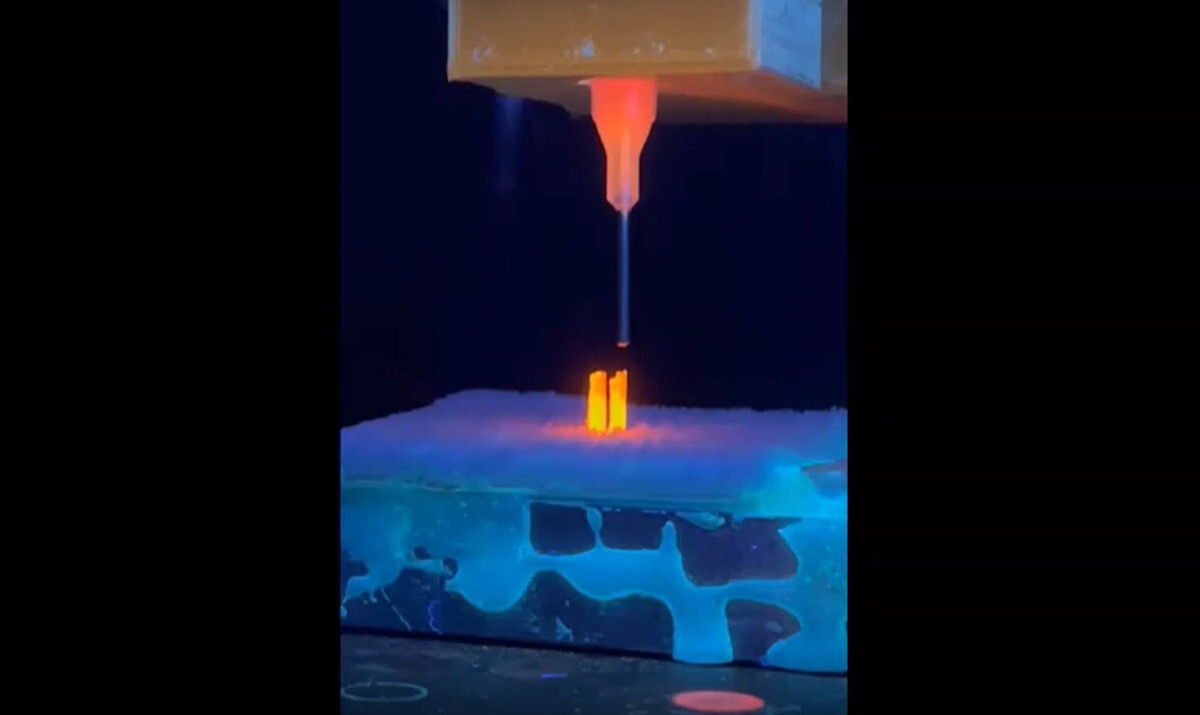
According to the researchers, the technique, which has been published in an Advanced Materials paper, takes advantage of the precision of the atomic microscope, which has a sharp cantilever that “touches” the surface of a chip with a positioning accuracy of just half a nanometre, which is about the same space between atoms in a silicon crystal. 

The researchers described how a tiny hole was drilled in the cantilever, so that when it was showered with phosphorous atoms, one would occasionally drop through the hole and embed in the silicon substrate. 

A key aspect of this was knowing precisely when an atom was embedded in the substrate so the cantilever could move to the next precise position on the array. 

Continue reading… “Researchers develop new method embedding atoms one-by-one to build quantum chip”

New Raytheon tech lets a single operator control 130 drones

By Bruce Crumley

A unit of Raytheon Technologies has not only developed a system allowing a single operator to control a swarm of 130 drones, but did so using off-the-shelf hardware and a focus on making the platform as easy to use as it is efficient.

Raytheon Intelligence and Space subsidiary Raytheon BBN created the tech permitting an individual or small group to operate 130 physical drones and 30 simulated UAVs in indoor and outdoor urban environments. The innovation was demonstrated at the US Defense Advanced Research Projects Agency’s fifth OFFensive Swarm-Enabled Tactics program, which showcases ways of deploying multiple drones in unified missions. The Raytheon BBN tech not only caught attention for its ability to enable one person to control over 100 craft at once, but also its simplified approach in doing that – and the capacity for fast, easy adaptation to new challenges.

The company began by using off-the-shelf hardware and software, then created in-house additions where any gaps arose. Reliance on widely accessible gear flowed from a major objective in the project: allowing everyday tech to ensure the final system was as familiar feeling and easy to use as it was effective in its operation.

Intentionally deprived of heavy-duty computing and intricate (and costly) sensor components, the project obliged researchers to come up with simple methods for planning and fulfilling what were often complex objectives. In doing so, the Raytheon BBN team conceived a scalable, modular, and decentralized system to manage a variety of immediate tasks and overall mission objectives, as well as a capacity to adapt to new ones in the future. 

To make that possible, the group figured out a way for the system to determine how drones in a swarm should be individually assigned, then get them working together so wider mission targets can be fulfilled most effectively. 

Continue reading… “New Raytheon tech lets a single operator control 130 drones”

This lithium-sulfur battery could quintuple electric vehicle ranges

By University of Michigan

A new biologically inspired battery membrane has enabled a battery with five times the capacity of the industry-standard lithium-ion design to run for the thousand-plus cycles needed to power an electric car.

A network of aramid nanofibers, recycled from Kevlar, can enable lithium-sulfur batteries to overcome their Achilles heel of cycle life—the number of times it can be charged and discharged—a University of Michigan team has shown.

“There are a number of reports claiming several hundred cycles for lithium-sulfur batteries, but it is achieved at the expense of other parameters—capacity, charging rate, resilience and safety.

The challenge nowadays is to make a battery that increases the cycling rate from the former 10 cycles to hundreds of cycles and satisfies multiple other requirements including cost,” said Nicholas Kotov, the Irving Langmuir Distinguished University Professor of Chemical Sciences and Engineering, who led the research.

Continue reading… “This lithium-sulfur battery could quintuple electric vehicle ranges”

Latest Stanford Research Breaks World Record In DNA Sequencing Technique Using AI That Can Help Clinicians Rapidly Diagnose Critical Care Patients

Using NVIDIA Clara, Google DeepVariant, and Oxford Nanopore Technologies sequencing, the Stanford University School of Medicine has been able to identify genetic diseases in as little as 7.5 hours. In just hours, a team of researchers from Stanford University was able to find a pathogenic variant and diagnose the rare seizure-causing genetic disorder.

This ultra-rapid sequencing research was published in New England Journal of Medicine. The proposed method set a new world record for fastest DNA sequencing technique. 

The research team accelerated both base calling and variant calling using NVIDIA GPUs on Google Cloud. They also sped up variant calling by turning it into an application with Clara Parabricks, a computational genomics application framework.

The team was able to optimize every step in the pipeline, including speeding up sample preparation and using nanopore sequencing on Oxford Nanopore’s PromethION Flow Cell. This allowed them generate more than 100 gigabytes worth of data per hour!

Continue reading… “Latest Stanford Research Breaks World Record In DNA Sequencing Technique Using AI That Can Help Clinicians Rapidly Diagnose Critical Care Patients”

World’s First Commuter Electric Plane Is Preparing for Maiden Flight

The prototype e-plane, named Alice, can accommodate nine passengers and two crew members.

By Sissi Cao 

The world’s first all-electric “commuter” plane, Alice, made by Israeli company Eviation, is preparing for its first test flight at an airport near Seattle.

A prototype of Alice was spotted on Monday at Arlington Municipal Airport north of Seattle, Washington, where it performed engine tests in preparation for a high-speed taxi test.

Alice made its first public appearance at the Paris Air Show in 2019. Eviation claimed the electric aircraft could reduce maintenance and operating costs by up to 70 percent compared with commercial jets. The latest iteration of Alice features a fly-by-wire system made by Honeywell and boasts a range of 440 nautical miles and a maximum cruise speed of 250 knots.

Alice’s “commuter” configuration can accommodate nine passengers and a crew of two. The plane can also be transformed into an “executive” configuration, designed for fewer people in business class-like seating, and a “cargo” configuration that offers a 450-cubic-foot, temperature-controlled cargo bay.

Eviation CEO Omer Bar-Yohay told FLYING magazine on Monday that Alice was only “five to six [nice weather] testing days away from starting the flight campaign.”

Eviation took Alice for a low-speed taxi test on December 17, the same date 118 years ago when the Wright Brothers test flew their first airplane. Bar-Yohay posted a video of the test on Twitter the next day and wrote, “December 17th, 1903 was a historic day as the Wright Brothers changed the world forever with the first powered flight. We just taxied Alice yesterday…no big deal.”

Continue reading… “World’s First Commuter Electric Plane Is Preparing for Maiden Flight”

World’s most powerful rocket that will launch humans to the Moon to be rolled out in February

With the Artemis mission, Nasa will land the first woman and the first person of colour on the Moon and establish a a long-term presence.

NASA¹s Space Launch System rocket will launch with Orion atop it from Launch Complex 39B at NASA¹s modernized spaceport at Kennedy Space Center in Florida. (Photo: Nasa)

Amid reports of the Artemis mission to the Moon being delayed, Nasa is preparing the mega Space Launch System (SLS) rocket for its debut flight. The maiden flight will carry Artemis-1, an uncrewed mission, setting the stage for crewed flights with Artemis missions II, III, IV and

Pegged to be the most powerful rocket in the world and the only machine capable of sending the Orion spacecraft towards the Moon, the two solid rocket boosters and four RS-25 engines produce more than 8.8 million pounds of thrust beyond Earth’s orbit and into the Moon’s.

“The Space Launch System team is not just building one rocket but manufacturing several rockets for exploration missions and future SLS flights beyond the initial Artemis launch. The Artemis I mission is the first in a series of increasingly complex missions that will extend our presence on the Moon. The SLS rocket’s unprecedented power and capabilities will send missions farther and faster throughout the solar system,” John Honeycutt, SLS program manager said.

Nasa had in 2020 said that it is targeting February 2022 for the Artemis 1 launch with the vehicle in the final phase of launch preparations. The rocket features some of the largest, most advanced, and most reliable hardware elements ever built for space exploration.A

The massive rocket will be rolled out in February with teams looking at the final date for the event. The SLS and Orion will journey to Launch Pad 39B atop the transporter-2crawler.

Continue reading… “World’s most powerful rocket that will launch humans to the Moon to be rolled out in February”

South Africa to launch three nanosatellites as part of R27 million space project

Higher Education, Science and Innovation minister Dr Blade Nzimande has announced the launch of three locally-produced nanosatellites from the US on Thursday (13 January), as part of South Africa’s new Maritime Domain Awareness Satellite (MDASat) constellation.

The MDASat will be an operational constellation of nine cube satellites that will detect, identify and monitor vessels in near real-time, in support of South African maritime domain awareness.

The launch of the first three satellites (MDASat-1) follows three years after the launch of the most advanced South African nanosatellite to date, ZACube-2, which was developed as a technology demonstrator for the MDASat constellation.

“Since its launch in 2018, ZACube-2 has been providing cutting-edge very high frequency (VHF) data exchange communication systems to the country’s maritime industry, as a contribution to Operation Phakisa,” Nzimande said.

The minister said his department had invested R27 million over three years in the development of the MDASat constellation.

Continue reading… “South Africa to launch three nanosatellites as part of R27 million space project”

Scientists Develop World’s Smallest ‘easy-to-use’ Antenna Using Human DNA

Calling it an ‘easy-to-use device’, the scientists said that this nanoantenna will help scientists identify new drugs and better understand nanotechnologies.

By Harsh Vardhan 

A team of chemists from the University of Montreal has designed the world’s smallest antenna using human DNA, which is the building block of genetic material and measures 20,000 times smaller than a human hair. Calling it an ‘easy-to-use device’, the scientists said that this nanoantenna will help scientists identify new drugs and better understand natural and human-designed nanotechnologies. Fitted with fluorescent molecules at the end, this nanoantenna has basically been designed to monitor the motions of proteins. Professor Alexis Vallée-Bélisle, who is also the study’s senior author said as per the University’s official release.

Continue reading… “Scientists Develop World’s Smallest ‘easy-to-use’ Antenna Using Human DNA”

Nuro’s newest autonomous delivery bot is designed for the masses

There’s even an airbag on the exterior

By Kirsten Korosec

Nuro showed off Wednesday one of the final pieces of its commercial autonomous delivery strategy.

The startup, which has raised more than $2.13 billion since former Google engineers Dave Ferguson and Jiajun Zhu founded the company in June 2016, unveiled a third-generation electric autonomous delivery vehicle designed for commercial operations and manufactured in partnership with BYD North America.

Nuro has dropped the alpha-numeric nomenclature (R1 and then R2) for this delivery bot that is designed to haul packages, not people. Instead, the vehicle is called “Nuro” — a self-titled album of sorts meant to introduce the robot to the masses and a name that illustrates where this flagship model sits within the company. If it’s not clear, the “Nuro” is at the top.

The Nuro bot is not a sidewalk delivery bot. This new generation, and all of Nuro’s previous iterations, are meant for the road.

Continue reading… “Nuro’s newest autonomous delivery bot is designed for the masses”

unity-and-hyundai-partner-to-build-virtual-twin-of-automotive-manufacturing-facility

 BY MAI TAO 

Unity, a platform for developing games and other 3D content, and Hyundai Motor Company have agreed a partnership to jointly design and build what they describe as “a new metaverse roadmap and platform for a meta-factory”.

The partnership will realize Hyundai’s vision of becoming the first mobility innovator to build a meta-factory, a digital-twin of the company’s physical plant, supported by a metaverse platform.

The introduction of Meta-factory, will allow Hyundai to test numerous scenarios virtually, in order to assess, calculate and create optimal operation conditions, without employees needing to be onsite. 

The collaboration culminates in a real-time 3D virtual platform, which will reach a broad group of Hyundai Motor Company customers, offering them a more comprehensive range of services across sales, marketing and customer experience.

Meaning, consumers will now be able to trial, test and engage various auto related solutions digitally, long before choosing which to transfer to physical vehicles.

Continue reading… “unity-and-hyundai-partner-to-build-virtual-twin-of-automotive-manufacturing-facility”

How This Hydrogen-Powered Aircraft Could Kickstart Zero-Carbon F1 Racing

Maca’s Carcopter S11, shown at CES, will be the only air racer powered by hydrogen fuel cells. The company says it’ll be race-ready in 2023. 

By J. GEORGE GORANT

Racers, start your fuel cells!

The hydrogen-powered Carcopter S 11 may be slow out of the gate compared to some of its competitors, but it has definitely joined the sprint to become the first alternative-powered VTOL racer. Competitor Alauda not only has a working full-scale prototype of its Airspeeder, it has already staged a short drag contest between two remotely controlled models, establishing itself as the early frontrunner to create a zero-carbon F1 type circuit.

But French company Maca announced its plans for the Carcopter a year ago, and showed off a one-third scale model last week at CES.

Continue reading… “How This Hydrogen-Powered Aircraft Could Kickstart Zero-Carbon F1 Racing”
Discover the Hidden Patterns of Tomorrow with Futurist Thomas Frey
Unlock Your Potential, Ignite Your Success.

By delving into the futuring techniques of Futurist Thomas Frey, you’ll embark on an enlightening journey.

Learn More about this exciting program.