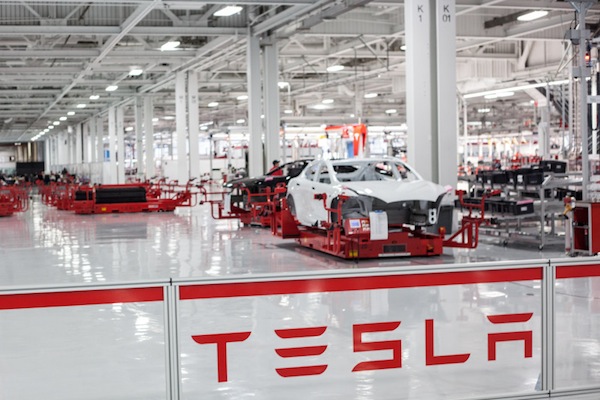
Cheaper robots may help move some car manufacturing work away from low-cost locations like China back to factories in Germany and North America, Donald Walker, Chief Executive of auto supplier Magna told Reuters.
It has been confirmed, Apple is building its own autonomous car. With Apple’s entry, it’s clear. The automotive industry has opened up again. The manufacturers we’ve become so familiar with over the last century — Daimler, Ford, BMW, Volkswagen, Toyota, and General Motors — aren’t necessarily the vendors we’ll be thinking of in the future. Competition is increasingly going to come from tech firms like Tesla, Google, and Apple, each of whom is building towards a future of autonomous vehicles that are basically highly advanced computers on wheels.
In California, Tesla has knocked off Toyota as the biggest auto employer in the state. Tesla employs over 6,000 people to the Japanese company’s 5,300. That lead is only likely to grow, as the EV manufacturer prepares to add another 500 jobs by the end of the year, and as Toyota begins its relocation to its new North American headquarters in Texas. The news comes barely a week after the company announced a $50 million loss during the first quarter of 2014.
Google might want to partner its technology with auto manufacturers rather than making and selling the cars itself.
Almost all the world’s automotive manufacturers are scrambling to develop self-driving cars. But, it appears, the world would rather buy a self-driving car made by a tech company. Consumers are more likely to splurge on a self-driving car made by Mercedes-Benz than Nissan; they’re even likelier to buy one made by the likes of Google and Apple, according to a study released by audit and advisory firm KPMG on Oct. 10.
Tesla has just unveiled battery swapping technology for an electric car to a live audience. The system isn’t all that technically complicated, but it’s a newish concept in the automotive industry.
More people bought a Tesla Model S, the $70,000 (and up) electric car, in the first quarter of 2013 than bought any of the similarly priced gasoline-powered cars from the top three German luxury brands, according to data from LMC Automotive. About 4,750 buyers bought a Model S while just over 3,000 people bought Mercedes’ top-level sedan. (Video)
New breakthroughs in connecting cars to the cloud (and eliminating the need for car ownership) show what a better future for cars might look like.
The global automotive industry is on a run by all accounts. Globally, sales are surging. Advances in hybrids, electric vehicles, and even conventional petrol engines are delivering eye-popping mileage gains.
While driving we can get connected to the world through the internet.
Everyday the world of automotive technology changes. Companies are designing very advanced in-car technology that needs to be secure but also easily usable to their customers. Now a days big automobile brands introduce the internet facility and secure navigation systems in cars. This is very beneficial to the consumers.
Futurist Thomas Frey: In 1954, Brook Stevens, a well-known industrial designer gave a keynote speech at an advertising conference titled “Planned Obsolescence.”
By his definition, planned obsolescence was “instilling in the buyer the desire to own something a little newer, a little better, a little sooner than necessary.”
China alone is forecast to see auto sales rise to 30 million units by 2020, 80 percent above the previous U.S. record.
The BMW 3-Series sedan might look like the conventional BMW but a closer inspection reveals it’s been stretched 11 centimeters — about 4 inches for metrically challenged Americans — almost all of that going to rear-seat occupants.
2013 Ford Shelby GT500 includes a new carbon fiber driveshaft.
If dieters think they have it hard, consider what Ford Motor is going through. Ford has created a goal of cutting 750 pounds of ugly, dangerous fat out of every car by the end of the decade.
A graduate student studying the effects of advanced biodiesel fuel on a John Deere engine.
Silicon Valley is recognized as the spawning ground of technology start-ups in the world of computers. Lower Manhattan has long been the place to set up shop for financial institutions. And of course the epicenter of American automaking is Detroit. Detroit has been evolving in recent times from a manufacturing center to a headquarters city. Still, there is no guaranty that its dominance is permanent.