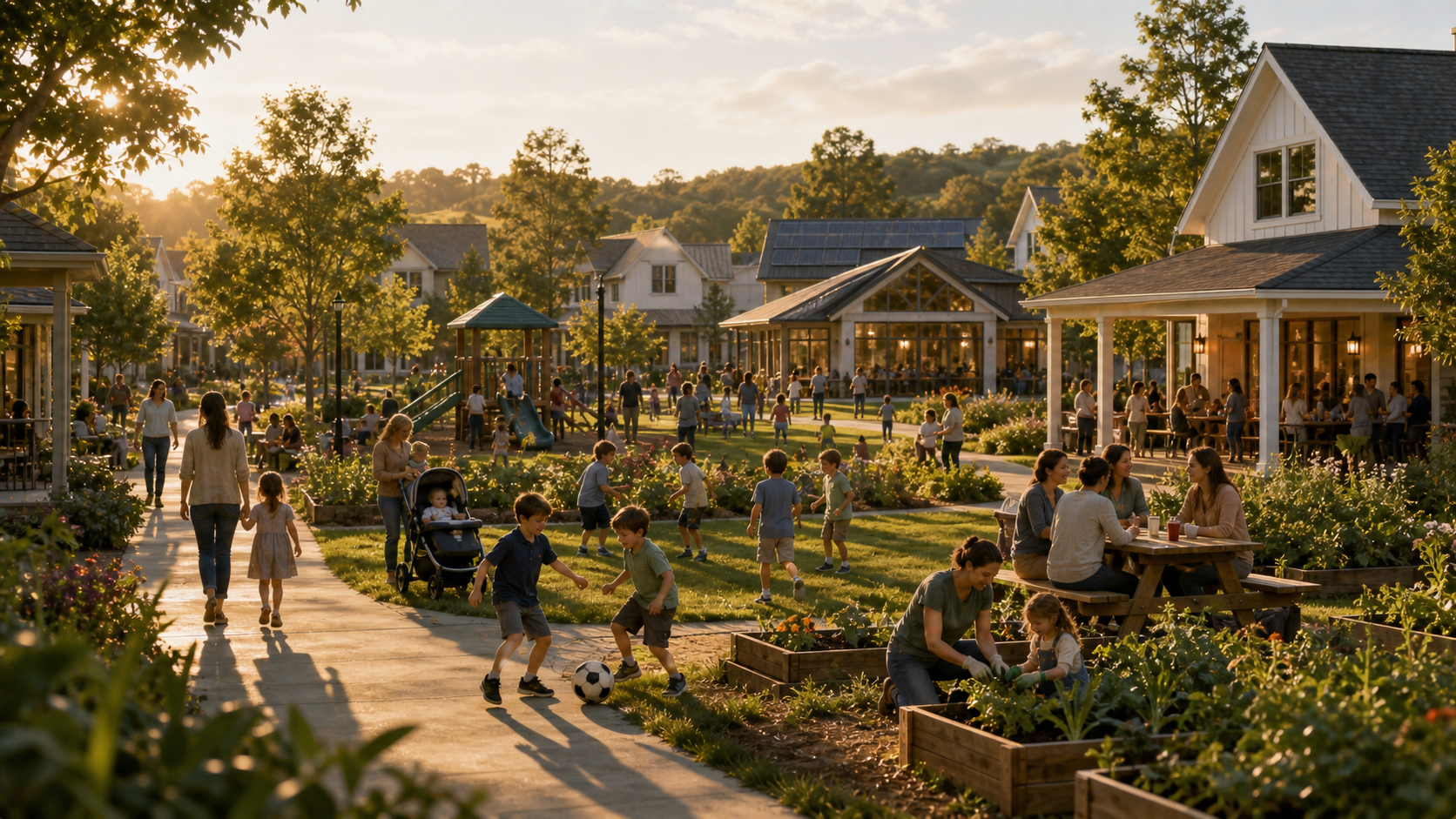
The Vitalists Part 6 – The Vitalist Colony

What happens when the vow becomes the neighborhood — and the neighborhood becomes the proof of concept

By Futurist Thomas Frey

Part 6 of 6: The Colony

Every transformative idea in human history has had a moment when it stopped being a philosophy and became a place.

The Puritan settlers didn’t write treatises about the ideal community and wait for governments to implement them. They built the community, in a specific geography, with specific people, under specific rules they had chosen together. The kibbutz movement didn’t lobby the Israeli government for agricultural reform before demonstrating what communal farming could produce. It built farms, on actual land, and let the results make the argument. The Shakers, the Oneida community, the Hutterite colonies, the cooperative villages of Scandinavia — whatever their specific ideology, they shared a recognition that ideas about how to live together only become real when someone actually lives together that way.

The Vitalist Colony is that moment for this series.

Not a policy proposal. Not a cultural advocacy campaign. Not an institutional framework waiting for governments to adopt it. A place — a designed, intentional, physically real community where the Vitalist vocation is the organizing principle of daily life, where the infrastructure described in the preceding five columns is built and operational, and where the results are visible and measurable and available to anyone who wants to evaluate them.

The Colony is the proof of concept. And proof of concepts, in the history of social transformation, have a track record that no amount of policy argument can match.

Continue reading… “The Vitalists Part 6 – The Vitalist Colony”

The Vitalists Part 3 – Incentive Structure

How Society Pays for the Most Important Job in the World

By Futurist Thomas Frey

Part 3 of 6: The Incentive Structure

A vocation without compensation is a hobby. A hobby does not reverse a demographic collapse.

Let me offer a thought experiment that I find clarifying every time I run it. Imagine that tomorrow morning the nursing profession simply stopped. Every registered nurse in every country simultaneously decided that the compensation, the recognition, and the working conditions were no longer sufficient to justify continuing. The crisis that would follow — the collapse of hospital function, the surge in preventable deaths, the grinding halt of elective care — would be front-page news within hours and a declared national emergency within days.

Now run the same thought experiment with mothers.

Imagine that the women currently raising the next generation of citizens decided, collectively, that the compensation, the recognition, and the conditions were insufficient. The crisis that follows is slower, quieter, and far more total. It is, in fact, the crisis already unfolding in slow motion in every developed nation on earth. It simply does not make the front page because the consequences arrive a generation after the choices that cause them.

The Vitalist framework exists to close that gap — between the consequence and its cause, between the value of the work and its compensation, between what we say we believe about the importance of children and what our actual institutional structures communicate about it. This column is about the incentive architecture that makes the Vitalist vocation not merely honorable but economically viable as a full-time profession — and about the lessons we can draw from the countries that have spent the last two decades running natural experiments in exactly this territory.

Continue reading… “The Vitalists Part 3 – Incentive Structure”

By 2050 Our Planet Could Be ‘Unrecognizable’

Earths city lights

This image of Earth’s city lights was created with data from the Defense Meteorological Satellite Program (DMSP) Operational Linescan System (OLS).

A growing, more affluent population competing for ever scarcer resources could make for an “unrecognizable” world by 2050, researchers warned at a major US science conference Sunday.


Continue reading… “By 2050 Our Planet Could Be ‘Unrecognizable’”