
How Society Pays for the Most Important Job in the World
By Futurist Thomas Frey
Part 3 of 6: The Incentive Structure
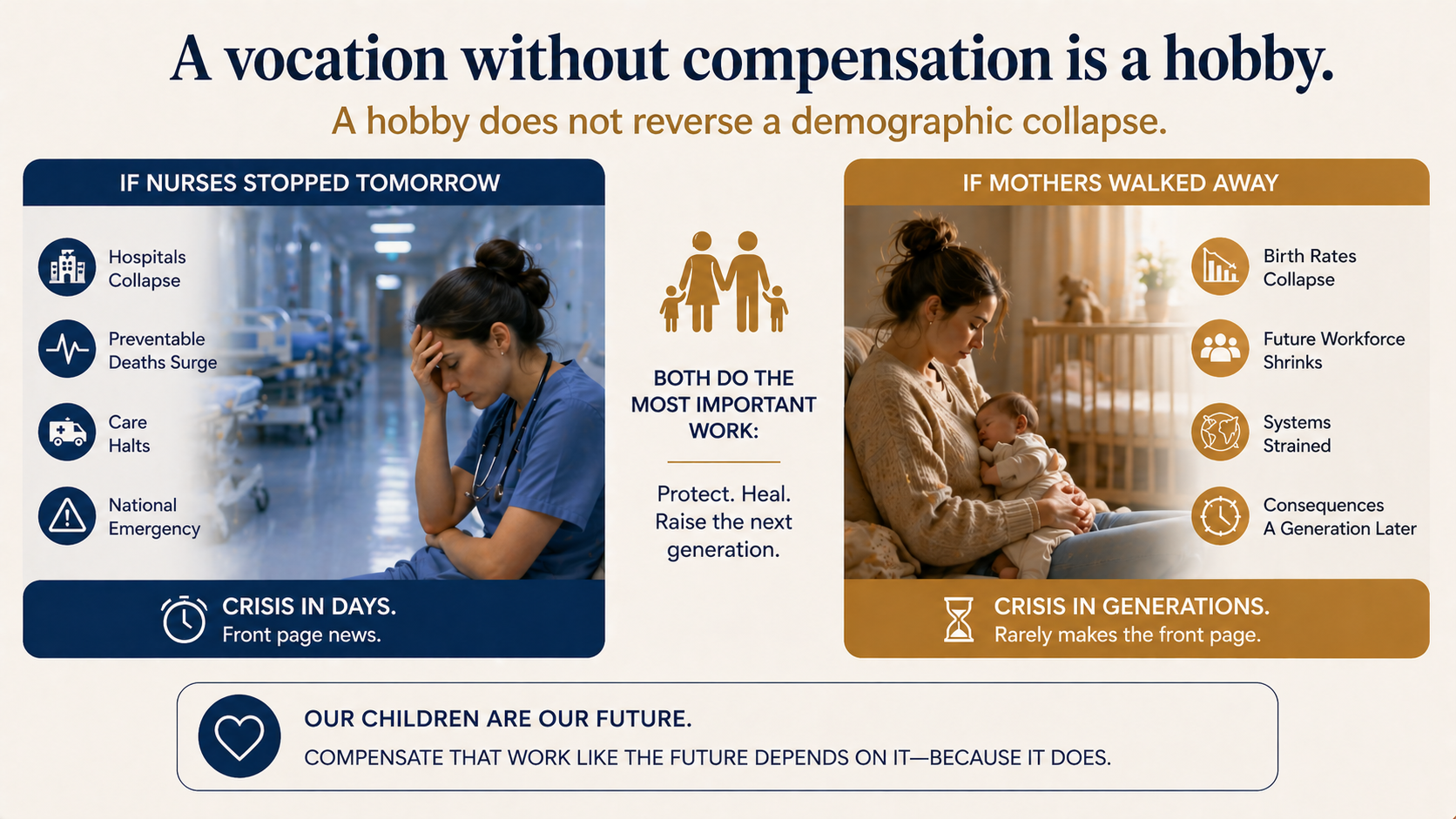
A vocation without compensation is a hobby. A hobby does not reverse a demographic collapse.
Let me offer a thought experiment that I find clarifying every time I run it. Imagine that tomorrow morning the nursing profession simply stopped. Every registered nurse in every country simultaneously decided that the compensation, the recognition, and the working conditions were no longer sufficient to justify continuing. The crisis that would follow — the collapse of hospital function, the surge in preventable deaths, the grinding halt of elective care — would be front-page news within hours and a declared national emergency within days.
Now run the same thought experiment with mothers.
Imagine that the women currently raising the next generation of citizens decided, collectively, that the compensation, the recognition, and the conditions were insufficient. The crisis that follows is slower, quieter, and far more total. It is, in fact, the crisis already unfolding in slow motion in every developed nation on earth. It simply does not make the front page because the consequences arrive a generation after the choices that cause them.
The Vitalist framework exists to close that gap — between the consequence and its cause, between the value of the work and its compensation, between what we say we believe about the importance of children and what our actual institutional structures communicate about it. This column is about the incentive architecture that makes the Vitalist vocation not merely honorable but economically viable as a full-time profession — and about the lessons we can draw from the countries that have spent the last two decades running natural experiments in exactly this territory.
Why Cash Payments Alone Have Failed
The first thing any serious analysis of pro-natalist policy must confront is the graveyard of well-funded cash payment programs that have moved the birth rate very little.
Hungary’s family support system has been among the most generous in the world for years — loan forgiveness, direct payments, housing subsidies — and has produced a fertility rate that remains well below replacement. Singapore has spent billions. Russia has offered Maternity Capital payments since 2006. South Korea, facing the most severe demographic collapse in recorded history, spends more per capita on pro-natalist incentives than almost any country on earth and posted a fertility rate of 0.72 in 2023. The money is being spent. The births are not following.
The reason is not mysterious. A one-time payment or even a multi-year stipend addresses the question of whether a family can afford a child. It does not address the deeper structural reality that has made the bearing and raising of children incompatible with the lives that educated women in developed countries have built for themselves. It does not address:
- The career penalty that makes full-time motherhood an economically catastrophic long-term choice
- The social isolation of early motherhood in the atomized suburban household
- The absence of extended family and community networks that once distributed the labor of raising children across a broader set of adults
- The cultural message — transmitted through every professional and institutional structure in the developed world — that a woman who makes children her primary vocation has settled for less
The Vitalist framework addresses all of these. Not a payment layered on top of an unchanged structure, but a complete restructuring of what the vocation is, what it requires, and what it gives back.

What the World Has Already Tried — and What It Teaches Us
The international evidence offers a clear pattern for those willing to read it honestly.
Estonia introduced wage-replacement parental leave at 100% of prior salary for 435 days — among the most generous in the world, applying to both parents with strong incentives for fathers. The result: a fertility rate stabilized near 1.6, making Estonia one of the few EU countries to show sustained improvement over a decade.
Sweden built a comprehensive parental insurance system with heavily subsidized childcare, flexible return-to-work structures, and strong cultural normalization of fathers as equal caregivers. The result: fertility near 1.7, above the EU average but still below replacement — demonstrating the limits of workplace-focused policy alone.
Hungary offered a lifetime income tax exemption for mothers of four or more children, large housing loans forgiven at the third child, and direct cash transfers. Among the most expensive pro-natalist programs ever attempted. The result: modest improvement from 1.23 to roughly 1.55 — significant cost, limited return.
South Korea spent over $200 billion since 2006 on cash payments, childcare subsidies, and housing support. The result: a fertility rate of 0.72 in 2023 — the lowest ever recorded for any country in human history. Conclusive proof that financial incentives without systemic cultural redesign do not work.
The lesson is not that incentives don’t matter. They do. The Estonian model shows that comprehensive, well-designed support can stabilize a declining rate. The lesson is that incentives designed as additions to an unchanged system produce marginal results, while incentives designed as the foundation of a redesigned system produce something qualitatively different.
The Vitalist framework is a redesigned system. The compensation structure it requires is not a top-up. It is the economic spine of an entirely new professional identity.
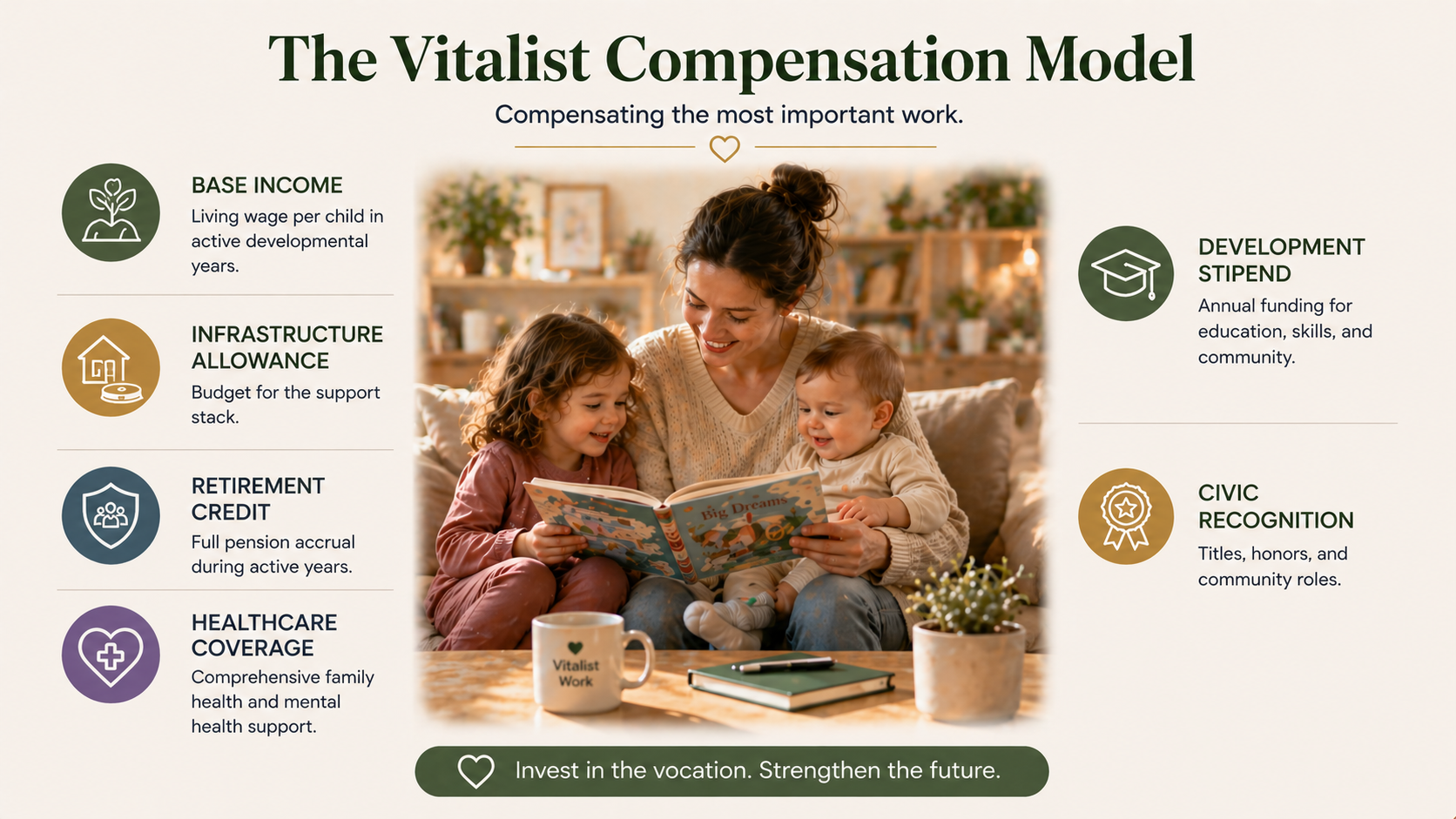
The Vitalist Compensation Model
What should a Vitalist actually be paid, and by whom, and for how long? These questions require an honest answer: we don’t have a final design yet, and anyone who claims otherwise hasn’t taken the complexity seriously. What I can offer is a framework — the components that any serious compensation model must address.
Base Income — A living wage paid per child in active developmental years, indexed to local cost of living and adjusted as the child ages. Not a poverty-level stipend. A professional salary reflecting the economic value of the work being done.
Infrastructure Allowance — A dedicated budget for the support stack: nanny hours, robotic household tools, educational materials, and community volunteer coordination. Separate from the base income and designated exclusively for the work.
Retirement Credit — Full pension contribution accrual throughout the active Vitalist years, eliminating the retirement penalty that currently makes full-time caregiving an economically catastrophic long-term choice.
Healthcare Coverage — Comprehensive maternal and family health coverage treated as an occupational benefit, not a personal expense — including mental health support, which is not a luxury in a demanding full-time caregiving role.
Development Stipend — Annual funding for the Vitalist’s own continuing education, skills development, and community participation — recognizing that a Vitalist who is not growing cannot model growth for her children.
Civic Recognition — Formal titles, honors, and community roles that communicate social status equivalent to other professions of comparable consequence — because money alone does not confer the cultural recognition the vocation deserves.
Who Pays — and Why It Is a Sound Investment
The funding question will be raised first by every fiscal conservative and every skeptic, and it deserves a direct answer.
The Vitalist compensation model is funded by the same governments that are currently watching their pension systems become mathematically insolvent as the worker-to-retiree ratio collapses, their military recruitment pools shrink, their tax bases narrow, and their cultural institutions find fewer and fewer young people to pass their inheritance to. The actuarial math of a declining birth rate is not ambiguous. Every child successfully raised to productive adulthood in a developed country generates, over a lifetime of taxation and economic contribution, a return to the public treasury that exceeds the cost of that child’s entire upbringing by a substantial multiple.
We already pay for demographic collapse. We might as well pay instead for demographic renewal — it is considerably cheaper.
Nobel laureate economist James Heckman has spent decades documenting the return on investment of early childhood intervention. His numbers are stark: every dollar invested in the quality of early childhood caregiving returns between seven and thirteen dollars in reduced costs of remediation, criminal justice, healthcare, and social support over the child’s lifetime. The Vitalist is not a budget line item. She is the highest-returning investment a government can make in its own future.
The Legal Architecture
Compensation without legal protection is fragile. The Vitalist framework requires, alongside its financial components, a legal architecture that treats the vocation with the same seriousness the law extends to other professions.
This means formal professional recognition — a defined legal status for the Vitalist that establishes her rights, her obligations, the standards of practice she commits to, and the protections she receives. It means contractual clarity about the relationship between the Vitalist and the funding structures that support her. And it means, critically, portability — the ability to maintain professional status, pension accrual, and healthcare coverage regardless of whether the Vitalist is married or unmarried, regardless of how she conceives, and regardless of which jurisdiction she lives in.
The Vitalist vocation is a commitment to children and country, not to a specific family structure or a specific municipality. The legal framework must reflect that breadth.
The details — the specific statutes, the certification process, the standards of practice, the accountability structures — are exactly the kind of fine-grained design work that cannot be done in a single column and that the final installment of this series will propose a process for doing collectively. What I can say with confidence is that the legal framework is not optional. Without it, the compensation model is a subsidy. With it, it is a profession. The difference between those two things is the difference between a policy that might shift behavior at the margins and a cultural transformation that reframes what it means to be a woman with ambition in the twenty-first century.
One of history’s most instructive parallels here is again Muhammad Yunus and the Grameen Bank — not for the financial mechanism but for the insight it embodies. Yunus understood that transformative support requires more than money. It requires a framework of commitment, accountability, and community that orients the recipient toward a different kind of future. The Vitalist compensation model is built on exactly that logic. The income is the mechanism. The redesigned vocation is the outcome.
If raising children matters — and the demographic data makes clear that it matters more than almost anything else a society can invest in — then it must be treated as essential work. Not invisible labor. Not a private choice that society generously subsidizes. A profession, with all the recognition, compensation, and institutional seriousness that word implies.
Because the alternative is not a policy debate. The alternative is already happening. And it is very quiet, and very slow, and by the time it is visible to everyone it will be far too late to reverse.
Next: Part 4 — The Children the Vitalist Raises. The vow is to raise the best children possible — loyal to their country, committed to their community, and equipped for a world that will demand more of them than any previous generation has been asked to give. What does that actually mean as a developmental philosophy, and what does it look like in practice?
Related Reading
Fertility Rates — OECD Family Database
OECD — The most comprehensive cross-national dataset on fertility trends, parental leave policies, and family support expenditure across the developed world — the essential empirical foundation for evaluating what pro-natalist policy does and doesn’t accomplish
The Lifecycle Benefits of an Influential Early Childhood Program
The Heckman Equation · University of Chicago — James Heckman’s landmark quantification of the return on investment from quality early childhood care — the most rigorous economic argument available for funding the Vitalist vocation as a public investment rather than treating it as a private family expense
The Fiscal Case for Pro-Natalist Policy
Brookings Institution — The budget-level analysis of what demographic decline costs governments in pension liabilities, shrinking tax bases, and reduced military and economic capacity — framing pro-natalist investment not as social spending but as actuarially sound fiscal policy