The First Electric Airplane That You Can Fast-Charge Like Your Tesla Is Coming Soon

Diamond Aircraft’s eDA40 can be recharged in about 20 minutes. You just can’t do it at your local Walmart. 

By J. GEORGE GORANT

Diamond Aircraft’s eDA40 is the result of several years’ worth of experimentation and testing of both hybrid and pure electric systems. The Austrian manufacturer is now poised to move forward with an electrified version of its DA40, a single-engine trainer aircraft that’s already certified. The eDA40’s twist is simple but practical: It plugs into DC fast-charging systems.

The charging apparatus is supplied by Electric Power systems, which develops certified systems for Aerospace, Defense, Automotive and Marine. The eDA40 will be the first electric plane that is Part 23 certified by the FAA and Europe’s aviation safety agency, EASA, with this charging option. That doesn’t mean you can land in the parking lot of your nearest big-box store and plug into one of the auto chargers. But in theory, you could.

Continue reading… “The First Electric Airplane That You Can Fast-Charge Like Your Tesla Is Coming Soon”

DARPA moving forward with development of nuclear powered spacecraft

n the Demonstration Rocket for Agile Cislunar Operations (DRACO) program, DARPA plans to develop a nuclear thermal rocket engine.

by Sandra Erwin 

The next phase of DRACO is a ‘full and open competition’

WASHINGTON – The Defense Advanced Research Projects Agency on May 4 issued a solicitation for proposals for the next phase of a demonstration of a nuclear powered spacecraft. 

The project, called Demonstration Rocket for Agile Cislunar Operations (DRACO), started over a year ago when DARPA selected a preliminary design for a rocket engine reactor developed by General Atomics, and chose two conceptual spacecraft designs by Blue Origin and Lockheed Martin.

The next phases of the program will focus on the design, development, fabrication and assembly of a nuclear thermal rocket engine. DARPA will conduct a “full and open competition” so this opportunity is not limited to the companies that participated in the first phase, a spokesperson told SpaceNews. Proposals are due Aug. 5.

The goal is to launch a flight demonstration of nuclear thermal propulsion in fiscal year 2026.

Continue reading… “DARPA moving forward with development of nuclear powered spacecraft”

Ep. 86: Space exploration (and why it matters) with sarah cruddas

Watch our interview with Sarah Cruddas on Youtube or catch it on the Futurati Podcast.

Sarah Cruddas is a space journalist, international TV host, and award winning author. She has an academic background in astrophysics and is a global thought leader in the growing commercial space sector.

Pairs Well With

Continue reading… “Ep. 86: Space exploration (and why it matters) with sarah cruddas”

Google has bought Raxium, a firm building 3D displays without the need for eyewear

By Paul Hill

Google has announced that it has bought Raxium, a company that has been developing single panel MicroLED display technologies for the last 5 years. According to the search giant, the technologies that Raxium has developed will be used in next-gen technology and offers “miniaturized, cost-effective and energy efficient high-resolution displays”.

Raxium is based in Fremont, California and will now be joining Google’s Devices & Services team where it will carry on its work and integrate products into future Google hardware. The announcement put out by Google was very brief and didn’t share any more details regarding what the Raxium team would now be working on.

Continue reading… “Google has bought Raxium, a firm building 3D displays without the need for eyewear”

This is Continental’s robot battery that could change the electric car market

This robotic battery can be installed in almost any electric vehicle and will facilitate and optimize charging.

The electric vehicle industry is advancing by leaps and bounds. Practically all car manufacturers are developing models that can be competitive in a market that is still dominated by Tesla. One factor that has limited the development of this technology is the batteries , their charging time and the autonomy they give the vehicle. In addition, there is the dependence on cables and outlets to be able to charge them.

Continental , the German firm known worldwide for making tires, is working on developing a wireless-charging robotic battery alongside Volterio , an Austria-based startup. The device has two parts: one that is fixed to the car (the one that receives the energy), and another that moves on the ground under the car (the one that sends the electrical charge). For an electric vehicle to charge correctly, the two parts must be aligned, which does not happen if the driver parks incorrectly. So there is power loss and the charging is not as efficient. Continental’s robot is capable of locating the precise place where it has to be positioned to achieve efficient loading, and it does so in an automated manner.

Continue reading… “This is Continental’s robot battery that could change the electric car market”

Why Biomining Could Be The Future Of Space Society

As investment in space technology booms, a trusted mineral extraction technique is under the microscope

By Joseph Smith

Investment in space-based technologies is at an all-time high. An estimated $17.1 billion was invested into 328 space companies by venture capital firms in 2021. Wall Street forecasters project that the ‘space economy’ will be worth trillions within the next 20 years and investment into space infrastructure has already grown by 50% since 2020 with $14.5 billion invested just last year.

One sector that is at the forefront of this rapid growth in space-related industries is space mining. We are now entering an era of commercial resource extraction in space and countries are now competing to gain access to the vast wealth of rare minerals available across our solar system and beyond.

The United States has become the first nation to ratify a law that recognizes property rights regarding materials acquired in space. Luxembourg and the United Arab Emirates are not far behind in this respect and are rapidly getting closer to implementing laws regarding space resource extraction. Many other countries, including China and Russia, have also made space mining a matter of national importance.

The potential financial benefits of mining in space are significant. The major asteroid belt in our solar system alone is so rich in mineral wealth that its value would give each person on earth $100 billion. For decades, scientists have puzzled over techniques to extract this wealth from space. However, the technology required to harvest these riches may have been under our noses the entire time in the process of biomining.

Already widely used to extract valuable minerals such as copper, gold, zinc, and cobalt on earth, biomining is a process whereby specific types of microbes leach these valuable metals directly from ores below the earth’s surface. It has been proven to be successful on an industrial scale across Chile. Biomining developments such as Lo Aguirre produced over 300,000 tonnes of copper between 1980 and 2002. Other mines in Chile have exclusively been using bioleaching to extract minerals since 1994.

Continue reading… “Why Biomining Could Be The Future Of Space Society”

World’s fastest electric car charger in Norway

ABB and Eviny have collaborated on the first installations of ABB’s Terra 360. ABB’s Terra 360 is now available for use by the country’s growing community of EV drivers at the Oasen Shopping Centre, Bergen and in the Norwegian ski resort of Geilo.

The pilot installations, which will be followed by more widespread roll out across Norway and Sweden, serve as a further demonstration of the ability of ABB charging technology to perform in extreme weather conditions and enable sustainable transport solutions in the widest range of locations.

The charging stations can simultaneously charge up to two vehicles with dynamic power distribution. With a maximum output of 360kW, the Terra 360 is a future proof solution capable of fully charging an electric car in 15 minutes or less.

Frank Muehlon, CEO of ABB E-mobility explains: “Having recently unveiled the Terra 360 to the world, these are truly landmark launches which we are delighted to partner with Eviny on. Norway is setting the global standard when it comes to the e-mobility transition, and we are excited to hear the reaction of EV drivers in one of the most advanced nations for EV adoption.”

Continue reading… “World’s fastest electric car charger in Norway”

Korean Startup Mars Auto is all set to launch Self-driving Trucks next year

Mars Auto has partnered with Logi Square to test the efficiency of the pilot operation by expanding it to ten semi-large trucks on the Gyeongbu Expressway section from the metropolitan area to Busan. 

By Dipayan Mitra

Korean self-driving technology developing startup Mars Auto announces that it plans to launch its self-driving trucks next year. Mars Auto has successfully tested its first self-driving truck. 

The company’s vehicle was equipped with a camera and a computer, allowing it to drive securely for 5 hours and 30 minutes on the highway from Seoul to Busan. 

Additionally, the movements of the autonomous truck did not require any human interference. Mars Auto has partnered with Logi Square to test the efficiency of the pilot operation by expanding it to ten semi-large trucks on the Gyeongbu Expressway section from the metropolitan area to Busan. 

Continue reading… “Korean Startup Mars Auto is all set to launch Self-driving Trucks next year”

Forget VR headsets – Apple now has a patent for a VR car

By Hamish Hector 

Apple’s ready to take us on a wild ride

A new Apple patent hints at how the company could use VR to entertain passengers traveling in an autonomous car — while also helping reduce motion sickness to boot.

The released schematics reveal how a driverless car and a VR headset could work together to keep travelers entertained on their journeys. VR headset wearers could be dropped into a game, or they could invite friends and celebrities to be their virtual travel companions.

On the business side, the patent (first mentioned on PatentlyApple) also showed how users could attend a business meeting while on the move – on the back of a flatbed truck no less. Rather than being confined to a virtual meeting room, you’d be able to look out at passing scenery, so you’d be less likely to become disoriented and motion-sick.

Continue reading… “Forget VR headsets – Apple now has a patent for a VR car”

How patient-on-a-chip tech could be the future of drug discovery

By Ben Hargreaves

Testing drug compounds on a chip designed to mimic human organs sounds closer to science fiction than reality, yet the technology already exists and is already being put to use. Ben Hargreaves discovers how the technology could provide more accurate safety predictions and even discover new treatments.

The limits of animal models in drug discovery are well known. If you are reading this then you are likely not a mouse, and as a result, will react to drug compounds differently. In testing new treatments, what is promising in animal models may not transfer particularly well to humans, which helps to explain why there is a 90% failure rate during clinical development. The low rate of success is one of the contributors to the high cost and the slow R&D process that takes promising compounds through early testing and into the clinic. Moreover, there is the question of the ethics of using animals, numbering in the millions each year, in clinical trials, which sees most euthanized at the end of the process.

The challenge that the pharma industry faces is the lack of better alternatives to animal models. There are existing alternatives, with one being human cell culture systems, which provide an environment that is closer to that which will eventually receive treatment but do not contain the complexity of a complete organism. An organoid system approach takes self-organising clusters of cells that grow in three dimensions, closely resembling real tissue and organs. Despite the potential, there are limiting factors such as the need to provide optimal culturing conditions for different types of organoid, with each potentially containing a range of cells types. An alternative to these systems is one that is growing in popularity and commercial application, a technology referred to as ‘organ-on-a-chip’.

Continue reading… “How patient-on-a-chip tech could be the future of drug discovery”

Meet Robosweeper: the autonomous EV truck that cleans and sanitises roads

BY MAXENE LONDON

Robosweeper, WeRide’s second purpose-built self-driving vehicle / WeRide YouTube

The Robosweeper is a new, fully electric and driverless truck that cleans and sanitises public roads, creating a solution for keeping highly populated city streets clean. 

Designed in collaboration with WeRide and Yutong Group, the Robosweeper cleans the roads by sweeping, sprinkling, and spraying disinfectant from its rear and sides. 

Following the pandemic, this sort of function is highly sought after, particularly in densely populated cities like China, which recently implemented one of the world’s most restrictive policies with the goal of having zero covid-19 cases. 

The vehicle looks like a futuristic concept bus, but it’s actually production-ready. It has heavily tinted windows which hide the lack of a driver in the cabin, and sensors that stick out of the body of the vehicle and allow for Level 4 autonomy. 

Continue reading… “Meet Robosweeper: the autonomous EV truck that cleans and sanitises roads”

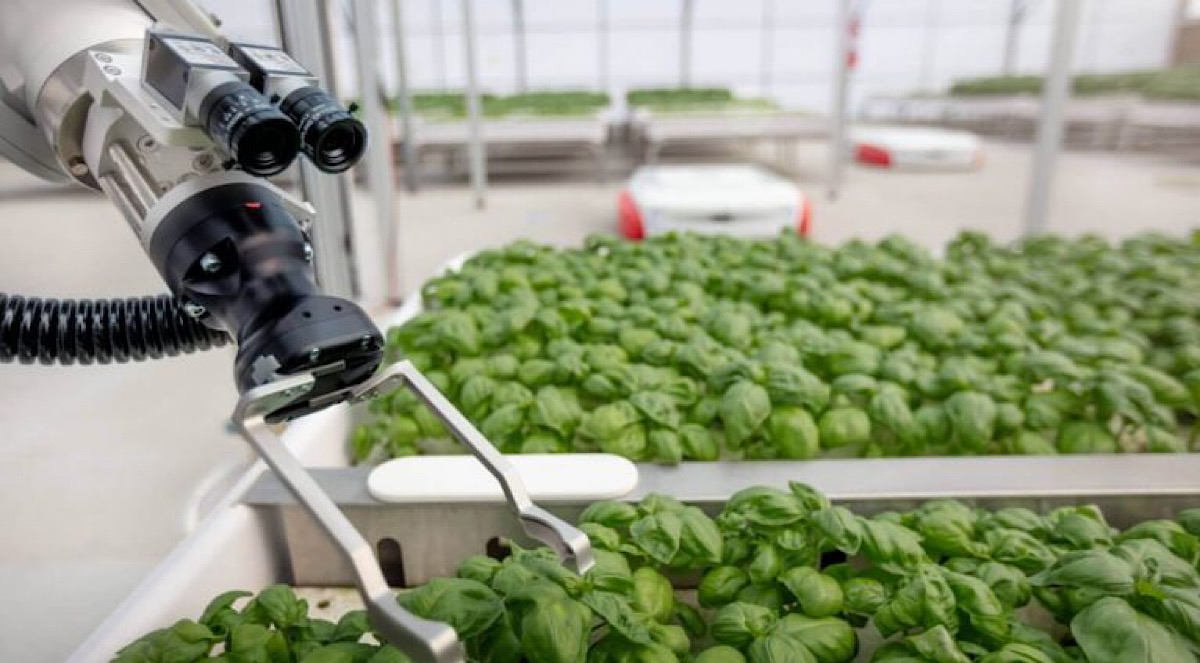
This California Greenhouse is Run by Robots

(Photo: Iron Ox)A farm technology startup is using robots and artificial intelligence to tackle sustainability concerns in agriculture.  

By Adrianna Nine

Northern California-based Iron Ox was born from the realization that conventional American agriculture negatively impacts the environment in a multitude of ways. The type of farming most of us are familiar with uses as much as 70 percent of the world’s fresh water supply and produces up to 1.19 gigatons of greenhouse gasses every year. There’s also the issue of wasted produce, with up to 40 percent of fruits and veggies ending up in a landfill before ever reaching a consumer. While companies like Imperfect Foods, Uglies, and Misfits Market aim to offset this by proudly selling produce your typical grocery store won’t, these businesses don’t address the root of the problem: how the produce is grown.   

Iron Ox uses two house-designed, AI-supported robots to perform most repetitive farming tasks and ensure resources are used efficiently. The first of these, called Grover, makes up the brawn of Iron Ox’s robotic crew. Able to lift more than 1,000 pounds, Grover helps move plant “modules” (i.e. planter boxes) around the greenhouse. Grover also helps water and harvest crops in tandem with Phil, the company’s brainier robot farmer. Phil monitors and delivers each module’s water, nutrient mix, and pH levels to maximize crop yield and quality while making sure resources aren’t overused. 

Continue reading… “This California Greenhouse is Run by Robots”
Discover the Hidden Patterns of Tomorrow with Futurist Thomas Frey
Unlock Your Potential, Ignite Your Success.

By delving into the futuring techniques of Futurist Thomas Frey, you’ll embark on an enlightening journey.

Learn More about this exciting program.