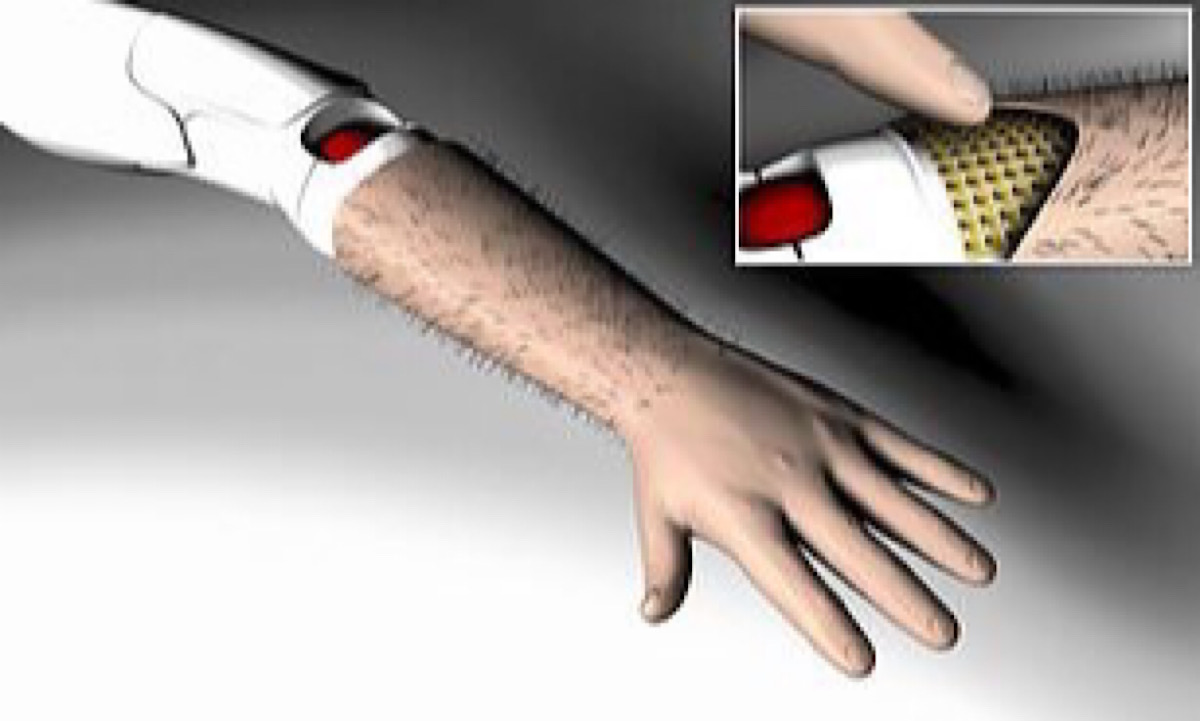
A hair-raising invention! Scientists are developing a robot with electronic HAIRS that mimic the natural touch of human skin

By SHIVALI BEST

  • The system uses an anisotropic magnetoresistance (AMR) sensor system
  • This system can precisely determine changes in magnetic fields
  • Hairs on the surface are linked to the sensors, which can detect touch
  • The e-skin could be used to make more realistic humanoid robots 

The idea of a robot with hairy arms may sound like a concept from the latest science fiction blockbuster.

But the bizarre invention could soon become a reality, as scientists have taken a major step forward in the development of electronic skin with integrated artificial hairs.

Hairs allow for ‘natural touch’ and let us detect different sensations such as rough and smooth, as well as the direction the touch is coming from.

Researchers from Chemnitz University of Technology say the ‘e-skin’ could have a range of uses in the future, including skin replacement for humans and artificial skin for humanoid robots.

Continue reading… “A hair-raising invention! Scientists are developing a robot with electronic HAIRS that mimic the natural touch of human skin”

Ulstein reveals thorium-powered ship concept to support ecocruising

The nuclear-powered Thor concept

By David Szondy

Norway-based marine group Ulstein has introduced Thor, its concept design for a 149-m (489-ft) replenishment, research and rescue (3R) ship powered by a thorium Molten Salt Reactor (MSR) that can be used to recharge battery-driven cruise ships at sea.

As environmental consciousness grows, ecotourism has become a booming business, but with the desire to visit exotic environments comes the need to protect these often under-threat locations. This is particularly urgent for cruise ships going into the polar regions, which are notoriously fragile.

Polar cruises not only have to deal with the intrinsic needs to protect the Arctic and Antarctic coastal regions, but also meet increasingly stringent government regulations and pressure from environmental groups. On top of this, icy seas make refueling ships away from port difficult, expensive, and potentially damaging to the surrounding area.

Continue reading… “Ulstein reveals thorium-powered ship concept to support ecocruising”

Space bricks made using astronaut urine could lead to Martian colony

Humans are working towards establishing a colony on Mars

Human settlements on Mars are one step closer after scientists created ‘space bricks’.

These could be created on the Red Planet by mixing astronauts’ urine with the dusty Martian soil.

The bricks are made by mixing dust with urea, the main compound in urine, and bacteria as well guar gum and nickel chloride.

The slurry can be poured into moulds of any shape and over a few days the bacteria convert the urea into calcium carbonate crystals.

These crystals, as well as biopolymers which are secreted by the bacteria, act as cement that holds the soil particles together.

The new bricks, which were developed by researchers from the Indian Institute of Science, are less porous than others which researchers have tried to use to make Martian bricks.

Continue reading… “Space bricks made using astronaut urine could lead to Martian colony”

App could soon provide at-home test for brain diseases via ‘eye selfies’

A smartphone user can image the eye using the RGB selfie camera and the front-facing near-infrared camera included for facial recognition. Measurements from this imaging could be used to assess the user’s cognitive condition.

By John Anderer
SAN DIEGO, Calif. — You may soon be able to screen yourself for neurological diseases like dementia and ADHD using nothing but a smartphone. All you’d have to do is take a selfie — of your eyes. Researchers at the University of California-San Diego are developing a new app that uses eye recordings to assess cognitive health.

The app uses both a near-infrared camera (built into most new smartphones available today) and a “regular selfie camera” to track pupil size dilations. Those pupil measurements can then help to assess a person’s cognitive condition, study authors explain.

“While there is still a lot of work to be done, I am excited about the potential for using this technology to bring neurological screening out of clinical lab settings and into homes,” says first study author Colin Barry, an electrical and computer engineering Ph.D. student at UC San Diego, in a university release. “We hope that this opens the door to novel explorations of using smartphones to detect and monitor potential health problems earlier on.”

Continue reading… “App could soon provide at-home test for brain diseases via ‘eye selfies’”

Stanford’s Futuristic Gravity Telescope Could Image Exoplanets – 1,000x More Powerful Than Current Technology

An example of a reconstruction of Earth, using the ring of light around the Sun, projected by the solar gravitational lens. The algorithm that enables this reconstruction can be applied to exoplanets for superior imaging. Credit: Alexander Madurowicz

By EMILY MOSKAL

A futuristic “gravity telescope” technique conceptualized by Stanford astrophysicists could enable astronomical imaging significantly more advanced than any present today.

In the time since the first exoplanet was discovered in 1992, astronomers have discovered more than 5,000 planets orbiting other stars. However, when astronomers detect a new exoplanet, we learn relatively little about it: we know that it exists and a few features about it, but the rest is a mystery.

To sidestep the physical constraints of telescopes, Stanford University astrophysicists have been developing a new conceptual imaging technique that would be 1,000 times more precise than the strongest imaging technology currently in use. By taking advantage of gravity’s warping effect on space-time, called gravitational lensing, scientists could potentially manipulate this phenomenon to create imaging far more advanced than any currently available.

In a paper published today (May 2, 2022) in The Astrophysical Journal, the researchers describe a way to manipulate solar gravitational lensing to view planets outside our solar system. By positioning a telescope, the sun, and exoplanet in a line with the sun in the middle, scientists could use the gravitational field of the sun to magnify light from the exoplanet as it passes by. As opposed to a magnifying glass which has a curved surface that bends light, a gravitational lens has a curved space-time that enables imaging far away objects.

Continue reading… “Stanford’s Futuristic Gravity Telescope Could Image Exoplanets – 1,000x More Powerful Than Current Technology”

SOUTH KOREA’S RECON LABS RAISES $4.4M TO HELP SHOPPERS VISUALIZE PRODUCTS BY CREATING 3D MODELS IN AR 

By Kate Park

Augmented reality (AR) can help customers shopping online preview products before making a purchase, and is a growing area of investment for e-commerce businesses. According to a recent survey of 16,000 Snapchat users in 16 markets, 92% of Gen Zers want to use AR and VR for online shopping.

Now, a South Korean augmented reality (AR) startup called RECON Labs, which enables e-commerce customers to create 3D models within a few hours by taking a short video of products via its platform PlicAR, has raised $4.4 million. The company will use its Series A funding to increase its headcount and enhance its platform PlicAR, which helps automatically turn a 2D image into a 3D view of its products without requiring any special skills in 3D modeling.

RECON Labs CEO Seong-hoon Ban told TechCrunch that the firm works with a number of e-commerce marketplaces and retailers, including furniture companies that want to help their clients visualize products in 3D models in actual life-size in augmented reality.

The company currently offers its service to more than 22 small and medium companies in South Korea, and is in discussion with potential customers in the fashion, toy and food sectors, Ban said. Retailers can save time and costs by using PlicAR without building their own 3D modeling platform, he added.

RECON Labs claims it has more than 10,000 products that are 2D converted into 3D content. The platform will let users download, upload, view, sell and buy 3D assets through its web-based service in the future, like Sketchfab, which was acquired by Epic Games in 2021, Ban said.

Continue reading… “SOUTH KOREA’S RECON LABS RAISES $4.4M TO HELP SHOPPERS VISUALIZE PRODUCTS BY CREATING 3D MODELS IN AR “

Washington is the first state to require all-electric heating in new buildings

Most new large apartment and commercial buildings must install heat pumps under the state’s new energy code.

By Emily Pontecorvo

New construction goes up in Bellevue in February 2022. A recently enacted state building code will require most new commercial buildings and large multifamily buildings to install electric heat pumps.

Washington recently became the first state in the country to mandate that newly constructed buildings be outfitted with all-electric space heating and hot water systems. 

The State Building Code Council voted 11-3 on April 22 to adopt a revised energy code that requires most new commercial buildings and large multifamily buildings to install electric heat pumps. The council is expected to consider a similar proposal for smaller residential buildings later this year. 

Heat pumps are an extremely energy-efficient technology that can extract heat from the outside air, even on very cold days, and pump it inside to provide space heating. They can also run in reverse and provide cooling in the summer. The revised code also mandates the use of heat-pump hot water heaters.

Continue reading… “Washington is the first state to require all-electric heating in new buildings”

Japan To Deploy VR-Controlled Giant Robot For Repairs On Railway Tracks

The video showcases the robot lifting and putting into position several large components

by Raag Mathur Ramdev

What’s incredibly unique about this robot is that the human who is controlling it, is doing so through VR goggles. While holding on to a pair of handles, the operator is able to move the robot’s arms and hands, thereby performing repairs remotely. 

The West Japan Rail Company has unveiled a giant worker robot that can carry out repairs and other tasks deemed too dangerous for human beings. According to publication New Atlas, the objectives are “to improve productivity and safety”, and allow workers to move around different forms of heavy equipment. When working on repairs or improvements, many railway workers are at risk of electric shocks as well as falling. The robot is controlled by a human being using Virtual Reality.

A video showcasing the robot’s functionality has been posted on the railways’ official Twitter handle.

Continue reading… “Japan To Deploy VR-Controlled Giant Robot For Repairs On Railway Tracks”

World’s first NFT museum in Seattle aims to ‘pull back the curtain’ on blockchain art

Non-fungible tokens (NFTs) are a type of digital asset.

  • In January, the world’s first permanent NFT art museum opened its doors in Seattle.
  • It aims to “pull back the curtain” on blockchain-based digital art.
  • Non-fungible tokens (NFTs) are a type of digital asset that has exploded in popularity recently, with NFT artworks selling for millions of dollars.

The world’s first permanent NFT art museum has opened in Seattle, aiming to “pull back the curtain” on blockchain-based digital art.

Non-fungible tokens (NFTs) are a type of digital asset that has exploded in popularity recently, with NFT artworks selling for millions of dollars. NFTs exist on a blockchain, a record of transactions kept on networked computers.

The museum opened its doors on 14 January, and has been providing an outlet for artists, creators, and collectors to display their NFTs in a physical setting while aiming to educate the public about this fairly new market for digital art.

Continue reading… “World’s first NFT museum in Seattle aims to ‘pull back the curtain’ on blockchain art”

World’s first ‘vertiport’ could be used for flying taxis in future

A rendering of a future vertiport.  

One vertiport already exists in Coventry city centre in the UK.

It is currently used to launch drones into the sky. But the company that designed it, Urban Air-Port, is also trying to adapt it to flying taxis by 2024.It plans to build 200 similar facilities worldwide in the next five years.

r“It is the future of a segment of aviation that is coming. It will be here by the end of this decade. And I think in the 2030s it will start to become ubiquitous,” said Michael Whitaker, the chief commercial officer of Supernal.

Continue reading… “World’s first ‘vertiport’ could be used for flying taxis in future”

This Diamond Could Store As Much Data As 1 Billion Blu-ray Discs

Even though it has a diameter of just two inches.

By Nathaniel Mott

Adamant Namiki Precision Jewel Co. has created a diamond wafer that, according to the company, could make its way into a variety of quantum computing projects.

“A 2-inch diamond wafer theoretically enables enough quantum memory to record 1 billion Blu-ray discs,” Adamant Namiki says. “This is equivalent to all the mobile data distributed in the world in one day.” The purity of the diamonds produced using this process could allow the material to be used in quantum computers, quantum memory, and quantum sensing devices.

Adamant Namiki collaborated with Saga University to develop this new diamond creation method. The company says it originally produced a diamond wafer of this size in September 2021, but that iteration of the process introduced too many impurities for the resulting diamond to be useful in quantum computers, so it’s spent the last few months investigating that problem.

Continue reading… “This Diamond Could Store As Much Data As 1 Billion Blu-ray Discs”

Waste plastic broken down not in centuries but in days by an AI-engineered enzyme

Breaking up is hard to do.

That’s certainly true for common plastics like polyethylene terephthalate (PET).  A water bottle made of a thin film of PET (perhaps half a millimeter thick) takes about 450 years to degrade.  Along the way it will exist as microplastics, which are so pervasive they are even turning up in living people’s lung tissue, as we saw for the first time just a month ago.  And even those kinds of numbers are guesstimates because many studies don’t last long enough to see any appreciable degradation of PET at all.

A lot of efforts to produce biodegradable and bioresorbable plastics are making good progress, and that’s great for the future, but what about the mountains of plastic that already exist and that we keep on generating?  In the U.S., the landfill rate for discarded plastics is still about 75%!  We have a lot of work to do.

Good thing Hal Alper’s chemical engineering lab at the University of Texas is on the job.  In the April 27 issue of Nature, they report on an enzyme they developed called FAST-PETase.  Designed with the help of artificial intelligence, it degrades untreated postconsumer PET not in centuries, but in days.  And this can be done at temperatures of 50°C and below, where many types of bacteria can thrive.  See where this is going?

Continue reading… “Waste plastic broken down not in centuries but in days by an AI-engineered enzyme”
Discover the Hidden Patterns of Tomorrow with Futurist Thomas Frey
Unlock Your Potential, Ignite Your Success.

By delving into the futuring techniques of Futurist Thomas Frey, you’ll embark on an enlightening journey.

Learn More about this exciting program.