WORMS AND COCKROACHES INSPIRED THIS ROBOT THAT CAN UNCLOG ANY PIPE

Have a clogged pipe? GE has a new robot that could help.

Everyone who lives in an older home knows that plumbing is hell. The smallest problem involves a plumber cursing at your bathtub with a metal snake, or worse, a giant truck drilling its way through tree roots that are causing backups. You might even need to have a new pipe installed . . . simply to access your old ones! It’s as costly as it is absurd.

But what if there were something like a Roomba for keeping your piping clear? That’s exactly what’s being developed by GE Research as it debuts the Pipe-worm. It’s a long, soft-bodied robot that inches its way through pipes, just like an earthworm—while mapping its way in the dark, just like a cockroach. The tool is being designed for city infrastructure first, but could make its way into houses in the future.

“You could imagine, you put it inside your pipe and you never have to think about it again,” says Deepak Trivedi, a mechanical engineer at GE Research. “Because the robot lives there and takes care of your pipes without you ever worrying about it.”

Continue reading… “WORMS AND COCKROACHES INSPIRED THIS ROBOT THAT CAN UNCLOG ANY PIPE”

From burrata to blockchain: How food and NFT are related

We find out over ‘glow in the dark dishes’ and sustainable eating

by Purva Grover

There are still a few of us who are wondering what are NFTs? These are non-fungible tokens, a unique digital file that’s stored on a blockchain network. Let’s dig deeper for clarity, shall we? Fungibility is an item that can be replaced by another identical one, and if something is non-fungible there is nothing with the same characteristics that can replace it. And NFTs are the buzzword, globally, and locally of course, with creators of all kinds exploring the ‘it’ thing. Interestingly, now NFT has entered the culinary world too. We find out.

Continue reading… “From burrata to blockchain: How food and NFT are related”

Aerospace startup reveals new modular lunar rover for carrying people and cargo on the Moon

The FLEX rover prototype

By Loren Grush

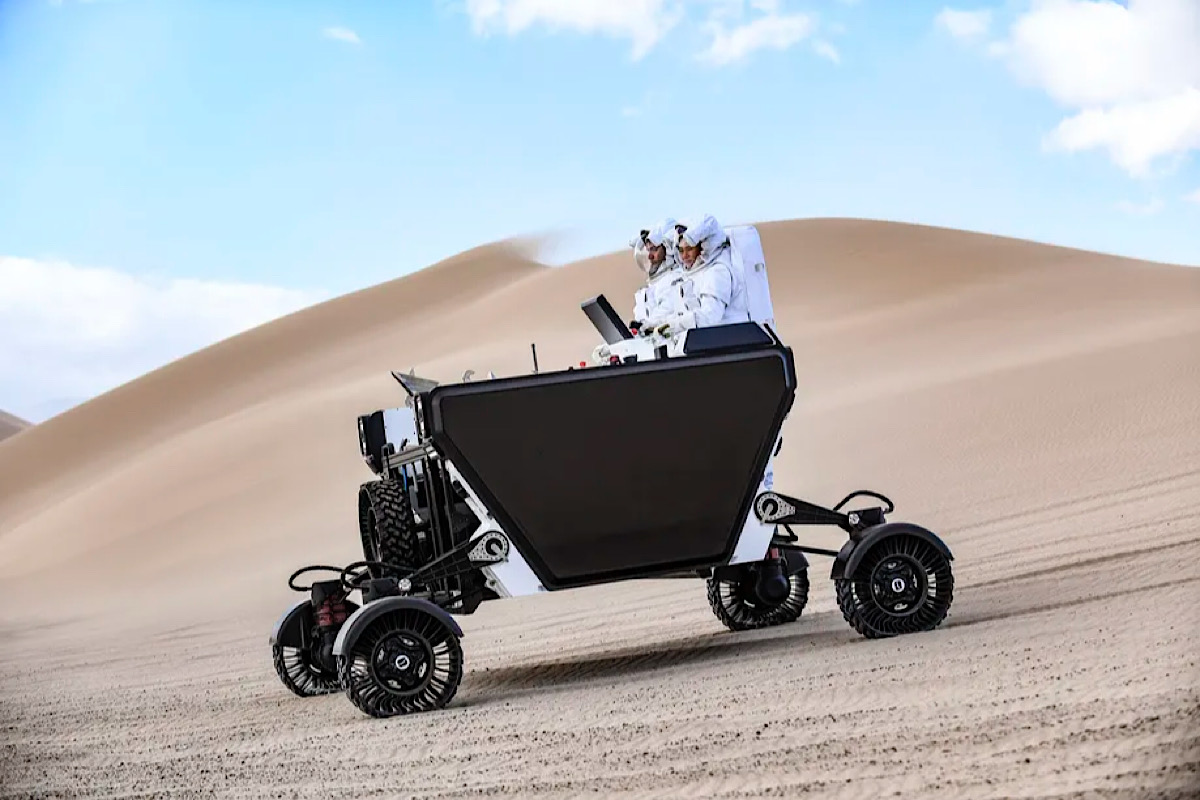
Today, aerospace startup Venturi Astrolab revealed its new interplanetary rover designed to transport cargo and people across the surface of the Moon — and eventually Mars. The company says it plans to build a fleet of these rovers over the coming decade to help NASA and commercial companies establish a long-term presence on the Moon.

Called FLEX, for Flexible Logistics and Exploration, the rover can crouch down and lift payloads up from the surface of the Moon, carrying them under its belly before depositing them at their intended location. With its “modular payload concept,” it can carry many different types of objects, so long as they are built to an agreed-upon standard of size and shape. In keeping with its name FLEX, the rover can maneuver semi-autonomously, be controlled remotely — or it can even be modified to include a crew interface, allowing astronauts to ride on the rover while guiding it through lunar terrain.“WE WANT TO SOLVE THE LOCAL TRANSPORTATION PROBLEM.”

The goal of FLEX and ultimately Astrolab is to capitalize on the world’s renewed push to send people back to the Moon, according to Jaret Matthews, Astrolab’s CEO. Currently, NASA is working to send the first woman and the first person of color to the Moon through the space agency’s Artemis program. And companies like SpaceX and Blue Origin are developing their own landers that will be able to take people to the lunar surface. In the meantime, various commercial companies, like Astrobotic and Intuitive Machines, are building robotic lunar landers that will carry cargo to the Moon. Matthews says he hopes that FLEX rovers will be up there by the time those efforts really ramp up.

“Companies like SpaceX and Blue Origin are solving the long haul transportation problem, and we want to solve the local transportation problem — and ultimately set the standard for lunar logistics,” Matthews tells The Verge.

Continue reading… “Aerospace startup reveals new modular lunar rover for carrying people and cargo on the Moon”

Autonomous vehicles can lose the steering wheel under new US safety standards

General Motors’ autonomous vehicles division sought a review of the safety rules before starting production of its purpose-built driverless pod   

By Tom Bateman  

Fully autonomous vehicles in the United States will no longer have to be equipped with manual controls like pedals and a steering wheel to meet safety standards.

New passenger safety regulations published on Thursday replace older rules written with the assumption that vehicles would always have to be controlled by a human driver.

In a statement announcing the “first-of-its-kind” safety ruling, the National Highway Transport Safety Administration (NHTSA) said the old wording of vehicle safety standards no longer made sense for vehicles designed to be entirely self-driving.ADVERTISING

“The occupant protection standards are currently written for traditionally designed vehicles and use terms such as “driver’s seat” and “steering wheel,” that are not meaningful to vehicle designs that, for example, lack a steering wheel or other driver controls,” the NHTSA said. 

“For vehicles designed to be solely operated by an ADS (Automated Driving System), manually operated driving controls are logically unnecessary,” the agency added.

The rule change comes after US carmaker General Motors and its self-driving technology unit Cruise petitioned the NHTSA last month for permission to build and deploy a self-driving vehicle without human controls.

Continue reading… “Autonomous vehicles can lose the steering wheel under new US safety standards”

America’s Clutter Problem

BY JOSH SANBURN 

When the Amazon packages arrive at her door, Dana Harvey experiences one of two feelings: Ecstasy or Nausea. Harvey, 54, is a family therapist in Los Angeles who also practices another kind of therapy–retail.

She readily admits to indulging in those fleeting moments of joy that come from purchasing. But Harvey also realized the moments were piling up all around her. Her 8-ft.-long pine dining table soon disappeared under mountains of clothes, purses and books. She began making excuses about why her house was a wreck. Eventually she stopped having friends over. She was too embarrassed.

Last year, Harvey hired a professional organizer to help her get her things in order and curb her spending. Together, they threw out or donated bags and bags of shoes, scarves, jewelry, hats, appliances, stuffed animals and unused makeup. Some items still had their tags attached. Today, more often than not, Harvey can find a place for the possessions she decided to keep. She often includes “Clear 10 Things” on her daily to-do list. Her home is less cluttered. Her friends stop by more. Her dining table is a table again. But as spring arrives, she still feels the pull of her iPad, the seasonal clothes and deals just waiting for her online.

For middle-class Americans, it’s never been easier to feel consumed by consumption. Despite the recession, despite a brief interlude when savings rates shot up and credit-card debt went down, Americans arguably have more stuff now than any society in history. Children in the U.S. make up 3.1% of the world’s kid population, but U.S. families buy more than 40% of the toys purchased globally. The rise of wholesalers and warehouse supermarkets has packed our pantries and refrigerators with bulk items that often overflow into a second fridge. One-click shopping and same-day delivery have driven purchasing to another level altogether, making conspicuous consumption almost too easy.

Continue reading… “America’s Clutter Problem”

Ep. 75 with Michael Cushman

Watch our interview with Michael Cushman on Youtube or listen on the Futurati Podcast website.

Michael Cushman is the former president of Engaging Change, head of strategy at the Garlic Media Group, and the managing director of the consulting arm of the Da Vinci Institute, as well as a noted expert on the future of education, the future of real estate, and myriad other topics.

Related

Continue reading… “Ep. 75 with Michael Cushman”

GraphCore releases new 3D chip that speeds AI by 40%

The Bow processor has a higher frequency of 1.85 GHz versus 1.35 GHz of its previous version, which came out in 2020. 

BY POULOMI CHATTERJEE

UK-based AI computer company GraphCore has announced a new combination chip called Bow, which is the world’s first Wafer-on-Wafer (WoW) processor. GraphCore claims that the processor will speed up processes like deep learning by 40 per cent and use 16 per cent less energy than previous generation processors. GraphCore has partnered closely with TSMC to make the Bow IPU. 

This is the latest version of an IPU or Intelligence Processing Unit from GraphCore. The firm had previously released two versions of the IPU. The Bow processor has a higher frequency of 1.85 GHz versus 1.35 GHz of its previous version, which came out in 2020. GraphCore has stated that its superscale Bow Pod 1024 offers up to 350 PetaFLOPS of AI compute. For users who are already on GraphCore systems, the new Bow IPU uses the same software minus any modifications. 

Continue reading… “GraphCore releases new 3D chip that speeds AI by 40%”

China’s blockchain ally joins Federal Reserve’s service provider showcase

Cypherium is the only blockchain company featured in the FedNow Service Provider Showcase for now, the CEO told Cointelegraph.


By HELEN PARTZ 

The United States Federal Reserve Banks are moving forward with a real-time payment project, the FedNow Service, allowing service providers to present their instant payment solutions, including those based on blockchain technology.

On Tuesday, the Fed officially launched the FedNow Service Provider Showcase, aiming to provide financial institutions and users with a range of services to help them implement FedNow Service, which launches in 2023.

At launch, the showcase includes more than 70 profiles and service providers that support instant payments, including Cypherium, a New York-based blockchain company, focused on instant payment solutions, blockchain interoperability and central bank digital currencies (CBDC). The platform is known for being involved in Chinese blockchain projects, including cooperation with Suzhou City Municipal for the city’s development of blockchain Infrastructure.

Other providers in the showcase include services like BNY Mellon Immediate Payments, Mastercard Track Business Payment Service and ePayments.

Continue reading… “China’s blockchain ally joins Federal Reserve’s service provider showcase”

Why This Start-Up Thinks Storing Containers In Space Is The Future

BY TUSHAR MEHTA


The future of humankind’s space endeavors is promising, with various private agencies taking humans into outer space or planning to take humans into space soon. But besides taking humans for a glorified taxi ride in a craft that flies extra high, many space-tech companies have also been attracting investors, garnering roughly $7.7 billion in investments from venture capitalists in 2021 according to PitchBook — a number that has gone up 50% over the previous year.


Among the ventures that have intrigued investors is Inversion Space, a Torrance, California-based company that aims to utilize the Earth’s orbit to store containers that can stay up for a period of up to five years. The company also envisions using the space surrounding the Earth for hyper-fast deliveries by propelling items into the space and then making them fall back into the atmosphere with the help of a parachute, The New York Times reports.

Inversion Space’s founders, Austin Briggs and Justin Fiaschetti, are betting on the possibility of space travel becoming more economical. As it becomes cheaper and easier to reach space — and humans identify ways to facilitate lodging in space, more companies might want to send to as well as bring objects back from the Earth’s orbit.

Continue reading… “Why This Start-Up Thinks Storing Containers In Space Is The Future”

GM WANTS FUTURE EVS TO BE HOME POWER BANKS—AND IT STARTS WITH A CALIFORNIA PILOT PROGRAM

By BENGT HALVORSON

Electric vehicles have the potential to be more than just transportation—by using their battery packs for supplemental home energy and grid stabilization. 

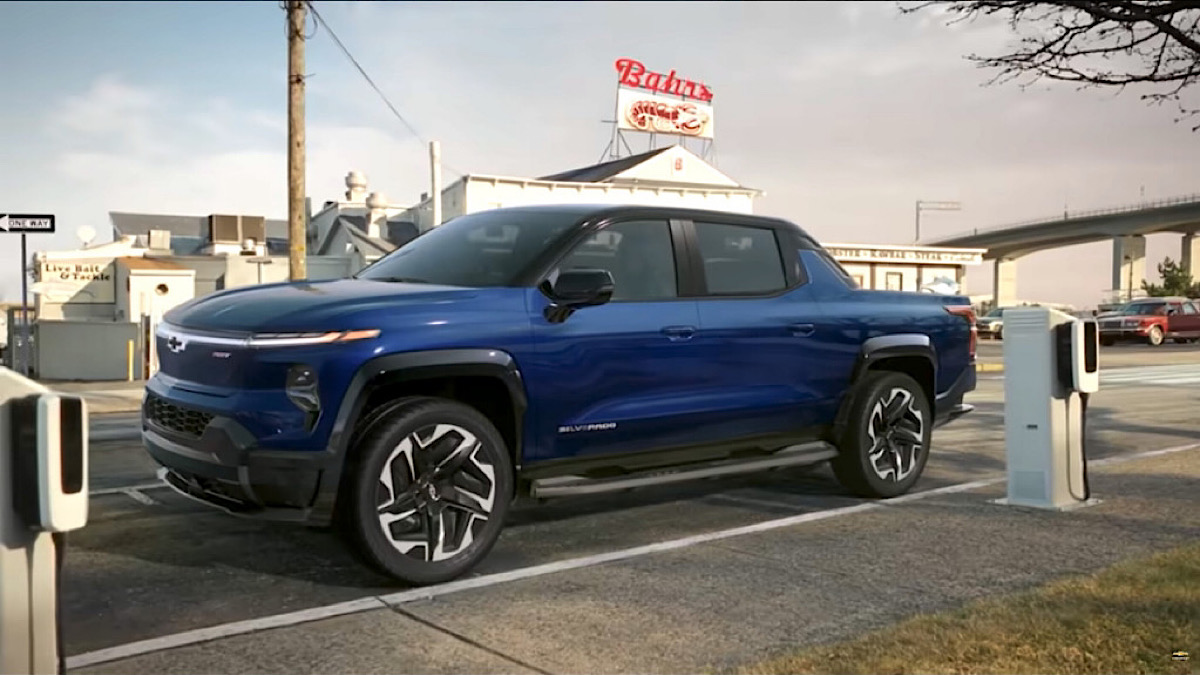
That’s what a collaboration between GM and Pacific Gas and Electric (PG&E), announced Tuesday morning, aims to explore—with the eventual hope of making every GM vehicle bidirectional-charging compatible in the future. 

Up to 85% of U.S. EV owners charge primarily at home, according to GM, and electric vehicles have large battery packs that are potentially available 24/7 but only typically used for a small portion of their capacity. 

The partners note that the average California home uses about 20 kwh per day. That’s less than a tenth of the GMC Hummer EV’s battery capacity. 

Within the pilot program, the companies will develop a software interface for the functionality, and decide on a core hardware set—to include a smart inverter and transfer switch. GM says that, depending on the required load, the solution it’s considering might be able to use both AC or DC. 

Continue reading… “GM WANTS FUTURE EVS TO BE HOME POWER BANKS—AND IT STARTS WITH A CALIFORNIA PILOT PROGRAM”

The Real-World Metaverse belongs in the automotive cockpit

Maybe this is what the Metaverse would look like.

Chen-Ping Yu explores potential use cases of the ‘Real-world Metaverse’ in the vehicle cockpit as well as the tech that’s still missing to make it a reality.

“Metaverse” is one of the hottest topics these days, spearheaded by Meta Platforms Inc. (then Facebook) riding on the successes of its Oculus virtual reality (VR) headset. While the Metaverse is intimately related to VR, there is also the real-world version of Metaverse that has been generating quite a bit of excitement recently. Here we’ll explore the importance of the Real-World Metaverse, a critical technology that it needs but has been largely overlooked, and how automotive is an optimal platform to deploy the Real-World Metaverse.

Continue reading… “The Real-World Metaverse belongs in the automotive cockpit”

Farmers May Soon Be Able to Talk to Pigs Using A Breakthrough AI That Interprets Their Grunts and Oinks to Improve Animal Wellbeing

Farmers May Soon Be Able to Talk to Pigs Using A Breakthrough AI to Help Improve Animal Wellbeing

By Margaret Davis

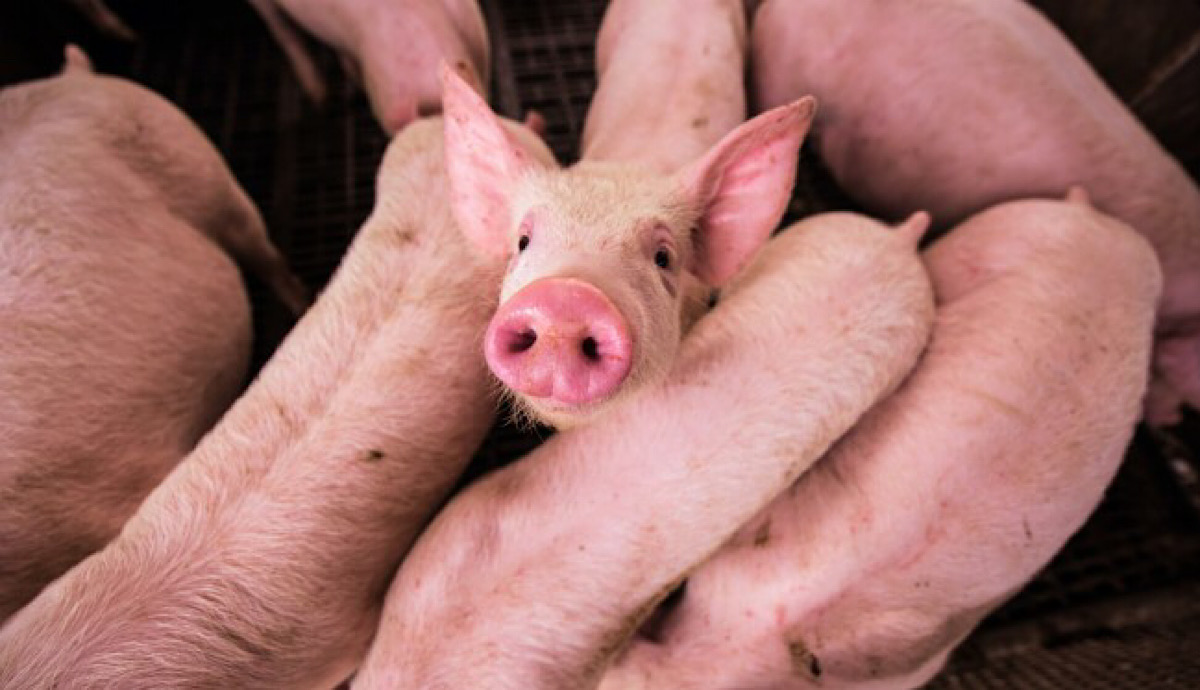
Researchers from the University of Copenhagen, the ETH Zurich, and the National Research Institute for Agriculture, Food, and Environment (INRAE) in France said they finally found a way of decoding the emotions of pigs using acoustic recordings of pig grunts from when they were born until they died in a recent study.

According to MailOnline, the novel algorithm could be used to understand the emotions of pigs and other mammals to monitor their wellbeing and improve their mental health. Study co-author Associate Professor Elodie Briefer from the Department of Biology of the University of Copenhagen said their study demonstrates how animal sounds mirror their emotions.

Continue reading… “Farmers May Soon Be Able to Talk to Pigs Using A Breakthrough AI That Interprets Their Grunts and Oinks to Improve Animal Wellbeing”
Discover the Hidden Patterns of Tomorrow with Futurist Thomas Frey
Unlock Your Potential, Ignite Your Success.

By delving into the futuring techniques of Futurist Thomas Frey, you’ll embark on an enlightening journey.

Learn More about this exciting program.