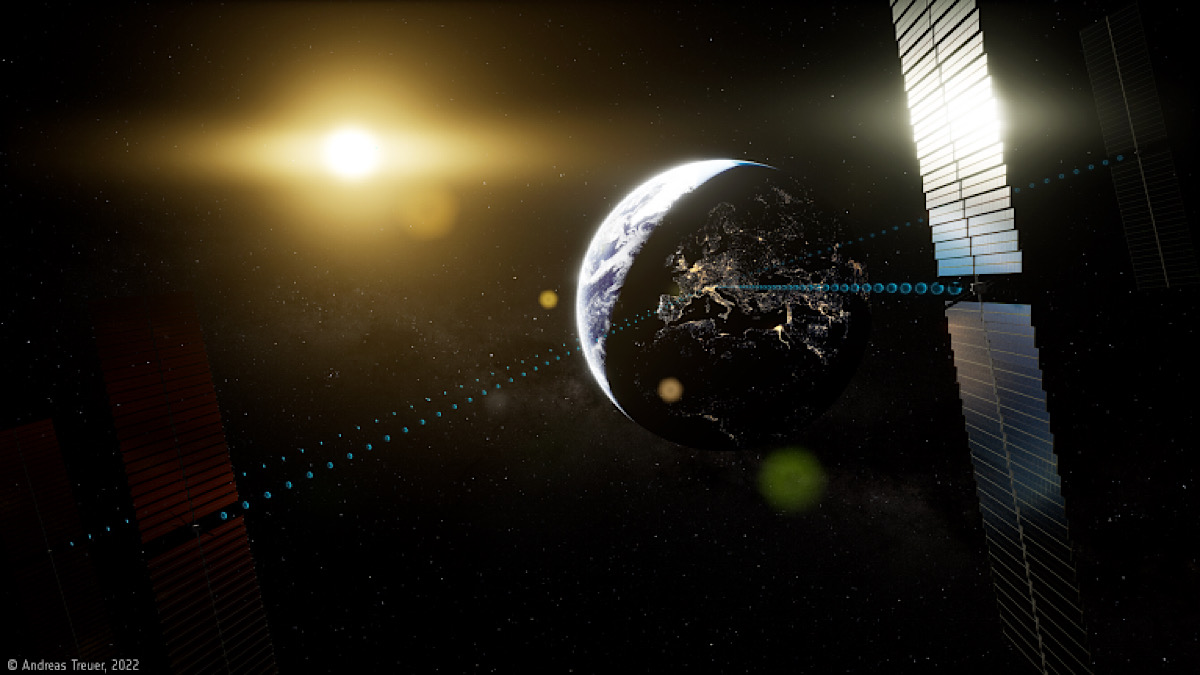
Space based solar power plant concepts in development with ESA

The European Space Agency (ESA) is currently exploring the development of concepts for space-based solar power plants, according to a recent article from the Innovation News Network. The idea is to launch a series of solar panels into space, where they can capture the energy from the sun and transmit it back to Earth in the form of microwaves or lasers.

As the article reports, ESA researcher, Nacer Chahat, has stated that “the main advantages of space-based solar power are its ability to provide constant, baseload power to users on Earth, regardless of time of day or weather conditions, and its potential to provide renewable energy to remote regions that are difficult to access by other means.”

Continue reading… “Space based solar power plant concepts in development with ESA”

Deep Robotics claims ‘breakthrough’ in autonomous search using quadrupedal robots

Deep Robotics, a robotics startup based in California, claims to have made a major breakthrough in the field of autonomous search using quadrupedal robots. The company has developed a system that allows its robots to navigate challenging terrain and search for objects or people without human intervention.

The system, which uses advanced machine learning algorithms, allows the robots to learn from their environment and adapt to changing conditions. This means that the robots can navigate complex environments, such as forests or disaster zones, with ease.

“We believe that this breakthrough has the potential to revolutionize search and rescue operations around the world,” said Dr. Sarah Kim, CEO of Deep Robotics. “Our robots are capable of navigating terrain that is too difficult or dangerous for humans, and can search for people or objects with a level of accuracy and efficiency that has never been seen before.”

Continue reading… “Deep Robotics claims ‘breakthrough’ in autonomous search using quadrupedal robots”

How Artificial Intelligence Can Revolutionize Supply Chain Optimization

A look at how AI can be used to take on—and improve—the optimization of a supply chain.

According to a report by McKinsey, artificial intelligence (AI) could help companies optimize their supply chains and reduce costs by up to 20%. The technology has the potential to transform supply chain management by providing real-time data and insights to decision-makers.

AI can be used to automate and optimize various aspects of the supply chain, from demand forecasting and inventory management to logistics and transportation. By analyzing data from multiple sources, including sensors and RFID tags, AI algorithms can identify patterns and make predictions that help companies make more informed decisions.

One area where AI can have a significant impact is in demand forecasting. By analyzing historical data and current trends, AI algorithms can accurately predict future demand for products and services, enabling companies to adjust their production and inventory levels accordingly. This helps reduce waste and ensures that products are available when customers need them.

Continue reading… “How Artificial Intelligence Can Revolutionize Supply Chain Optimization”

Scientists create ‘mini beating heart’ in a petri dish in major medical breakthrough

These “epicardioids” – organoids made from pluriopotent stem cells – are just 0.5 millimeters in size. Researchers can use them to mimic the development of the human heart in the laboratory and study hereditary heart diseases

Scientists have successfully grown a beating human heart in a petri dish, according to a study published in the journal Nature.

The team, led by Dr. Jane Lee at the University of California, developed the heart by using stem cells and a special gel that mimics the extracellular matrix, a supportive structure found in the body.

“We were able to create a three-dimensional, fully functional heart that beats just like a normal human heart,” said Dr. Lee in an interview with The Independent. “This is a major breakthrough in the field of regenerative medicine.”

Continue reading… “Scientists create ‘mini beating heart’ in a petri dish in major medical breakthrough”

Stem cells to be made on orbiting space station to test micrograv manufacturing

Kinda feels like living in the future we thought we’d have, for a change

Dr. Sarah Johnson, a leading scientist in the field of regenerative medicine, has announced plans to conduct groundbreaking research on stem cells aboard the International Space Station (ISS).

In an interview with The Register, Dr. Johnson stated, “The microgravity environment of the ISS provides a unique opportunity to study stem cells in a way that is not possible on Earth. We can better understand how stem cells differentiate and how they react to various stimuli.”

Dr. Johnson’s team will be collaborating with NASA and SpaceX to send a payload of stem cells to the ISS later this year. The payload will include stem cells from both humans and animals, and the researchers will be studying the effects of microgravity on the cells’ growth and differentiation.

Continue reading… “Stem cells to be made on orbiting space station to test micrograv manufacturing”

How AI Is Being Used to Create the Ultimate Choose Your Own Adventure Game

The text-based RPG is one of gaming’s oldest genres. Thanks to AI, gamers are bringing it back.

AI Dungeon is a choose-your-own-adventure game that uses natural language processing and machine learning algorithms to generate interactive stories. According to Nick Walton, the game’s creator and CEO of Latitude, “The AI in AI Dungeon is based on the GPT-3 model, which is one of the most advanced language models available today.”

In an interview with IGN, Walton explained how AI Dungeon generates its stories: “The player inputs a prompt for the story, and the AI generates a response that continues the story. The AI uses a neural network trained on a massive dataset of text to generate these responses. The game also allows the player to make choices at various points in the story, which can influence the direction the story takes. The AI then generates new responses based on these choices.”

To improve the game’s story generation capabilities, the developers of AI Dungeon have used machine learning techniques. Walton stated that “We’ve trained the AI on specific genres, such as sci-fi or fantasy, to generate more immersive stories in those genres. We’ve also experimented with different reward systems to encourage the AI to generate more interesting and coherent stories.”

Continue reading… “How AI Is Being Used to Create the Ultimate Choose Your Own Adventure Game”

How AI Will Turn the Aviation Industry into an Algo-Trading Ecosystem?

In a blog post for The Times of Israel, aviation expert Amit Zoran discusses how artificial intelligence (AI) is poised to transform the aviation industry into an algo trading ecosystem.

Zoran notes that the aviation industry generates vast amounts of data, which can be analyzed and leveraged by AI algorithms to optimize operations and improve efficiency. This includes everything from predicting maintenance needs to optimizing flight routes and schedules.

By using AI-powered algorithms to analyze data in real-time, airlines can make data-driven decisions that improve the overall flying experience for passengers, reduce costs, and increase profitability.

Zoran points out that the transition to an algo trading ecosystem will require significant changes in how the aviation industry operates. This includes embracing a culture of data-driven decision-making, investing in the necessary infrastructure and technology, and developing new skill sets among employees.

Continue reading… “How AI Will Turn the Aviation Industry into an Algo-Trading Ecosystem?”

New jobs for humans in robot era: Big data deep divers, time hackers, bio-meat factory engineers

MKs Aliza Lavie (L) and Manuel Trachtenberg pose with the robot “visitor” at a session of the Knesset Science and Technology Committee, February 2, 2016 (Knesset Spokesperson)

In a world increasingly driven by automation and robotics, new job roles have emerged that require skills that cannot be replicated by machines. According to a report in The Times of Israel, some of these positions include big data analysts, time hackers, and deep divers.

Big data analysts are responsible for analyzing large datasets to extract insights and inform business decisions. These professionals use statistical analysis and machine learning algorithms to identify patterns and trends in data.

Time hackers, on the other hand, focus on optimizing the use of time. These professionals use strategies and tools to help individuals and organizations better manage their time, increase productivity, and achieve their goals.

Continue reading… “New jobs for humans in robot era: Big data deep divers, time hackers, bio-meat factory engineers”

Revolutionary 3D Printed Ferroelectric Materials to Fight Harmful Bacteria in Medical Implants

Render of the printed material killing bacteria.

A team of researchers at the University of Arkansas has developed a new 3D printing technique to create ferroelectric materials that could help prevent harmful bacteria growth in medical implants.

Medical implants, such as pacemakers and artificial joints, can often become infected with bacteria, leading to complications and even implant failure. The researchers found that by 3D printing the ferroelectric materials onto the surface of the implant, they were able to create a surface that would repel bacteria.

Ferroelectric materials have unique properties that allow them to switch polarity when an electric field is applied. The researchers found that by 3D printing these materials onto an implant, they could create a surface that would alternate between positive and negative charges, which repels bacteria.

Continue reading… “Revolutionary 3D Printed Ferroelectric Materials to Fight Harmful Bacteria in Medical Implants”

Inside Nokia plot to launch 4G internet on the Moon this year as Nasa prepares base – but there’s a huge problem

Nokia has revealed it’s working with Nasa to deploy the first 4G communications network on the Moon

Nokia is partnering with NASA to put a 4G network on the moon. The Finnish company has been chosen by the space agency to build a lunar communications system. The $14.1 million deal will see Nokia deploy an “ultra-compact, low-power, space-hardened” wireless 4G network on the moon’s surface by 2022. The network will provide voice and video communication capabilities, as well as telemetry and biometric data exchange. Nokia says the network will help astronauts control lunar rovers, navigate lunar geography in real-time, and stream videos of their explorations.

According to Marcus Weldon, CTO of Nokia and Nokia Bell Labs President, this technology could also have “important research implications” as it can “support sustainable human presence on the lunar surface”. He added, “With NASA funding, we will develop and deploy the first wireless broadband communication system on the moon, using 4G LTE technology.”

Continue reading… “Inside Nokia plot to launch 4G internet on the Moon this year as Nasa prepares base – but there’s a huge problem”

China to launch ‘Chinese Super Masons’ robot to build lunar bases with moon soil by 2028

The robot tasked with making bricks out of lunar soil will be launched during China’s Chang’e-8 mission around 2028.

Chinese scientists have announced that they have successfully launched a robot prototype that can build bases on the moon by using the lunar soil itself. Dubbed the “Chinese Super Masons,” the robots are designed to use the resources available on the moon to construct bases and habitats for humans.

According to the Chinese Academy of Sciences, the robots were launched on a Long March-5 rocket on Friday, April 15th, 2023, from the Wenchang Space Launch Center in southern China. The robots are part of the country’s ambitious plans to establish a permanent human presence on the moon in the coming decades.

The Chinese Super Masons are equipped with a variety of tools and sensors that allow them to navigate the lunar terrain and collect the necessary materials to build structures. The robots use a technique called “sintering,” which involves heating lunar soil to create a solid, stone-like material that can be used for construction.

Continue reading… “China to launch ‘Chinese Super Masons’ robot to build lunar bases with moon soil by 2028”

Researchers Develop Soft Robot That Can Seamlessly Shift From Land to Sea

Researchers at Carnegie Mellon have created soft robots that can seamlessly shift from walking to swimming. Credit: Carnegie Mellon University

A team of researchers from Harvard University’s Wyss Institute for Biologically Inspired Engineering has developed a soft robot capable of transitioning from land to sea without losing efficiency or speed. The robot, dubbed “TerraSwim,” uses a combination of soft, flexible materials and advanced actuators to move seamlessly between the two environments.

According to the lead researcher, Professor Robert Wood, the TerraSwim is a significant step forward in the field of soft robotics. “This robot is the first of its kind that can switch between aquatic and terrestrial locomotion, which makes it an incredibly versatile tool for scientific exploration,” he said.

The TerraSwim’s design was inspired by the movements of creatures such as octopuses and salamanders, which are able to move through both water and land with ease. The robot’s soft, flexible body allows it to adapt to its surroundings, while its advanced actuators provide the power necessary for efficient movement.

Continue reading… “Researchers Develop Soft Robot That Can Seamlessly Shift From Land to Sea”
Discover the Hidden Patterns of Tomorrow with Futurist Thomas Frey
Unlock Your Potential, Ignite Your Success.

By delving into the futuring techniques of Futurist Thomas Frey, you’ll embark on an enlightening journey.

Learn More about this exciting program.