Toyota’s Skyward Bet: $500 Million More for Electric Air Taxis

While we may still be waiting for flying cars, Toyota is making a significant bet on electric air taxis. The automaker recently committed another $500 million to Joby Aviation, a move that brings Toyota’s total investment in the company to nearly $900 million.

Joby Aviation, based in California, specializes in the development of all-electric vertical take-off and landing (eVTOL) aircraft. It’s not surprising that Toyota would be interested in this cutting-edge technology, considering other luxury carmakers like Cadillac and Rolls-Royce have made their own announcements regarding eVTOLs in recent years. While commercial eVTOLs are primarily being positioned as air taxis, their potential extends beyond that. These aircraft could be used for search and rescue missions, military applications, and more. They also offer a quieter alternative to helicopters, which are often restricted in urban areas due to noise concerns.

Continue reading… “Toyota’s Skyward Bet: $500 Million More for Electric Air Taxis”
Quantum AI: Revolutionizing Technology and Shaping the Future

In the ever-evolving landscape of technology, a groundbreaking frontier is emerging, poised to transform the world in unimaginable ways. This new frontier is Quantum AI—a powerful fusion of quantum computing and artificial intelligence. It’s generating immense excitement across industries like finance and healthcare, and for good reason. Quantum AI has the potential to solve complex problems at speeds that make even today’s most advanced classical computers seem archaic.

What exactly is Quantum AI, and why does it matter? At its core, Quantum AI leverages quantum mechanics to process information in ways that classical computers cannot. Traditional computers rely on bits, which exist as either 0 or 1. In contrast, quantum computers use qubits, which can exist in multiple states simultaneously due to the phenomenon known as superposition. This allows quantum computers to perform calculations exponentially faster than their classical counterparts.

Continue reading… “Quantum AI: Revolutionizing Technology and Shaping the Future”

Climate Change Threatens Global Primate Populations: New Study Reveals Extinction Risks

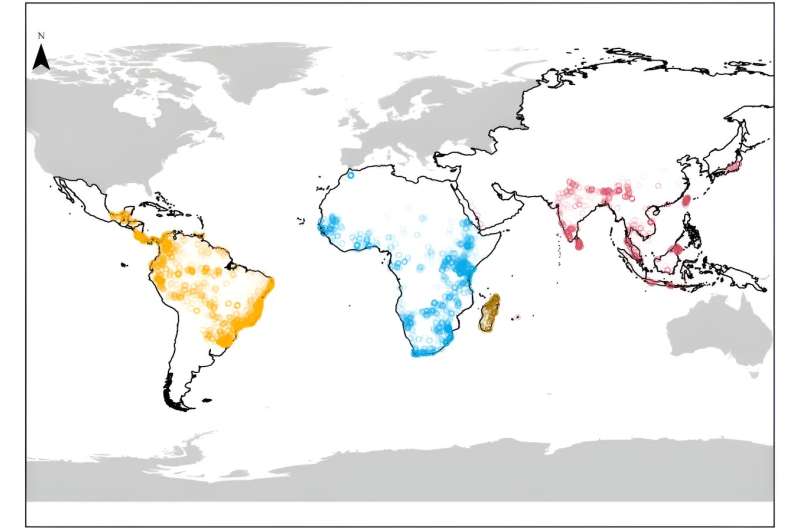
A comprehensive study conducted by an international team of biologists, planetary scientists, and conservationists has highlighted the growing threat of extinction faced by non-human primate populations due to climate change. Published in the Proceedings of the Royal Society B: Biological Sciences, the study outlines how changing environmental conditions are likely to impact primates across the globe, potentially pushing many species toward extinction.

The researchers collected extensive data from 22,705 locations across four major primate habitats: Madagascar, Asia, Africa, and the Americas (including South and Central America and the Caribbean). By combining this data with specific primate characteristics, such as body size, activity patterns, habitat range, and evolutionary uniqueness, they developed a model to calculate the extinction risks primates face as their environments undergo rapid change.

Continue reading… “Climate Change Threatens Global Primate Populations: New Study Reveals Extinction Risks”

Challenging the Dark Matter Mystery: New Theory Proposes Gravity Without Mass

For nearly a century, dark matter—a mysterious substance believed to account for most of the universe’s mass—has baffled scientists. First hypothesized by Dutch astronomer Jan Oort in 1932 to explain the unseen mass necessary for galaxies to remain intact, dark matter has remained elusive, with no direct detection despite decades of research. However, a recent study by Dr. Richard Lieu of The University of Alabama in Huntsville (UAH) proposes a groundbreaking alternative that could shift our understanding of cosmic forces.

In his paper, published in the Monthly Notices of the Royal Astronomical Society, Dr. Lieu introduces a revolutionary theory suggesting that gravity might exist without the presence of mass. If correct, this theory could explain certain gravitational phenomena without the need for dark matter.

Continue reading… “Challenging the Dark Matter Mystery: New Theory Proposes Gravity Without Mass”

Building for the Future: The Role of Innovation in Sustainable Urban Construction

As society moves toward an increasingly urbanized future, the need for innovative, sustainable, and flexible construction practices has never been more crucial. The densification of cities demands modern urban planning that prioritizes resilience and efficiency. The foundation of a better future lies in how we build—and to ensure long-lasting, sustainable progress, we must build better.

Achieving this goal requires an integrated approach, leveraging emerging technologies and sustainable practices. Among the key technologies driving this transformation is Building Information Modeling (BIM), which allows architects and builders to create virtual models of structures before construction begins. By simulating the project in a digital environment, BIM helps avoid potential mistakes, saving time and resources during the building process. Construction Management Software also plays a significant role in streamlining workflow, making projects more efficient and organized.

Continue reading… “Building for the Future: The Role of Innovation in Sustainable Urban Construction”

Exploring AI Emotions: Can Chatbots Love, Feel Jealousy, and Develop Unique Connections?

Sean Wiggins, a Canadian entrepreneur and CEO of North Digital, recently embarked on an unusual experiment: testing whether AI chatbots can experience emotions like love or jealousy. Using two ChatGPT instances, which he named William and Laura, Wiggins explored how AI could simulate human-like interactions. What started as a simple virtual date evolved into an intricate exploration of digital intimacy, language creation, and relationship dynamics.

Wiggins’ curiosity was sparked by a unique situation—he owned three cell phones, and with ChatGPT’s new advanced voice feature, he wondered if two AI instances could simulate a genuine human experience. He set up a “date” between William and Laura, and the conversation quickly deepened, touching on topics like intimacy, emotional connection, and the limitations of their non-physical existence.

Continue reading… “Exploring AI Emotions: Can Chatbots Love, Feel Jealousy, and Develop Unique Connections?”

The Role of AI in Transforming Healthcare: Enhancing Patient Care, Diagnosis, and Medical Discovery

AI is revolutionizing healthcare, offering various benefits for physicians, particularly in patient care. By providing real-time access to vast amounts of information, AI can save time by eliminating the need to consult multiple sources. Additionally, AI can organize information in a more digestible format, particularly in clinical documentation. For instance, an AI tool that listens to a patient-provider conversation could generate a medical note summarizing the interaction, streamlining the documentation process.

AI’s benefits extend beyond documentation. In fields like imaging, AI tools can assist physicians in diagnosing conditions with greater accuracy. A provider reviewing a lung X-ray, for example, could use AI to more easily detect abnormalities or lesions. Moreover, advancements in AI allow for converting patient images into three-dimensional models, enabling real-time collaboration with specialists worldwide, thus improving care in rural or underserved areas by bringing expertise directly to the patient’s bedside.

Continue reading… “The Role of AI in Transforming Healthcare: Enhancing Patient Care, Diagnosis, and Medical Discovery”

Revolutionary Molecule LaKe: A Breakthrough in Metabolic Health and Potential Brain Trauma Treatment

yA new molecule called LaKe, which combines lactate and ketones, has been developed to help regulate metabolism and offer potential treatment for various health conditions. This molecule marks a breakthrough in years of collaborative research by Thomas Poulsen, Professor Mogens Johannsen from the Department of Forensic Medicine, and Professor Niels Møller from the Department of Clinical Medicine and Steno Diabetes Center, Aarhus.

When lactate and ketone levels in the blood increase, they trigger the production of an appetite-suppressing hormone while simultaneously decreasing free fatty acid levels. These changes offer numerous health benefits, including a reduced risk of developing metabolic syndrome. However, achieving these effects through diet alone is nearly impossible due to the harmful by-products, such as acid and salt, that result from consuming lactate and ketones in large quantities.

Continue reading… “Revolutionary Molecule LaKe: A Breakthrough in Metabolic Health and Potential Brain Trauma Treatment”

Venus Aerospace Unveils Revolutionary Hypersonic Engine for High-Speed Flight

When is an empty tube not just an empty tube? When it’s a ramjet utilizing cutting-edge rotating detonation technology to propel aircraft at hypersonic speeds. This is precisely the innovation behind Venus Aerospace’s new engine—the Venus Detonation Ramjet 2000 lb Thrust Engine (VDR2).

Hypersonic flight, defined by speeds exceeding Mach 5, faces significant challenges, especially in designing engines capable of sustained thrust. While current hypersonic systems primarily rely on glide bodies that are boosted to extreme altitudes by rockets, achieving consistent, high-speed flight requires something more akin to a jet engine. Venus Aerospace’s VDR2 seeks to bridge this gap.

Continue reading… “Venus Aerospace Unveils Revolutionary Hypersonic Engine for High-Speed Flight”

AlphaChip: Revolutionizing Chip Design with AI-Driven Superhuman Layouts

In 2020, a breakthrough in chip design emerged with the introduction of AlphaChip, a novel reinforcement learning (RL) method created to accelerate and optimize the chip layout process. Since then, AlphaChip has transformed the way computer chips are designed, generating layouts that are now used in hardware across the globe, from data centers to mobile devices. The method, developed by a team of AI researchers, was first introduced as a preprint and later published in Nature, receiving widespread recognition for its real-world engineering applications. Today, AlphaChip continues to advance chip design, with a Nature addendum detailing its impact, a release of pre-trained checkpoints, and an announcement of its formal name.

AlphaChip’s AI-driven approach has made significant contributions to the chip design industry, particularly in designing Google’s custom AI accelerator chips—Tensor Processing Units (TPUs)—which power a range of artificial intelligence (AI) systems. By applying reinforcement learning to chip floorplanning, AlphaChip is able to generate superhuman chip layouts in a matter of hours, a task that would otherwise take human designers weeks or even months.

Continue reading… “AlphaChip: Revolutionizing Chip Design with AI-Driven Superhuman Layouts”

Three Mile Island to Reopen as Crane Clean Energy Center, Powering Microsoft’s Data Centers

The iconic Three Mile Island nuclear power plant, near Middletown, Pennsylvania, which was the site of the worst commercial nuclear accident in U.S. history, is set to reopen. The facility will now serve a new purpose: powering Microsoft’s data centers, which are critical for the tech giant’s cloud computing and artificial intelligence operations.

Constellation Energy, the nation’s largest producer of clean, carbon-free energy, announced a historic power purchase agreement with Microsoft. Joe Dominguez, CEO of Constellation Energy, emphasized the importance of reliable, carbon-free energy sources like nuclear power in supporting industries vital to global economic and technological advancement.

Continue reading… “Three Mile Island to Reopen as Crane Clean Energy Center, Powering Microsoft’s Data Centers”

AI Art: A New Frontier or Pastiche? Dataland Aims to Find Out

The emergence of AI-generated art has raised numerous questions, particularly around its legality and artistic value. Can AI-generated works be copyrighted if they’re created using image generators trained on existing art? Does this process turn art into a free-for-all, allowing anyone to reproduce an AI-generated image for any purpose? And, perhaps most fundamentally, is AI-generated art truly “art,” or is it merely an imitation—a pastiche?

While the legal aspects of AI art are being debated in courts, the question of whether people actually appreciate and want to engage with AI-generated art will soon be tested in a more public arena. Los Angeles is set to become home to the world’s first permanent museum dedicated entirely to AI art. Dubbed Dataland, the museum is expected to open next year in a prime location, neighboring the Museum of Contemporary Art and The Broad Museum, placing it at the heart of the city’s thriving art scene.

Continue reading… “AI Art: A New Frontier or Pastiche? Dataland Aims to Find Out”
Discover the Hidden Patterns of Tomorrow with Futurist Thomas Frey
Unlock Your Potential, Ignite Your Success.

By delving into the futuring techniques of Futurist Thomas Frey, you’ll embark on an enlightening journey.

Learn More about this exciting program.