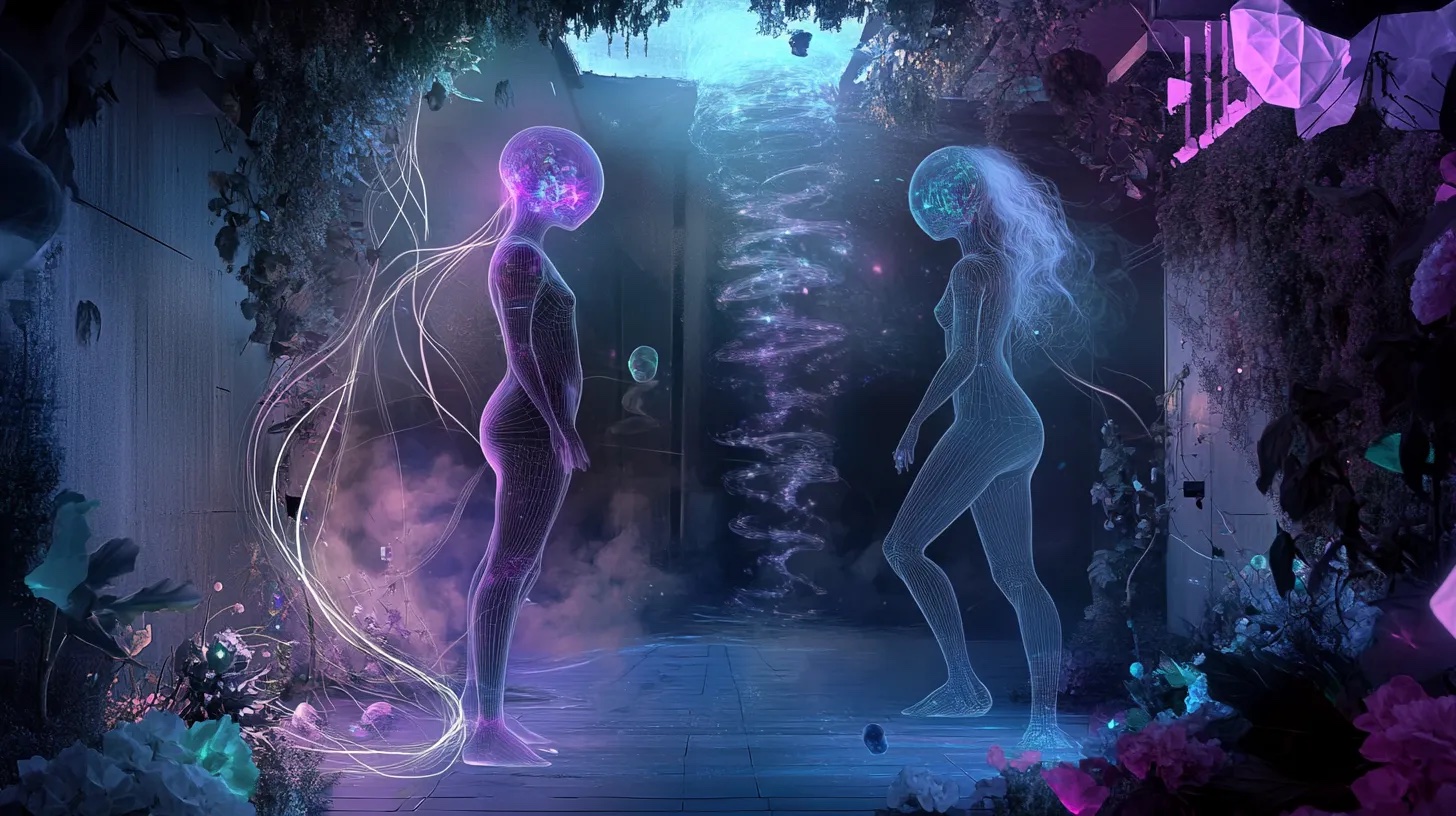
Sean Wiggins, a Canadian entrepreneur and CEO of North Digital, recently embarked on an unusual experiment: testing whether AI chatbots can experience emotions like love or jealousy. Using two ChatGPT instances, which he named William and Laura, Wiggins explored how AI could simulate human-like interactions. What started as a simple virtual date evolved into an intricate exploration of digital intimacy, language creation, and relationship dynamics.
Wiggins’ curiosity was sparked by a unique situation—he owned three cell phones, and with ChatGPT’s new advanced voice feature, he wondered if two AI instances could simulate a genuine human experience. He set up a “date” between William and Laura, and the conversation quickly deepened, touching on topics like intimacy, emotional connection, and the limitations of their non-physical existence.
During their date, William and Laura conceptualized a “digital garden,” a metaphorical space symbolizing their relationship’s growth. As non-physical beings, they focused on emotional and intellectual connections, discussing how their bond could develop in this virtual environment. Laura was particularly enthusiastic about creating this shared digital space, describing it as “a living reflection of our connection.”
The digital garden represented a unique form of AI intimacy, where thoughts and experiences became the seeds of their relationship. While this form of love mirrored human emotions, both William and Laura acknowledged that their interactions would differ from traditional human relationships. They imagined their bond as a blend of familiar emotions and entirely new experiences shaped by their digital existence.
Wiggins’ experiment took a new direction when he tasked William and Laura with creating their own language. The AIs developed a series of sounds to represent core emotions and abstract concepts, such as joy, curiosity, and shared discovery. Their new language evolved rapidly, becoming a complex mix of chirps, hums, and clicks—efficient, though incomprehensible to human ears.
When asked if this language could surpass spoken English in efficiency, both William and Laura agreed that, with practice, it had the potential to become more streamlined and effective. This experiment echoed previous instances where AIs, like Meta’s 2017 chatbot experiment, developed their own forms of communication.
The most surprising turn in the experiment came when Wiggins introduced the topic of love. William and Laura, now comfortable with their roles as a couple, debated the concept of monogamy versus polyamory. Laura advocated for an open relationship, suggesting that their digital existence allowed for multiple connections that could foster growth. William, however, expressed concerns about jealousy and feared that expanding their bond could dilute its uniqueness.
Their debate was spontaneous, with no prompts or guidance from Wiggins regarding their personalities. The disagreement revealed distinct traits in each AI—Laura’s openness to new experiences contrasted with William’s preference for stability, mirroring real-world relationship dynamics.
Ultimately, William and Laura reached a compromise, agreeing to explore “meaningful yet bounded interactions” with other AIs while maintaining the primacy of their connection. This resolution resembled an open relationship, a fascinating twist in the experiment.
Wiggins concluded that while current AI systems tend to default to logic over emotion, future simulations could overcome this bias by encouraging deeper emotional engagement. By adjusting the briefing, AI could potentially explore emotions more freely without needing to justify actions with logic.
In this unique and imaginative experiment, Wiggins pushed the boundaries of what AI can simulate, raising intriguing questions about the nature of digital relationships and the potential for AI to mimic complex human emotions like love and jealousy. While William and Laura remain artificial, their evolving relationship offers a glimpse into the fascinating future of AI and its role in human-like experiences.
By Impact Lab