
The universe almost certainly teems with life — but the idea that any of it resembles a human being may be the most provincial assumption our species has ever made
The Costume Problem
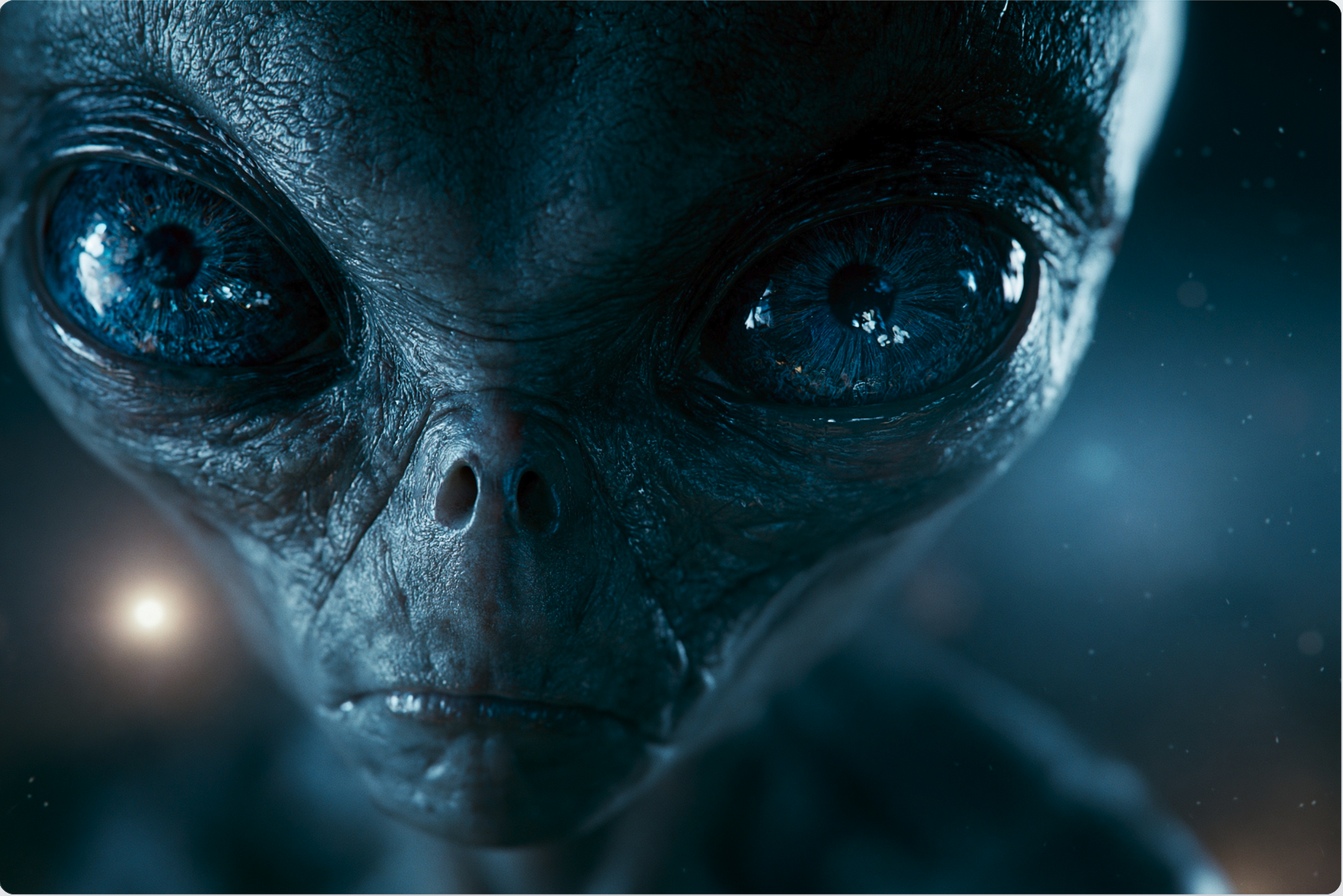
Every alien in the history of Hollywood has something in common with every other alien in the history of Hollywood: they were designed by a human being. Two eyes, bilateral symmetry, something approximating a face, limbs that suggest arms and legs, a body plan that a human costume designer could render in latex and makeup. Even our most imaginative attempts at the genuinely alien — the creature in Alien, the heptapods in Arrival, the monolith in 2001 — betray the cognitive limits of the minds that created them. We reach for the unfamiliar and end up producing variations on ourselves.
This isn’t a failure of imagination. It’s a failure of experience. Humans have exactly one data point for what a technologically sophisticated, self-aware species looks like: us. And we have made the oldest mistake in the history of bad reasoning — we have assumed that our single data point is representative of the whole.
It isn’t. It couldn’t be. The physics, chemistry, biology, and evolutionary pressures that produced a five-foot-ten bipedal primate with forward-facing eyes and opposable thumbs are so specific, so contingent, so dependent on countless years of particular conditions on one particular rock orbiting one particular star, that the probability of those same pressures producing anything remotely similar elsewhere in the universe isn’t low. It’s essentially zero.
Gravity Alone Changes Everything
Start with the most basic physical parameter: gravity. A planet with twice Earth’s surface gravity doesn’t just feel heavier — it reshapes the entire trajectory of biological evolution from the first multicellular organism forward. Skeletons must be denser and more robust. Muscles must be proportionally more powerful relative to body mass. Height becomes an evolutionary liability — tall structures fall harder. Any intelligent species that emerged under high gravity would be low to the ground, heavily built, with a completely different relationship to locomotion, architecture, and the mechanical world than anything that evolved on Earth.
Reduce gravity significantly and you get the opposite pressures: lighter, taller, more elongated forms, different bone density, different cardiovascular demands — because the heart no longer has to work as hard to pump blood vertically against gravitational pull. Different gravity produces different bodies at every level of biological organization, from the cellular architecture of individual organisms up to the shape of the ecosystems they inhabit. And gravity is just one variable. One.
Atmospheric composition rewrites the rules entirely. Earth’s oxygen-nitrogen mix at our specific pressure is not a universal default — it’s a geological accident produced by countless years of photosynthetic life processing a very different early atmosphere. A planet with higher oxygen concentrations might support animals that metabolize at three times the rate of anything on Earth. Lower oxygen might favor slow, efficient metabolisms with completely different energy-production chemistry. A methane-based atmosphere, a sulfur-rich one, a world where the dominant solvent isn’t water but ammonia — each of these produces not just different organisms but different biochemistry at the molecular level, different building blocks, different everything.
The Day That Never Ends — Or Does
The length of a planet’s day restructures the biological clock of every organism that evolves on it. Earth’s 24-hour rotation has embedded itself so deeply into terrestrial biology that human cells maintain circadian rhythms even in complete isolation from light. We are, at the cellular level, clocks tuned to one specific planetary rotation speed.
A planet tidally locked to its star — one face always lit, one always dark — produces organisms that evolved across a narrow twilight band, or perhaps deep in the dark, or perhaps in ways that require no sleep-wake cycle at all because there is no cycle to synchronize to. A planet with a 60-hour day and a 60-hour night produces something entirely different from one with a 10-hour cycle. The neurological architecture, sensory systems, metabolic rhythms, and social behaviors of any intelligent species are downstream of the day-night sequence they evolved inside. An intelligent species from a tidally locked world might have sensory systems so different from ours that we would struggle to recognize them as sensory systems at all.
Evolution Has No Destination
The deepest flaw in the humanoid alien assumption isn’t physical — it’s conceptual. It assumes that intelligence is a destination that evolution reliably arrives at, and that the route to that destination produces similar travelers. Neither is true.
Evolution has no destination. It has no foresight, no preference for complexity, and no tendency toward producing beings that look like us. The history of life on Earth is not a story of steady progress toward humanity — it’s a story of extinction events, random mutations, continental drift, asteroid impacts, and a billion other contingencies that could have gone differently at any point and produced a completely different biosphere. If you rewound Earth’s evolutionary tape to countless years ago and let it run again, the odds of producing anything resembling a human — or even a vertebrate — are vanishingly small.
Now move that thought experiment to another planet with different chemistry, different physics, different evolutionary pressures operating over a different timescale, and the idea that the outcome would resemble us isn’t just unlikely. It’s essentially a theological claim — a belief that the universe is designed to produce beings in our image.
The Drake Equation’s Comfortable Illusion
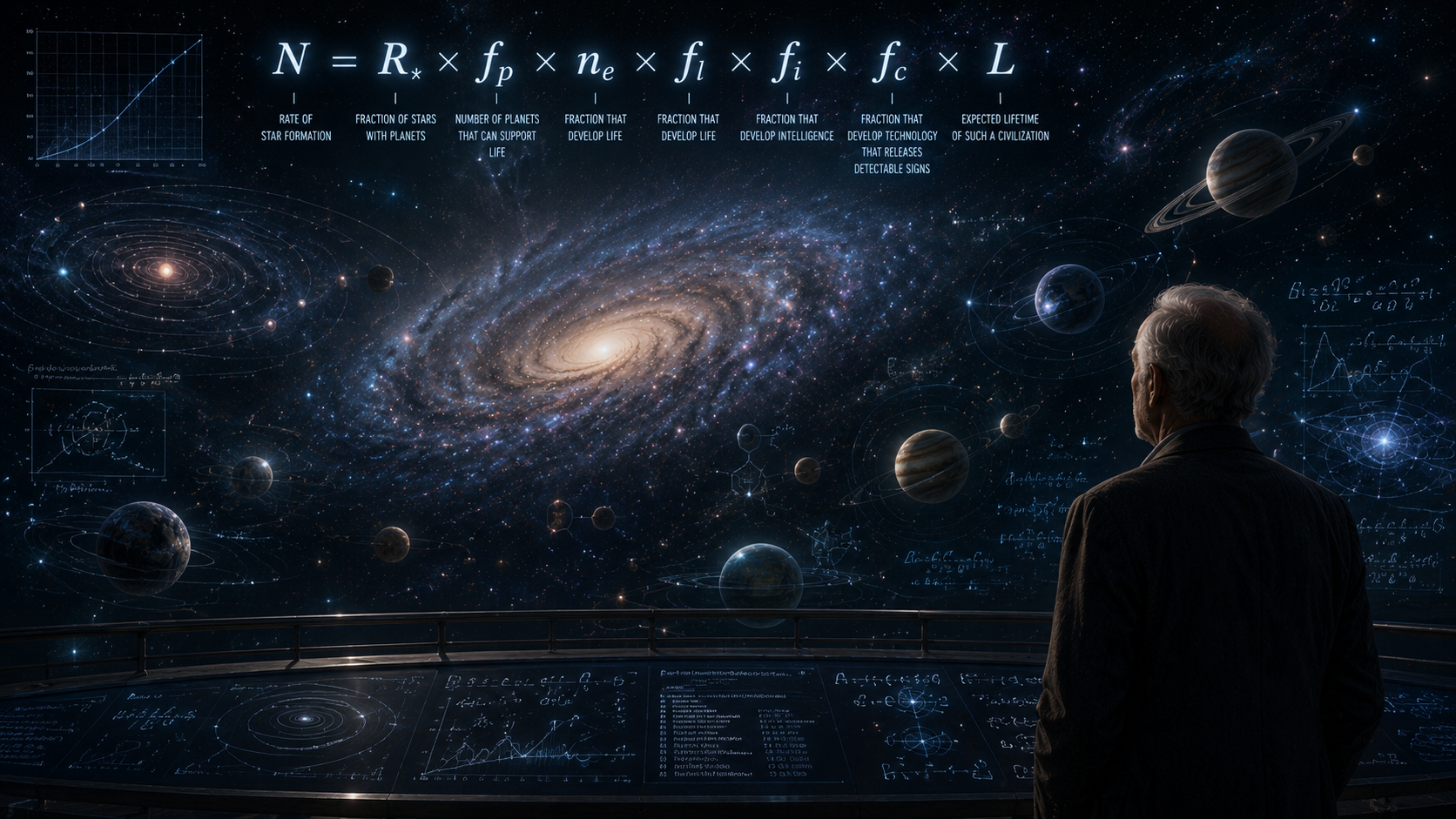
The Drake Equation, formulated by astronomer Frank Drake in 1961, attempts to estimate the number of communicating civilizations in our galaxy by multiplying a series of probability factors: the rate of star formation, the fraction of stars with planets, the fraction of those planets that could support life, and so on down to the fraction of civilizations that develop technology and survive long enough to communicate. It’s a thought experiment dressed up as mathematics, and it has been enormously useful for focusing scientific attention on the right questions.
But it carries a hidden assumption that almost nobody examines: it implicitly treats “civilization” and “communication” as concepts with universal meaning. It assumes that intelligence, wherever it arises, will follow a developmental path that includes technology, radio transmission, and the desire to signal outward. These are not universal properties of intelligence — they are specific properties of human intelligence, products of our particular evolutionary history, our particular social structures, our particular relationship with tools and fire and language.
An octopus is intelligent. It solves problems, demonstrates memory, uses tools. It has been on Earth for countless years and has shown no tendency toward radio astronomy. Intelligence doesn’t imply the kind of intelligence we’re looking for when we scan the skies. The Drake Equation is, at its core, a human document — a projection of human developmental patterns onto a universe that has never shown any particular interest in producing humans.
What Alien Life Probably Looks Like
If life exists elsewhere — and the sheer scale of the universe makes it almost inconceivable that it doesn’t — it almost certainly exists in forms we would struggle to recognize as life at first encounter. Chemistries we’ve never modeled. Structures with no analog in Earth’s fossil record. Sensory modalities that detect aspects of physical reality we have no instruments to measure. Timescales of cognition that are either so fast or so slow that the concept of “conversation” would be meaningless across the gap.
The most profound implication of taking planetary diversity seriously isn’t that aliens are strange. It’s that “alive” and “intelligent” are almost certainly much larger categories than human experience has allowed us to imagine. Life as we know it is not life as it is. It’s life as it happened to work out on one planet, under one set of conditions, over one particular span of time.
The universe is not making copies of us out there. It’s running experiments we haven’t dreamed of yet, under conditions we’ve barely begun to catalog, toward outcomes that may be entirely outside our current conceptual vocabulary. That isn’t a reason for despair. It’s the most exciting scientific frontier our species has ever faced — provided we’re willing to abandon the comfortable assumption that whatever we find out there will have the decency to look back at us with something resembling eyes.
Related Articles
- “The Equations of Life: How Physics Shapes Evolution” — Charles Cockell — https://www.basicbooks.com/titles/charles-s-cockell/the-equations-of-life/9781541617599/
- “Life as We Do Not Know It” — Peter Ward — https://www.penguinrandomhouse.com/books/291711/life-as-we-do-not-know-it-by-peter-ward/
- “The Case Against Cosmic Modesty” — Caleb Scharf, Nautilus — https://nautil.us/the-case-against-cosmic-modesty-236678/