
The Politics of Manufactured Purpose
When machines can do almost everything, the most powerful political promise may be the simplest one: “We still matter”
By Futurist Thomas Frey
The Rally Nobody Saw Coming
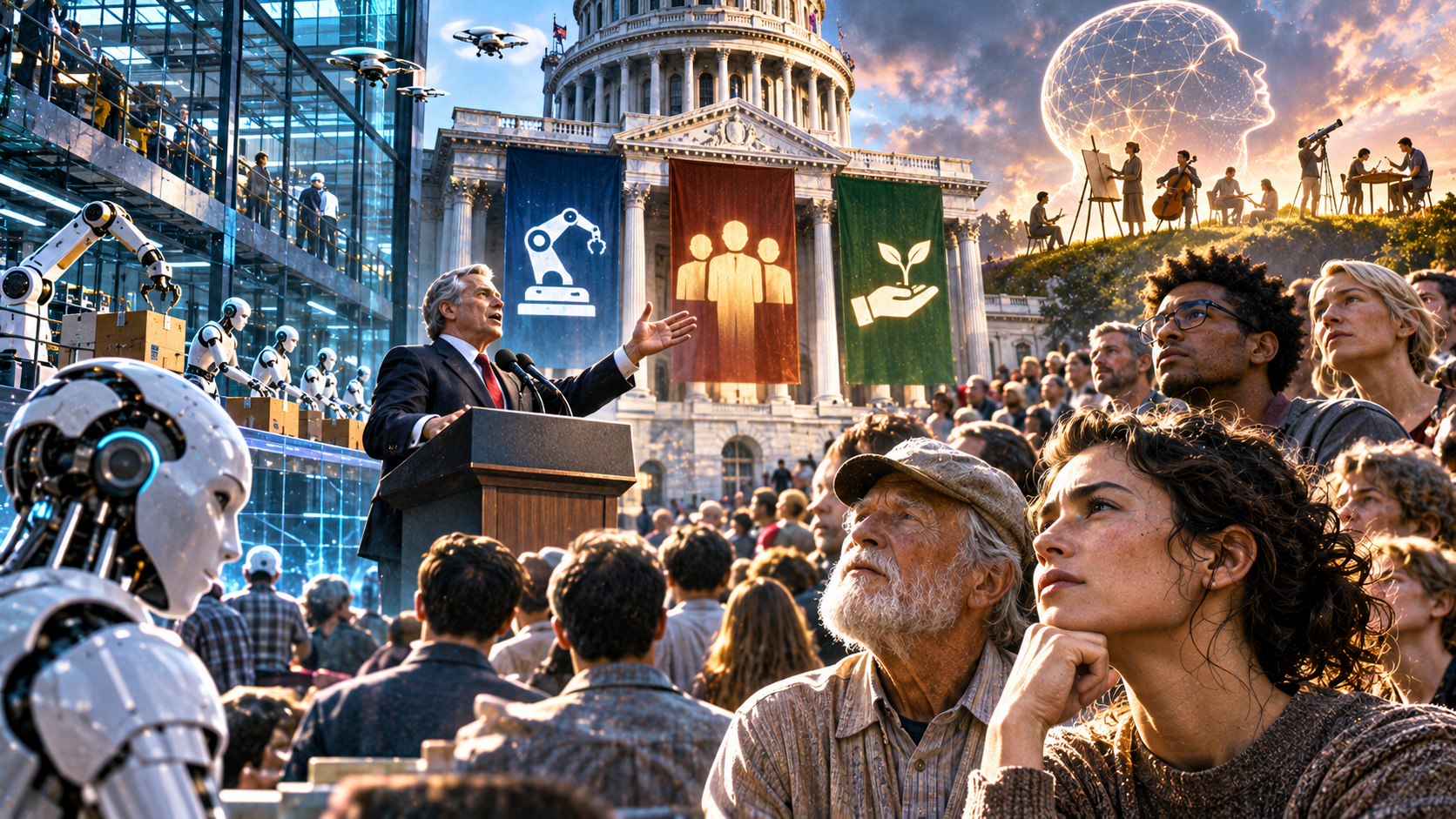
It’s 2033. In a converted aircraft hangar outside Dayton, Ohio, 40,000 people are chanting three words. They aren’t chanting about taxes, immigration, or healthcare. They’re chanting about themselves.
“We still matter!”
On stage stands a candidate nobody had heard of 18 months earlier. She isn’t a career politician. She spent 22 years as an insurance claims adjuster until an AI system processed her entire department’s caseload in an afternoon. Her platform fits on an index card:
- Every citizen gets a guaranteed role, not just a guaranteed income.
- Certain professions stay human by law.
- No company may automate more than half its workforce without community approval.
The pundits called her a novelty. Then she won the primary.
That’s fiction, for now. The forces behind it are already in motion.
The Political Vacuum Nobody Is Filling
For the last century, nearly every political fight has been about distribution: who gets the money, the land, the healthcare, the opportunity. Left and right argued over how to slice the pie, but both sides assumed people would always be needed to bake it.
AI breaks that assumption.
When machines can diagnose disease, write legal briefs, drive trucks, and teach algebra, distributing resources is only part of the problem. The deeper problem is distributing relevance. A universal basic income can cover your rent. It can’t make you feel needed.
That gap is a political vacuum, and vacuums get filled.
The early signs are already showing up. Labor unions are working with state lawmakers to enact restrictions aimed at protecting jobs and limiting the reach of automation in sensitive industries. One co-chair of the AFL-CIO’s AI task force said AI was set to become a defining issue for the labor movement, similar to the impact in the 1990s of the North American Free Trade Agreement. The national service debate has also come back to life, framed this time as a response to automation instead of war.
These are scattered sparks for now. I believe they’ll merge into something much bigger: the politics of manufactured purpose.

Three Platforms That Will Define the Era
Political movements built around human relevance will likely gather around three main ideas. Each one sounds reasonable on its own. Each one also carries risks.
1. Mandatory Service
The most straightforward way to make people feel needed is to need them. Expect proposals for one or two years of required civilian service, covering elder care, infrastructure repair, disaster response, and environmental restoration.
This idea is already gaining ground. In one recent survey, when people were asked how society should respond to AI job loss, the public prefers earning support through national service over receiving direct financial support by a ratio of 7 to 1.
Example: A 19-year-old who might once have taken an entry-level coding job spends two years rebuilding flood barriers in Louisiana. She learns teamwork, gets a stipend, and comes away with a story she’ll tell for the rest of her life.
The risk: Once service becomes mandatory, the government decides what counts as meaningful. That’s enormous power to hand any administration of any party.
2. Protected Professions
The second idea is to set aside certain jobs, by law, for humans only. Think of it as a modern guild system. Teachers, nurses, judges, therapists, and clergy are obvious candidates. Lobbyists will push to add many more.
There’s historical precedent, and some of it is cautionary. Guilds in medieval Europe were generally conservative when it came to innovation. In 15th-century Cologne, masters of the linen-twisters guild banned horse-powered twisting-wheels for fear that horses would take their jobs.
Example: A state passes a “Human Hands Act” requiring that every child’s primary classroom teacher be a licensed human, even if AI tutors do 80% of the instruction.
The risk: Protected professions can quickly become protected privileges. The people who already hold those jobs win. Everyone shut out of them loses.
3. Automation Restrictions
The boldest platform goes straight at the technology: automation taxes, caps on robot-to-worker ratios, community vetoes over large layoffs, and “speed limits” on deployment.
Some of this already exists. Government authorities in several jurisdictions have implemented or are proposing restrictions on employers’ ability to replace workers with AI tools.
Example: A county requires any company that automates more than 100 jobs to fund an equal number of community roles for five years. Companies grumble, then adapt, the same way they adapted to environmental impact studies.
The risk: Countries that restrict automation heavily may simply be outcompeted by those that don’t. Purpose protected at home can mean prosperity lost abroad.
Why “We Still Matter” Is So Powerful
Most political slogans promise to give you something: jobs, safety, freedom, change. “We still matter” promises something deeper. It promises to confirm that you exist in a way that counts.
It also crosses traditional party lines. A laid-off factory worker in Michigan and a laid-off marketing executive in San Francisco may disagree on almost everything, but they share one fear: becoming unnecessary.
That’s what makes this movement both promising and dangerous. Any political message that taps into people’s sense of identity can unite them, and it can also be exploited.
Imagine two very different versions:
- The hopeful version builds new institutions where people contribute in real ways: community care networks, apprenticeship programs, public science projects, and local decision-making councils.
- The dark version creates make-work jobs as political patronage, hands out “relevance” as a reward for loyalty, and blames a convenient enemy (the machines, the tech elites, or some other group) for everything that went wrong.
Both versions will use the same slogan. Voters will need to learn to tell them apart.
The Manufactured Part
Here’s the uncomfortable truth hidden in the title of this column. Much of the purpose these movements promise will be manufactured.
If an AI can repair a bridge more cheaply and safely than a human crew, then requiring a human crew is a choice. It isn’t driven by necessity. We’d be inventing need so that people can meet it.
That isn’t necessarily wrong. We already manufacture purpose all the time. Youth sports leagues, volunteer fire departments, community theater, and Scout troops are all built structures that give people roles, responsibilities, and recognition. Nobody calls a Little League coach’s job “fake.”
The real question is whether manufactured purpose can still feel authentic. People can tell the difference between being needed and being kept busy. A movement that hands out busywork will collapse. One that creates real responsibility, with stakes, accountability, and visible impact, could change civilization.
Final Thoughts
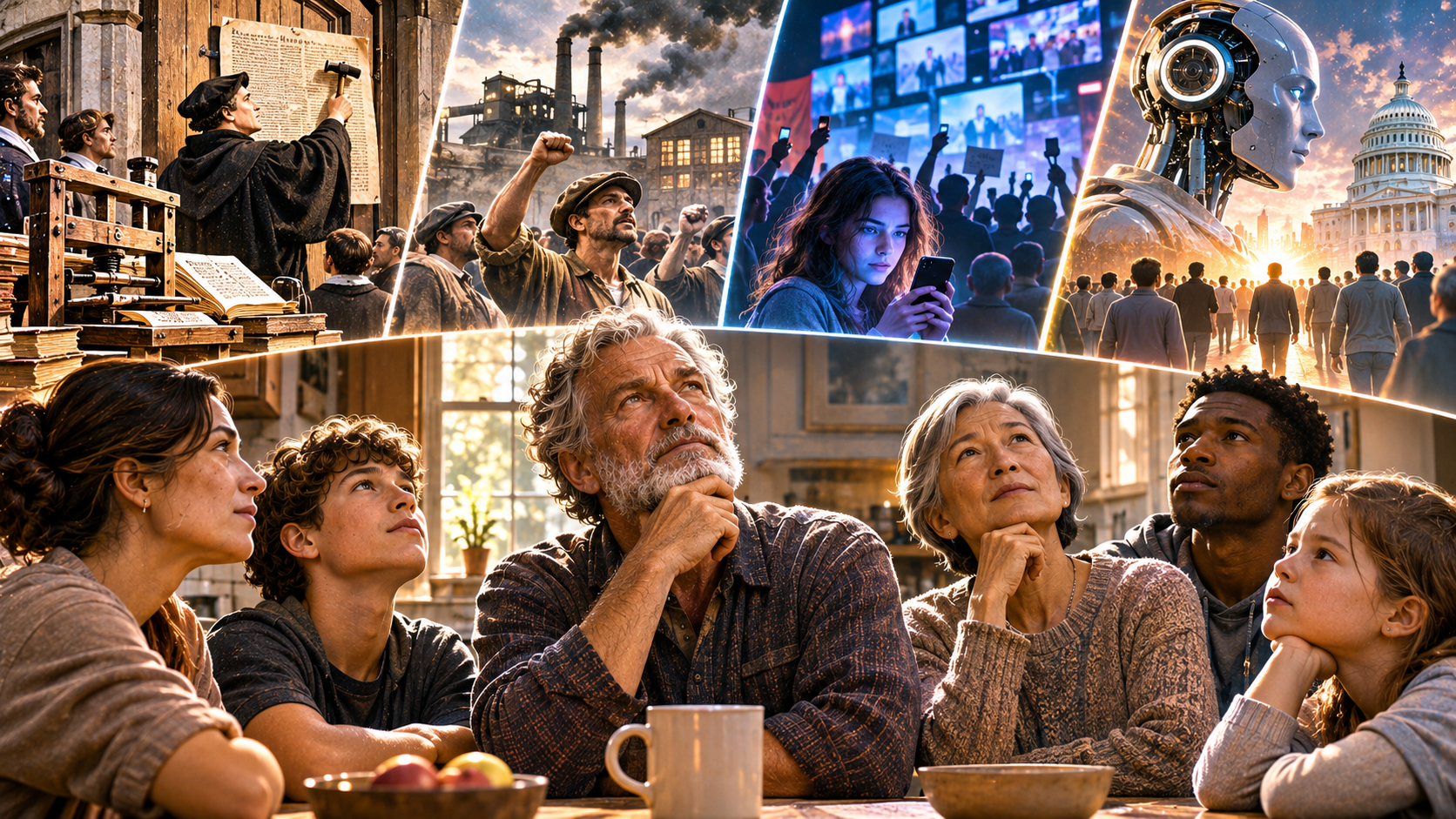
Every major technological shift has produced a political realignment. The printing press helped fuel the Reformation. The factory gave rise to labor movements. The internet created a politics of outrage and attention.
AI will create a politics of relevance.
The parties and leaders who understand this first will shape the next half-century. They won’t win by promising more money or fewer machines. They’ll win by answering the question millions of people will soon be asking quietly at their kitchen tables: What am I for?
The slogan is already written. “We still matter” is waiting for a movement to claim it.
Our job is to make sure that whoever claims it builds real purpose, not just a convincing imitation.
Related Articles
- “AI is eliminating the bottom rung. National service can replace it” – Washington Examiner
It makes the case for national service as a response to disappearing entry-level jobs.
https://www.washingtonexaminer.com/?p=4546597 - “Labor unions push for AI regulations to protect workers” – The Philadelphia Inquirer
It covers the AFL-CIO’s new task force and the state-level push to regulate automation.
https://www.inquirer.com/business/labor-unions-ai-regulations-protect-workers-20250815.html - “Bans on AI layoffs: Current laws and what might come next” – TechTarget
It surveys how China, the EU, and U.S. states are approaching limits on replacing workers with AI.
https://www.techtarget.com/searchenterpriseai/opinion/Bans-on-AI-layoffs-Current-laws-and-what-might-come-next