
A museum built around humanity’s first real upgrade to the human senses
By Futurist Thomas Frey
Every museum in this series has explored a technology reshaping the world from the outside — robots, synthetic organisms, space habitats, quantum machines. This one is different. It’s not about a new kind of object. It’s about a new kind of you.
For 300,000 years, human situational awareness has run on the same operating system: two eyes, two ears, a nose, and a brain doing its best to stitch fragments of sensory data into an accurate picture of the world. That system got us out of the savanna and into cities, but it was never built for a world of wildfires, orbital debris, and information moving faster than any nervous system evolved to track. We are now in the early stages of upgrading that system for the first time in our species’ history — and a museum built around that upgrade wouldn’t just display new technology. It would let visitors briefly experience what it feels like to perceive more than a human body was ever designed to.
Welcome to the Museum of Expanded Perception.
Why This Museum Belongs in the Same Family as the Others
Every institution in this series has made the same underlying argument: the most important technologies of the next fifty years are best understood by standing next to them, not reading about them. Robots need a Robotarium. Synthetic biology needs a living materials lab. Quantum mechanics needs a room you can physically walk through.
Situational awareness technology deserves the same treatment, arguably more urgently than any of them, because it’s the one category already quietly embedded in daily life without most people realizing it. A firefighter’s smart helmet, a satellite tracking system, a smartwatch that knows to warn you before a storm arrives — none of these show up in a highlight reel the way a humanoid robot does. This museum’s job is to make the invisible upgrade visible.
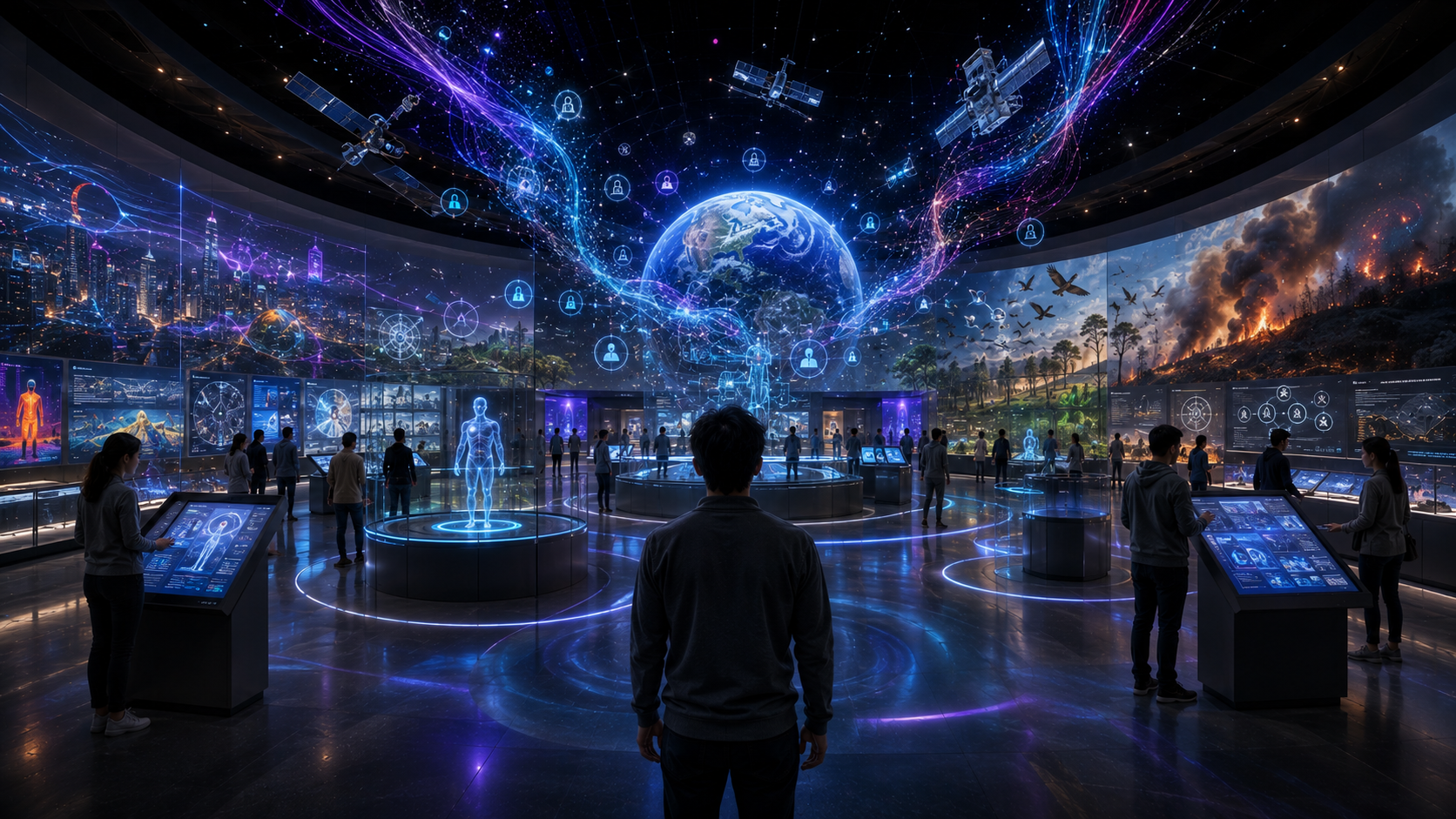
The Frontline Gallery: Where Expanded Senses Save Lives
The first gallery opens with the clearest, highest-stakes proof that this technology matters: emergency response. Firefighters already use forward-looking infrared cameras built into their gear, letting them see heat signatures through smoke and total darkness, finding victims and navigating collapsed structures faster than unaided human eyesight ever could. Research teams have gone further still, developing smart helmets that layer additional environmental data directly onto existing firefighting equipment.
This gallery would let visitors put on a version of that same infrared visor and walk through a simulated smoke-filled room, watching heat signatures resolve out of what looks, to the naked eye, like total darkness. It’s the fastest possible way to make an abstract statistic — lives saved by expanded perception — into a felt, physical experience.
The Orbital Gallery: Awareness Beyond the Human Body
The second gallery takes the same core idea and stretches it somewhere no human sense organ could ever naturally reach: low Earth orbit. As commercial satellite launches accelerate, space is becoming dangerously crowded, and traditional tracking — built on manual analysis — can no longer keep pace. AI-powered systems now fuse data from ground telescopes, radar, and space-based sensors into a single, continuously updated map of everything orbiting the planet, catching debris and unregistered objects human analysts would likely miss.
The centerpiece here is a real-time orbital map projected across the gallery’s ceiling, pulling from actual public tracking data, letting visitors watch collision risks get identified and resolved the same way mission controllers do — an entire planet’s worth of traffic control, made visible above their heads.
The Security Gallery: From Passive Recorder to Active Interpreter
The third gallery tackles the shift happening in professional security and defense work, where wearables are moving from passive recorders to active decision-support tools — devices that don’t just capture what’s happening, but interpret it and tell the wearer what to do about it. Industry analysts point to this year specifically as the moment agentic AI, digital twins, and AR wearables move from hype into daily frontline use.
Visitors here would try on AR glasses that overlay real-time threat and hazard identification onto an ordinary room, experiencing firsthand the difference between a camera that merely records and a system that actively watches on your behalf.
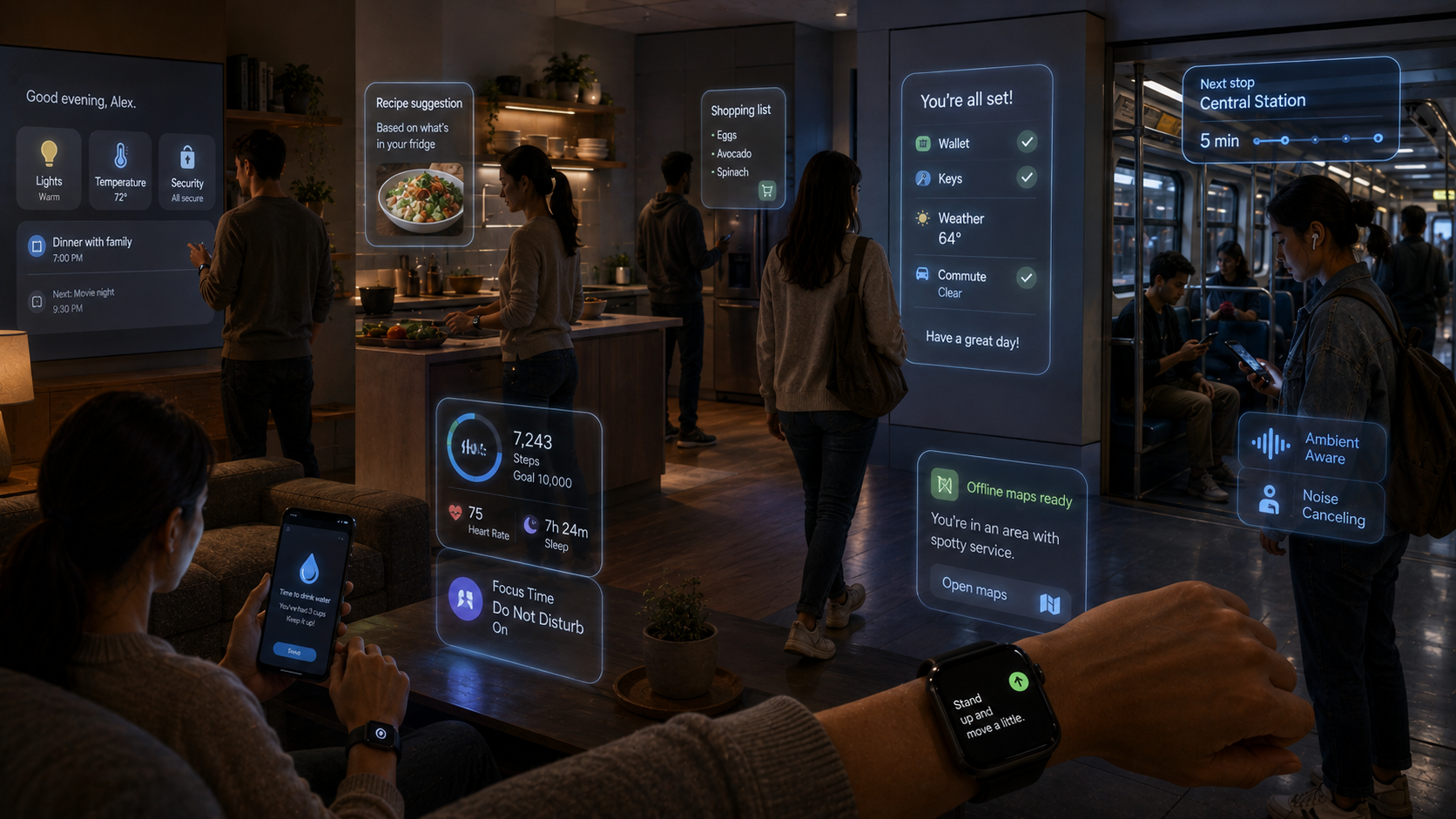
The Everyday Gallery: The Upgrade Hiding in Plain Sight
The fourth and final gallery is deliberately the least dramatic — and the most important, because it’s the one most visitors are already carrying in their pocket without realizing what it represents. Consumer wearables have quietly built context-aware systems that draw on location, activity, and routine data to surface exactly the right information at exactly the right moment — suggesting an offline navigation tool the instant you lose cell coverage on a hike, or letting earbuds toggle between full environmental awareness and focused isolation depending on what a commuter actually needs.
This gallery would be staged like an ordinary living room, kitchen, and commute — visitors’ own devices lighting up with real examples of context-aware assistance as they move through the space, making the case that the “future” this museum is describing isn’t ten years away. It’s already running quietly in most visitors’ pockets.
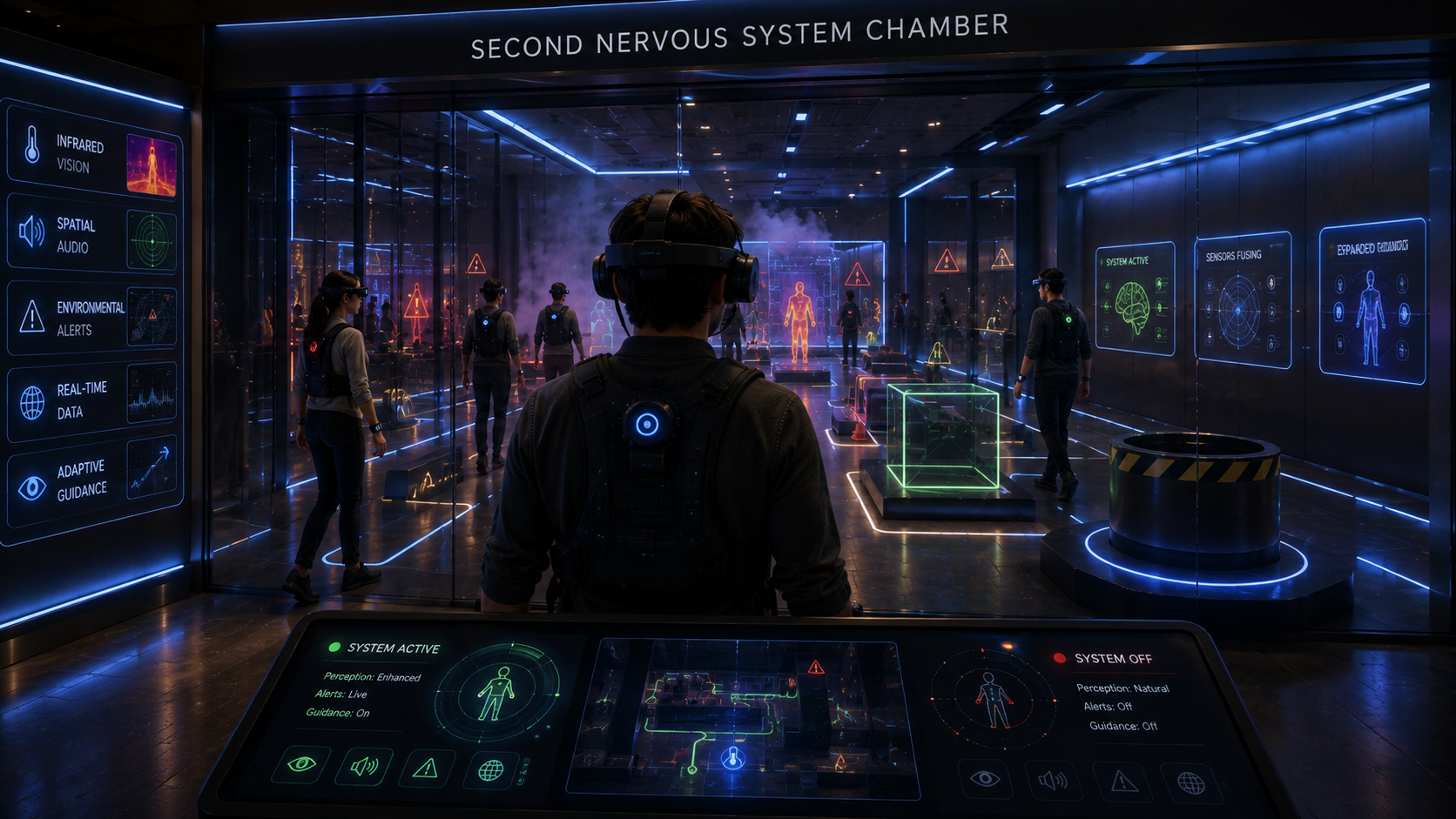
The Signature Exhibit: The Second Nervous System Chamber
Every museum in this series needs one exhibit visitors travel specifically to experience, and for the Museum of Expanded Perception, it has to be the Second Nervous System Chamber — a fully equipped walk-through room where visitors briefly wear a combination of the technologies from every gallery at once.
Inside the chamber, visitors put on a headset layering infrared vision, spatial audio cues, and real-time environmental alerts over their normal senses. As they move through a deliberately disorienting obstacle course — dim lighting, hidden objects, sudden simulated hazards — the system highlights heat sources, flags obstacles before visitors consciously notice them, and gently redirects attention toward information a person’s unaided senses would have missed entirely.
Then, halfway through, the system shuts off. Visitors finish the same course using only their natural senses, and the contrast lands immediately: the same room, suddenly slower, blurrier, and more uncertain. It’s the single clearest way to make an abstract idea — the gap between human perception and the world’s actual pace — into something a visitor feels in their own body, then watches disappear the moment the system powers back on.
The Tradeoff the Museum Doesn’t Shy Away From
A museum built entirely around expanded perception has an obligation to end with an honest question, not just a celebration. Every device that watches the world on your behalf is also, by definition, capturing data about that world — and about you. A firefighter’s helmet feeding data back to command is an obvious safety win. A security wearable capturing everything an employee sees throughout a shift raises real questions about consent and who controls that record.
The final room of the museum poses that tradeoff directly to visitors, without resolving it for them: as perception expands, so does the record of what was perceived, and who gets to keep it.
A Museum for the Upgrade Already Underway
The species that spent 300,000 years working with the same two eyes and two ears is quietly building itself a second nervous system, one wearable, one sensor, one AI-fused dataset at a time. Most museums document technology after it’s already changed the world. This one has a rarer opportunity: to let visitors feel the change happening to their own perception, in real time, before they walk back out into a world that’s already upgrading around them.
Related Articles
- Information Technology and Innovation Foundation (ITIF) — The Promise of Wearable AI: Opportunities Across Emergency Response
- MarketsandMarkets — The Future of Space Situational Awareness Industry with AI
- SecurityBrief — From hype to reality: The three forces defining security in 2026