The Future of the Grocery Store
What Happens When Shopping Stops Requiring a Shopper
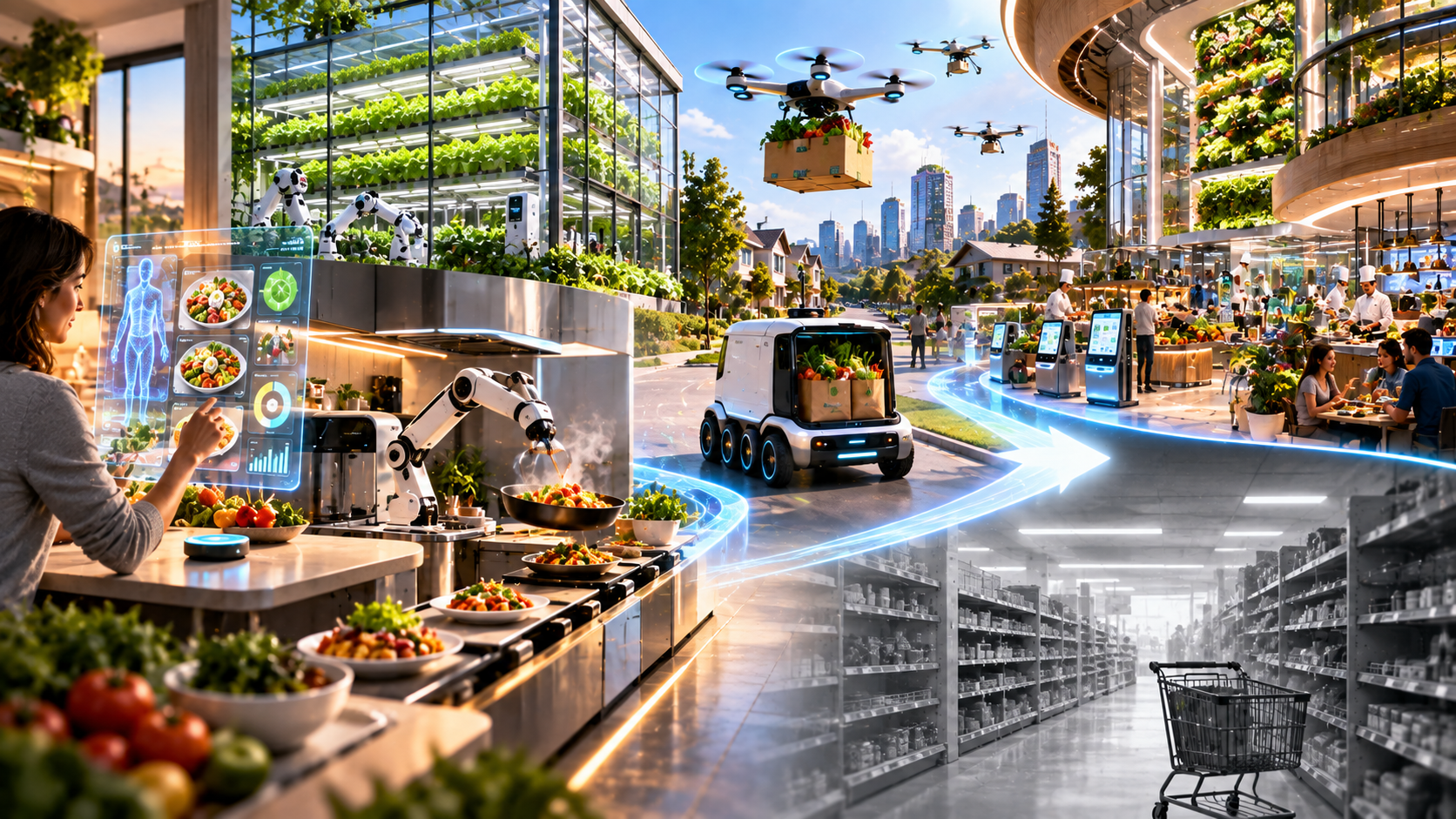
Predictive purchasing, automated kitchens, personalized nutrition, robotic delivery, and locally produced food could steadily eliminate reasons to wander supermarket aisles. Grocery stores may evolve into food-production and experience centers — or disappear from some communities altogether.
I want you to picture something that would have sounded like science fiction a decade ago, but that a handful of grocery chains are already building toward right now: you tell an AI assistant you want a healthy dinner your kids will actually eat for under forty dollars, and a complete shopping cart appears in seconds — priced, in stock, matched to your family’s preferences and your usual store — without you ever touching a single aisle.
This isn’t a hypothetical. At Groceryshop 2026 in Las Vegas, Instacart’s CEO opened the conference with exactly that example, telling an audience of more than 4,000 retail leaders, “I believe that AI is going to transform grocery more than any other technology shift to date.” DoorDash reported that customers using its new conversational shopping tool are building baskets fifty percent larger and checking out five times faster than customers using a traditional app. Kroger, one of the largest grocers in America, is now openly exploring what it calls a “managed service” model, where you stop making a weekly list altogether and simply hand your goals to an AI agent that plans and completes the shop for you.
The grocery store, as a physical destination you navigate with a cart and a list, is being quietly dismantled from the inside. The question worth asking isn’t whether this happens. It’s what’s left standing once it does.
The Death of the Average Shopper
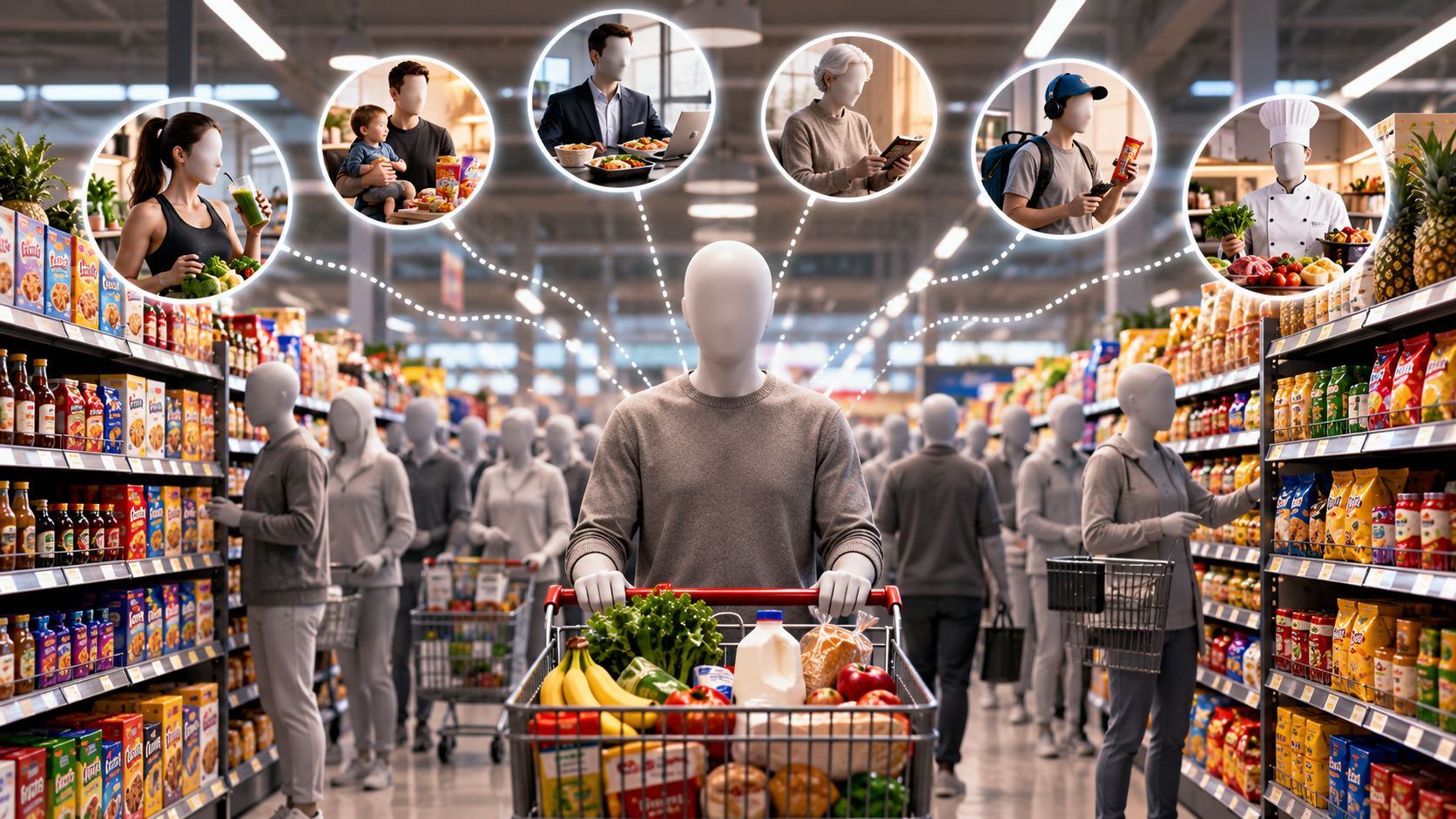
For most of the history of modern retail, the grocery store was built around a mythical figure: the average shopper. Aisles, shelf placement, store layout, even advertising were all optimized for a generic customer who didn’t actually exist, but whose habits were close enough to everyone’s to make mass merchandising work.
That figure is now officially extinct. Nielsen research presented at Groceryshop found that financially stretched households now make up a third of the U.S. population, up seventeen percent since 2022, while grocery as a category has lost five billion dollars in shopping trips over three years as people scatter across warehouse clubs, mass retailers, and convenience formats instead. As one NielsenIQ executive put it bluntly at the conference: “Consumers are no longer hunting for a deal, they’re assembling one.” Add in the rapid rise of GLP-1 medications, which are measurably shrinking basket sizes while shifting spending toward protein and nutritional density, and you get a shopper who increasingly buys less, more selectively, and often without ever physically entering a store.
When there’s no longer an average shopper to design a store around, the store itself loses its organizing logic.
Why Amazon Walked Away From Its Own Grocery Experiment
Nothing illustrates this shift more starkly than Amazon’s retreat from its own Amazon Fresh stores — a decision that looked, on the surface, like an admission of defeat from a company that had poured cashierless checkout, sensor-laden ceilings, and computer-vision carts into reinventing the physical grocery aisle. It wasn’t defeat. It was a recognition that grocery retail runs on margins of one to three percent, leaving almost no room for the cost of heavy in-store sensor infrastructure, and that frictionless checkout — however impressive as engineering — never fundamentally changed the fact that most people still want to browse produce, compare brands, and make spontaneous food decisions in person.
Amazon’s real advantage was never the storefront. It was warehousing, routing, predictive demand modeling, and last-mile delivery — the invisible infrastructure behind the store rather than the store itself. By stepping back from physical Fresh locations, Amazon is betting that the future value in grocery lives in logistics and data, not glass storefronts and shelf space. That’s a strategic signal worth taking seriously from a company with more grocery data than almost anyone else on earth.
The Store That Watches Itself
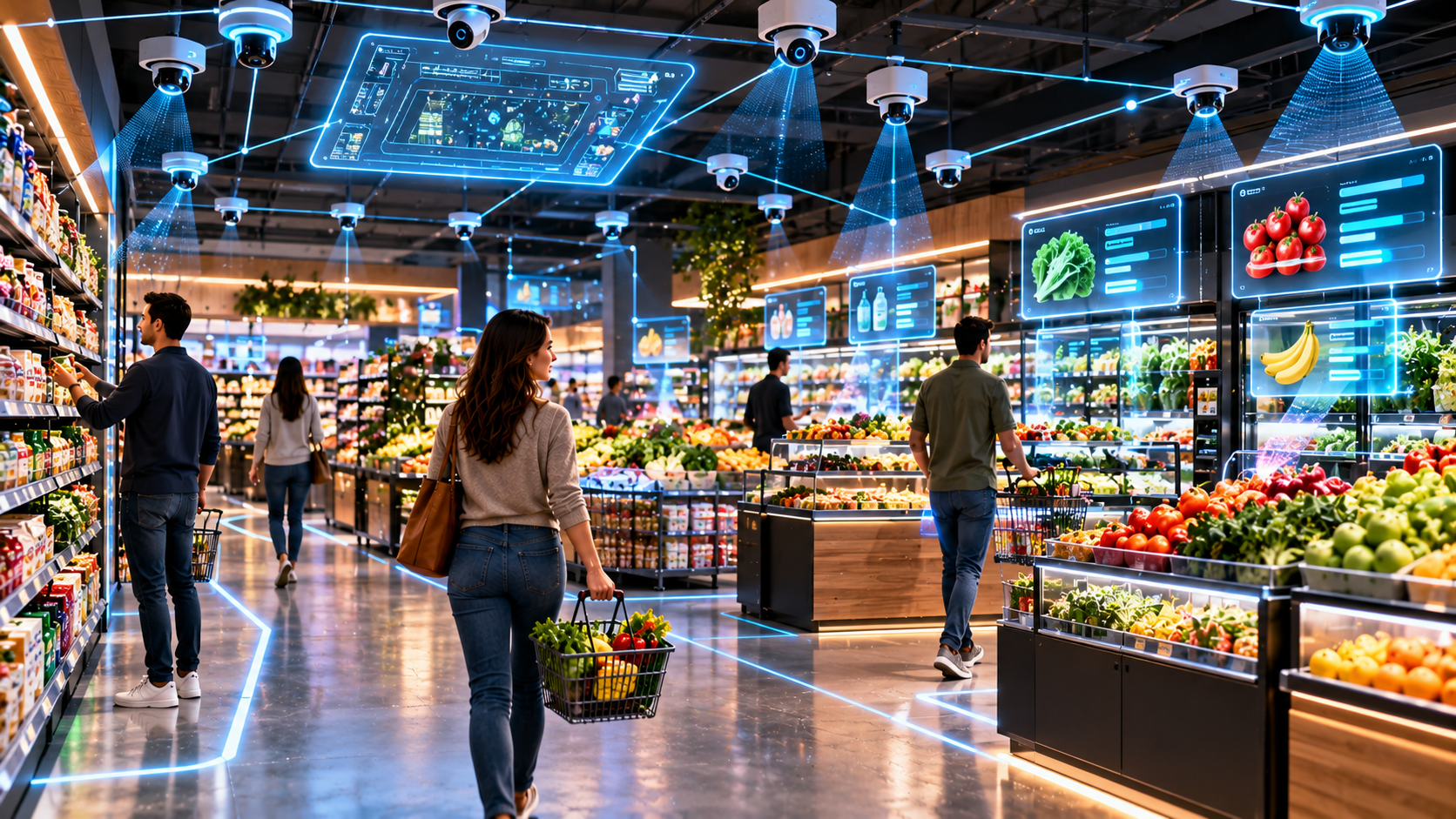
Here’s a subtler shift happening at the same time: even stores that stay open physically are quietly turning into something closer to a sensor network than a retail floor. Startups are retrofitting existing supermarkets with dense camera arrays and edge computing that enable checkout-free shopping and continuous, real-time inventory tracking — without requiring retailers to rebuild their stores from scratch.
Think about what this actually means on the ground. A conventional grocery store knows what it sold only after the fact, through receipts tallied at the register. A sensor-equipped store knows, in real time, which shelf is nearly empty, which end-cap display is actually drawing attention, and which product just got picked up and put back down by an undecided shopper. The store becomes a continuously learning system, feeding operational intelligence back into pricing, staffing, and restocking decisions — a foundation less for making you browse longer and more for making your visit, when you do make one, feel almost unnervingly frictionless.
Why the Food Might Not Travel Anymore
The final, and perhaps most physically dramatic, piece of this transformation is where the food itself gets made. Deloitte’s grocery industry research describes a shift from “mass to micro” — away from centralized production shipped long distances and toward hyperlocal systems that bring the growing and processing of food much closer to where it’s actually eaten. In Deloitte’s own survey, seven out of ten grocery executives said they now expect to shift their supply chains from global sourcing toward more local alternatives, explicitly to cut food miles, reduce spoilage, and offer fresher products on demand.
Picture a grocery store ten years from now that still has a produce section — except the lettuce was grown in a vertical farming module built into the back of the same building that morning, never trucked in from a thousand miles away, never losing freshness to days in transit. Or imagine a micro-factory tucked into a distribution hub, assembling private-label products on demand for a specific regional store rather than shipping identical pallets nationwide from one giant central plant. This isn’t speculative engineering — companies are already deploying exactly these distributed micro-factory models at retail locations and distribution hubs today, explicitly aimed at making hyperlocal food production viable at commercial scale.
What Actually Survives in the Physical Store
Given all of this, it would be easy to conclude that the grocery store as a physical place is simply doomed. I don’t think that’s quite right, and the data backs up a more interesting conclusion: shoppers haven’t stopped wanting a physical food experience — they’ve just stopped wanting it for routine replenishment.
What survives in-store is almost certainly the part AI and automation handle worst: genuine sensory discovery. Inspecting a ripe avocado by hand. Catching sight of an unfamiliar spice and deciding on impulse to try it. Running into a neighbor near the bakery counter. Watching a loaf actually get baked by a machine in a vertical farming display you can see through glass. The store of the future likely narrows its job considerably — from “the place where all food shopping happens” to “the place where food becomes an experience rather than a transaction” — while nearly everything routine, predictable, and list-based quietly migrates to an AI agent that handles it before you ever think to ask.
My Prediction: The Bifurcated Grocery Future
I believe grocery is heading toward a genuine split rather than a single future. In dense, affluent communities, physical stores survive and even flourish by becoming smaller, more experiential, more production-visible spaces — part market, part demonstration kitchen, part social hub — while the routine restocking of staples disappears almost entirely into predictive, AI-managed replenishment that arrives at your door before you’ve consciously run out. In lower-margin, less densely populated communities, where the economics never supported an experiential retrofit in the first place, physical grocery stores may simply close, leaving residents dependent on delivery networks and micro-fulfillment hubs for anything beyond what a dollar store or pharmacy already stocks.
That split carries a real risk worth naming honestly: the communities that already struggle most with food access could be the ones least likely to retain a walkable grocery store at all, even as wealthier neighborhoods gain more delightful, more local, more experiential food destinations than ever before. The technology making all of this possible is remarkable. Whether it gets deployed in a way that serves every community, or only the ones that can already afford the experience, remains the genuinely open question — and it’s one worth grocery executives, city planners, and policymakers answering together, before the aisles quietly empty out on their own.
Related Articles
- “Groceryshop 2026: AI Agents Are Now Building the Grocery Basket” — RetailNews.ai — retailnews.ai/article/groceryshop-2026-ai-agents-grocery-basket
- “The Grocery Store Is Disappearing as These Startups Reveal the Future of Grocery: Robots, AI, and Invisible Stores” — Sparknify — sparknify.com/post/20260127-grocery-store-is-disappearing-en
- “What Does the Future Hold for Grocery Stores?” — Relocalize — relocalize.com/blog/future-grocery-stores