3D food printers have been able to create very basic food items, such as sugar sculptures and very simple pizzas — but now a team of researchers at Columbia University has developed a machine that can make more complex snacks.
At Food Ink, the main draw isn’t even the food, but the way in which it’s made. You see, everything at this London concept restaurant is 3D-printed. From the dishes to the dishes upon which they sit, you’re eating at the throne of technology. Because who wants hand-prepared meals when they can be printed? Continue reading… “The chef is a 3D printer at this restaurant”
Batteries are becoming more and more crucial in our lives every year. From our smartphones to our laptops, and increasingly even our cars, batteries make the world go round. The only problem is that today’s generation of lithium batteries are increasingly incapable of providing energy on a scale that we need – especially when it comes to the charges they hold and the time it takes to recharge them. But there is a solution on the horizon, and it is being made possible by a radical material shift. For scientists from Swinburne University in Melbourne, Australia, have developed a new battery (technically speaking a supercapacitor) made from 3D printed graphene, which can hold a larger charge of energy, is recharged in a matter of seconds and will last a lifetime.
Another breakthrough has been made in the world of 3D printing as new tiny cameras have now been developed using this technology that is small enough to be injected into the human body with just a standard syringe. That is pretty impressive! These tiny, microscopic cameras are the size of a grain of salt, but they could transform the world of healthcare as we know it.
Mobile phones hold a trove of personal information that can be valuable to law enforcement investigating serious crimes, but they are notoriously hard to get into without a passcode or the owner’s fingerprint.
Police in the US found a way around this difficulty by 3D printing a murder victim’s finger to gain access to their smartphone and hopefully find evidence that would lead to the perpetrator of the crime.
Disney Research has been on a serious roll with its 3D printing innovations and 3D printing patents. Fromhigh-res 3D printing processes, to replicating reflective properties onto 3D printed surfaces, to 3D printed wall-climbing robots, it seems as though Disney is looking to redefine how movie merchandise is made using 3D printing technology. But their latest study shows that they are also keen to bring 3D printing principles to other industries, for they have developed a new compiler that lets knitting machines behave like 3D printers and easily produce customized objects.
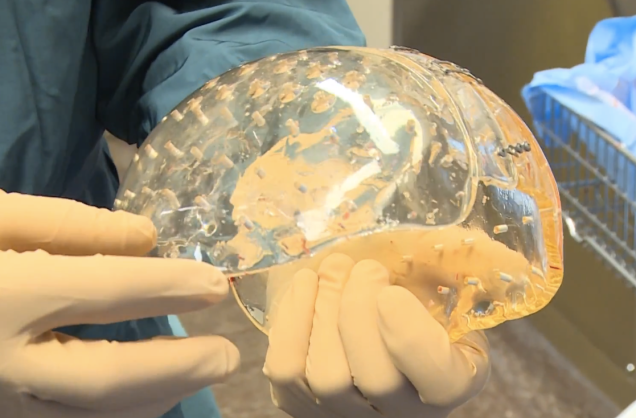
Surgeons in Holland implanted a transparent plastic skull in a woman whose skull has never stopped growing. The rare bone disease that was wrecking her vision and destroying her life has been been bested by a simple 3D printer. The team of surgeons, led by Dr. Bon Verweij at the University Medical Center in Utrecht, expect her new skull to last indefinitely.
According to a recent UK study, the average woman spends roughly one year and three months of her life applying makeup—that translates to over three hours every single week, or 28 minutes a day—never mind the amount of time we spend touching it up over the course of the day and then taking it all off at night. While that number seems extreme, I have to admit that I’m probably one of those women.
Creator of the world’s first 3D-printed cars, Local Motors, has developed the first self-driving “cognitive” vehicle, using IBM Watson Internet of Things (IoT) for Automotive. It’s set to debut later this year in Washington DC.
MIT researchers have invented a radical pixel-mapping printing technique by bypassing computer-aided design (CAD) software. They have quickly and efficiently modeled and printed thousands of hair-like structures.
The smart Spider Dress, powered by Intel Edison, blends fashion with robotics and wearable technology to express the wearer’s emotions and protect their personal space. This is the just the beginning of where we can go with the latest wearables.
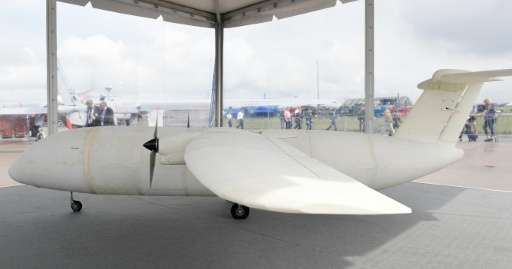
Dwarfed by huge jets all around, the mini-plane Thor was an eye-catcher at the Berlin air show this week. The small Airbus is the world’s first 3D-printed aircraft.