Home energy storage market set to grow 10 times over by 2018

energy storage

Costs for home energy storage are dropping fast.

A few years ago, most people didn’t have any idea the home solar PV market would grow so fast. But it has, and there’s no stopping its momentum now. Similarly, there aren’t many people that realize how fast the home storage market is going to grow.


Continue reading… “Home energy storage market set to grow 10 times over by 2018”

Is the realtor an endangered species?

real-estate

So far real estate brokers have done very well in the Internet era.

Last month, around 18,000 people gathered in New Orleans to look at the future of real estate brokerage. Inside the massive Ernest N. Morial Convention Center booth after booth at the 2014 Realtors Conference & Expo extolled the joys and efficiencies of the new electronic economy and the technologies which can make brokers and lenders more efficient and profitable.


Continue reading… “Is the realtor an endangered species?”

The technology-driven future will bring upheaval and opportunity

Thomas-Frey

Futurist Thomas Frey

Thomas Frey, executive director and senior futurist at the DaVinci Institute estimates that billions of jobs will disappear in the next 15 years due to the Internet of Things (IoT) and many associated technological advances, but these extreme and accelerating changes will also create many new industries and countless new jobs to replace those they’ve eliminated.


Continue reading… “The technology-driven future will bring upheaval and opportunity”

The world reshaped in 2015: The end of the population pyramids

population pyramid

Demographers, teachers and politicians will stop talking about the population pyramid and start referring to the population dome in 2015. The change in terminology will reflect a profound shift in the shape and structure of societies. This is a shift that has been going on for 50 years and is only half complete.


Continue reading… “The world reshaped in 2015: The end of the population pyramids”

What mobility will look like in 2025

future mobility 2

On any given morning in the year 2025, you’re running late for work, but your self-driving car senses you coming and gets ready to pick you up. Once you’re inside, it syncs with your mobile devices, calculates the least congested route, and finds someone else heading in the same direction, so your cars can link up to save space on the road. As the car drives, you catch up on email.


Continue reading… “What mobility will look like in 2025”

The Swasthya Slate – an affordable diagnostic machine that could disrupt health care

Swasthya

Kahol built a prototype of a device called the Swasthya Slate (which translates to “Health Tablet”).

Kanav Kahol was a member of Arizona State University’s department of biomedical informatics. He became frustrated at the lack of interest by the medical establishment in reducing the costs of diagnostic testing, and seeing almost no chance of getting the necessary research grants he returned home to New Delhi in 2011Kahol had noted that, despite the similarities between most medical devices in their computer displays and circuits, their packaging made them unduly complex and difficult for anyone but highly skilled practitioners to use. And they were incredibly expensive — costing tens of thousands of dollars each.


Continue reading… “The Swasthya Slate – an affordable diagnostic machine that could disrupt health care”

Nanosize batteries could revolutionize green energy

nano battery

The latest breakthrough in the search for lighter, more potent batteries is small battery made up of a billion nanopores, or microscopic holes capable of producing electric current.

Nanosize batteries that are 80,000 times thinner than a human hair could revolutionize green energy. They could advance the use of electric vehicles, now limited by short driving ranges, and of renewable energy, which needs storage for times when the wind doesn’t blow or the sun doesn’t shine.

Continue reading… “Nanosize batteries could revolutionize green energy”

Why we need radical change in the disease-model of mental health

conversation with a therapist

It is difficult reliably to distinguish different “disorders.”

By Peter Kinderman: The idea that our more distressing emotions such as grief and anger can best be understood as symptoms of physical illnesses is pervasive and seductive. But in my view it is also a myth, and a harmful one. Our present approach to helping vulnerable people in acute emotional distress is severely hampered by old-fashioned, inhumane and fundamentally unscientific ideas about the nature and origins of mental health problems. We need wholesale and radical change, not only in how we understand mental health problems, but also in how we design and commission mental health services.


Continue reading… “Why we need radical change in the disease-model of mental health”

Exposure to environmental factor linked to huge rise in ADHD: Study

Sticking out tongue

Exposure to a component of air pollution increases the chances of children developing ADHD by five times.

A link between rising air pollution in urban areas and the rapid increase in diagnosis in ADHD (Attention Deficit Hyperactivity Disorder) has been discovered in a new study.


Continue reading… “Exposure to environmental factor linked to huge rise in ADHD: Study”

Data deluge will disrupt medicine within this decade

exponential-medicine

Health and medicine will undergo a greater transformation than any other industry or field in the next decade.

At this year’s Exponential Medicine 2014, the overriding theme for the event was information. In his opening talk, Peter Diamandis said health and medicine are poised to undergo a greater transformation than any other industry or field in the next decade. Of course, he meant treatments and technology will meaningfully advance. But more than that, it is the liberation of data that will make care more targeted, proactive, and effective.

Continue reading… “Data deluge will disrupt medicine within this decade”

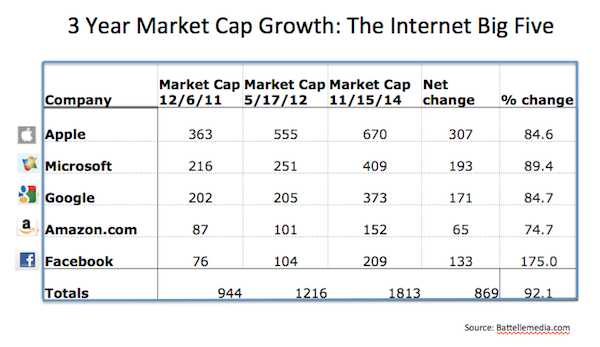
The big 5 internet companies doubling in three years on a trillion dollar base

big 5

By John Batelle: From time to time I have tracked what I call the “Internet Big Five” – the key platform technology companies that are driving the Internet economy. Nearly three years ago I wrote the first of this series – The Internet Big Five. I identified Apple, Google, Microsoft, Amazon, and Facebook as the “big five,” and compared their relative strengths in financials, consumer reach, and technology strengths. Some of the metrics were admittedly subjective – ranking relative offerings in “engagement” and “data,” for example.


Continue reading… “The big 5 internet companies doubling in three years on a trillion dollar base”

Discover the Hidden Patterns of Tomorrow with Futurist Thomas Frey
Unlock Your Potential, Ignite Your Success.

By delving into the futuring techniques of Futurist Thomas Frey, you’ll embark on an enlightening journey.

Learn More about this exciting program.