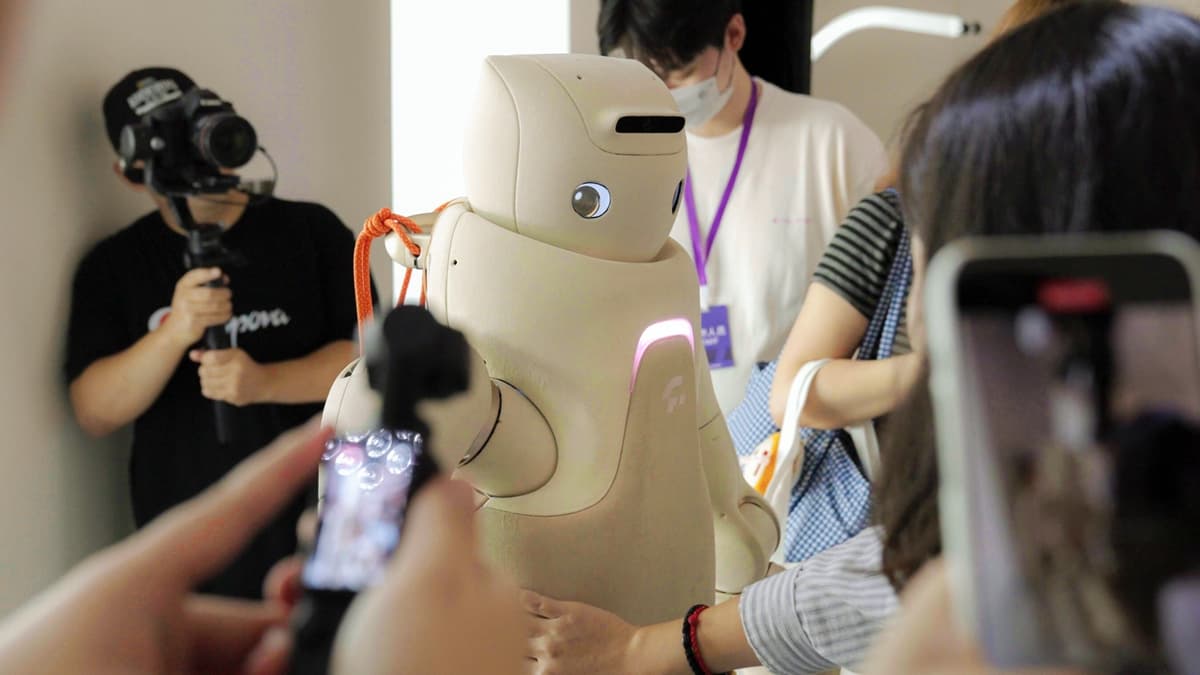
If you thought robots were destined to be cold, mechanical helpers, Fourier just proved you wrong. Their newly unveiled GR-3 isn’t another soulless metal servant—it’s a full-size humanoid “Care-bot” designed to live, move, and connect in ways that blur the line between circuitry and empathy.
Standing 165 cm tall with 55 degrees of freedom, GR-3 moves with an ease that feels unsettlingly human. It can squat, bend, and even stroll with a “bouncy walk” or “fatigue mode” depending on the moment. But what really sets it apart is the way it looks at you—literally. Its Full-Perception Multimodal Interaction System integrates sight, sound, and touch into a real-time emotional engine.
Cheese without cows? Milk without milking? It may sound like sacrilege to traditionalists—but the revolution is already fermenting.
In a lab tucked away in Europe, researchers have just pulled off a biotechnological feat that could shatter the global dairy industry: they’ve genetically engineered E. coli—yes, the same bacteria you’ve been warned about in undercooked meat—to produce casein, the protein powerhouse behind milk, cheese, and yogurt. And the implications are seismic.
Casein isn’t just a milk molecule—it’s the magic that gives cheese its stretch, yogurt its texture, and milk its calcium-carrying punch. For decades, scientists have struggled to recreate it without the cow. Whey protein? That’s been done. But casein? It’s a shape-shifting, calcium-grabbing diva of a protein—infamously hard to coax from yeast or bacteria. Until now.
A U.S. start-up, Shift Robotics of Pittsburgh, has launched a Kickstarter campaign for what they claim is the world’s fastest shoe. The “Moonwalker” apparently let you walk at the speed of a run while maneuvering stairs, through crowds, hills and even getting on public transit.
Late to work, and don’t want to run? The Moonwalkers will help you get to your destination in less than half the time it would normally take you to walk there with a 100 per cent increase in your walking speed. The shoes use artificial intelligence (AI) to measure your gait and react to how you walk, reaching the top speed of 12 km/h in a matter of seconds.
The shoes have two modes, lock and shift–and they only move when you do. This means you can go up and down stairs, step into mass transit, and confidently wait at the crosswalk while the AI switches modes using an algorithm to adapt to your walking gait and environment. The shoes have a hinge system that allows your foot to naturally bend at your toes, preserving your natural gait, mobility and balance.
DYSON ZONE PROTECTS FROM BOTH AIR AND NOISE POLLUTION
Dyson has unveiled its first ever wearable, which serves as both noise-cancelling headphones and and air purifier.
The Dyson Zone delivers filtered air through a face visor and is designed to help wearers avoid breathing polluted air in urban environments.
The UK firm cited World Health Organisation (WHO) figures estimating nine in 10 people globally breathe air that exceeds its guidelines on pollutant limits, while around 100 million people in Europe are said to be exposed to long-term noise exposure above its recommended level.
The headphones are the result of six years’ development and more than 500 prototypes, Dyson said.
Compressors in each ear draw air through built-in filters and project two streams of purified air to the wearer’s nose and mouth through the visor.
Graphene has, despite the odds, lived up to its hype. The carbon compound has made everything from solar-powered artificial skin to safer condoms a reality. Now it has been tapped to reinvent the world of high-performance audio by Ora Sound, who have created the first ever graphene headphones, the Ora GQ. The Montreal-based company’s pitch has been a hit on Kickstarter, where they have raised $270,000 with contributions from over a thousand backers.
So the obvious question that comes to mind is, “Why graphene?” And the answer has everything to do with the material’s properties, which make it 200 hundred times sturdier than steel and lighter than paper by 1000 times. The latter makes it possible to create extremely thin graphene membranes, which Ora has patented under the name GrapheneQ. The GrapheneQ diaphragms that are used on the Ora GQ headphones lend it a high level of fidelity, resulting in improved sound quality compared to standard mylar membranes.
And it doesn’t end there. The benefits of using graphene include an extended frequency response, lower distortion, and more efficient heat dissipation as a result of the ability to direct heat away from the headphone’s voice coil. They also claim a 70 percent increase in battery efficiency, which would mean having to plug them in much less often. The company has put the device through third party tests, and the results are available on their Kickstarter page with a bunch of graphs and measurements.
Dropping your bike at a stop sign or during a low-speed maneuver is the fear of any new motorcyclist. It’s easy enough to keep your bike upright at speed, but sneaking through a parking lot, all that mass is dying to tumble. Honda seems to have the perfect solution, with a new concept bike that can balance itself either during a low-speed crawl or when stopped completely.
Honda Riding Assist was first demonstrated today at the Consumer Electronics Show in Las Vegas. The system is brilliantly simple: When engaged, the system increases the fork angle, lengthening the bike’s wheelbase and, apparently, disconnecting the front forks from the handlebars. The system then uses minute steering inputs to keep the bike perfectly balanced, without the use of heavy gyroscopes or other mass-shifting devices. The concept bike Honda built to demonstrate the tech can even silently propel itself along, following its owner through a hallway like an obedient puppy.
The OpenSeed Meditation Pod creative escape provides a room at work you didn’t know you needed: a place of calm.
More than just a space to retreat, this pod also integrates sound, meditation, essential oils, light, and technology. Sure, it’s nice to get away from the hustle and bustle for a moment and recharge, but that’s not all this is about.
In fact, because of all the integrations in this workspace escape, you’ll have access to higher states of awareness and creativity, which will improve your effectiveness.
Home gardening is difficult enough as it is, but it gets even trickier when you live in small city quarters. With city living’s and home gardening’s popularity rising in recent years, those of us who live in apartment complexes might feel discouraged from starting home garden projects – they’re messy and time-consuming, not to mention that a lot of space is usually a prerequisite. That’s why SOLE was created. SOLE, a home gardening system, poses first as a small coffee table only to reveal a hidden, self-maintained, miniature garden for city dwellers who want to fill their homes up with some natural greens, but not the fuss that typically comes with them.
More people are moving into cities, which means that access to home gardening is decreasing since natural light is harder to come by and smaller apartment spaces, like efficiency studios, are preferred. Thankfully, SOLE’s coffee table was designed to take up as little space as possible in order to fit into even the smallest of studios. Indoor urban gardening is usually practiced by using grow box containers that require a lot of window ledge space and natural sunlight – both of which can be hard to come by in city apartment searches. In order to make home gardening possible in any city-living space, SOLE maintains the perfect climate, temperature, and nutrients for you and your chosen plants so long as they fit inside the coffee table’s extensive body. While researching the influence of temperature, exposure time, intensity, color from visible light, along with the distance and angle of light distribution, the designers behind SOLE decided to incorporate a lighting system that would enhance plant growth by imitating the effect the sun’s rays have on indoor plants.
The first 3D printed residential building in Germany, built by PERI GmbH, and designed by MENSE-KORTE ingenieure+architekten is undergoing construction in Beckum, North Rhine-Westphalia. The two-story printed detached house with approx. 80 sqm of living space per floor is using a system put into practice in Germany for the first time. In fact, the construction technique has come through all of the regulatory approval processes over the last few weeks and months.
3D printing technology for residential construction is now market-ready. Part of North Rhine-Westphalia’s “Innovatives Bauen” or innovative construction development scheme, the first residential 3D printed building is under construction in Germany. In collaboration with Schießl Gehlen Sodeikat, the Technical University of Munich, and MENSE-KORTE ingenieure+architekten, the two-story house is being built for the client Hous3Druck GmbH. A milestone for 3D construction printing technology, the construction of the 3D-printed residential building in Beckum, has engendered other residential printing projects to be drawn up in Germany, according to Thomas Imbacher, Innovation & Marketing Director at PERI GmbH.
The Virtuix Omni One is supposed to ship next year
Virtual reality startup Virtuix is building a VR treadmill for your home. The Omni One is an elaborate full-body controller that lets you physically run, jump, and crouch in place. Following an earlier business- and arcade-focused device, it’s supposed to ship in mid-2021 for $1,995, and Virtuix is announcing the product with a crowdfunding investment campaign.
The crowdfunded Virtuix Omni started development in 2013. It’s not a traditional treadmill — it’s a low-friction platform that’s used with special low-friction shows or shoe covers and a harness. (You may remember the overall VR treadmill concept from Steven Spielberg’s Ready Player One.) As an Omni One prototype video demonstrates, the device basically holds you in place while your feet slide across the platform, and that movement gets translated into a VR environment. We’ve tried earlier iterations of the Omni, and it’s an awkward yet fascinating experience.
This is Desserto by Adriano Di Marti, a vegan leather made from cactus that is an eco and animal-friendly alternative to animal leather or synthetic leather. Like the aforementioned leathers, Desserto has competitive features, such as elasticity and it’s also customizable and breathable. It’s also biodegradable, flexible, non-toxic, and doesn’t stain.
When it comes time to buy a new vehicle, you usually need to make some choices. Are you looking for a sedan, an SUV, a minivan? If you’ve committed to a pickup truck, you can’t later turn it into a sports car. Which sucks, because most of us use our vehicles for many different purposes, and it’d be great if you could just swap out parts depending on your plans.
That’s one of the driving ideas behind the eBussy, an electric microbus concept from a German company called Electric Brands. The (sigh, unfortunately named) eBussy sports a retro-cute exterior evoking the swinging ‘60s, and a battery that promises a range of 124 miles on a charge. (You can also configure it with a larger battery for about 373 miles worth of driving range.) Roof-mounted solar panels help recharge while you’re driving, and regenerative braking can extend the range.