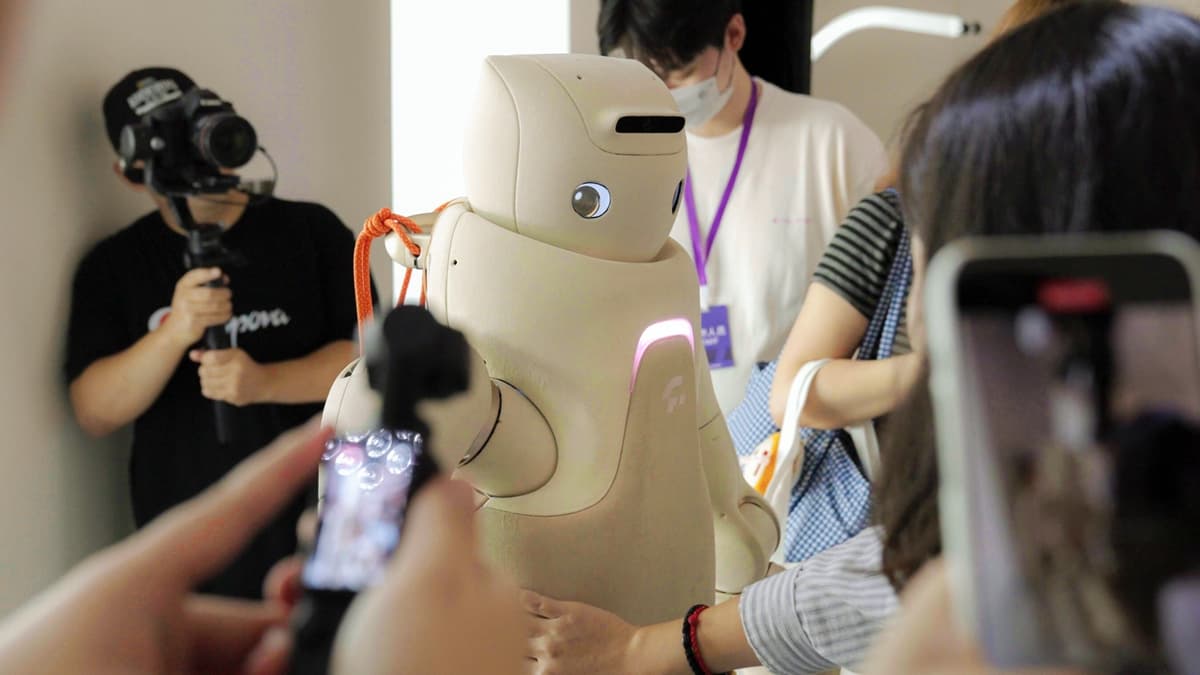
If you thought robots were destined to be cold, mechanical helpers, Fourier just proved you wrong. Their newly unveiled GR-3 isn’t another soulless metal servant—it’s a full-size humanoid “Care-bot” designed to live, move, and connect in ways that blur the line between circuitry and empathy.
Standing 165 cm tall with 55 degrees of freedom, GR-3 moves with an ease that feels unsettlingly human. It can squat, bend, and even stroll with a “bouncy walk” or “fatigue mode” depending on the moment. But what really sets it apart is the way it looks at you—literally. Its Full-Perception Multimodal Interaction System integrates sight, sound, and touch into a real-time emotional engine.
A four-microphone array tracks your voice. Structured-light cameras lock onto your eyes. Thirty-one pressure sensors scattered across its body read your touch—whether it’s a tap on the arm or a comforting hand on the shoulder—and trigger subtle, lifelike reactions. It blinks. It tracks your gaze. It leans in just slightly, as if it’s listening not just to your words, but to you.
GR-3’s “dual-path” brain makes it just as capable of reflexive, rule-based responses as it is of engaging in layered, contextual conversations powered by a large language model. This means it can adjust to your tone, interpret your intent, and respond with the kind of nuance we used to think only humans could deliver.
Wrapped in soft-touch materials and warm neutral tones, GR-3 is meant to feel familiar, even comforting. In hospitals, eldercare facilities, public spaces, and homes, it isn’t just there to assist—it’s there to build rapport. To offer comfort. To be present.
And Fourier isn’t just selling a robot. They’re launching a platform—one that developers can customize with new algorithms, locomotion styles, and interaction modes. It’s not hard to imagine GR-3 evolving into a library-reading storyteller, a hospital mobility coach, or a concierge who remembers your favorite coffee order.
The bigger question isn’t whether GR-3 can function in human environments—it’s whether humans are ready to accept a machine that can look back at them with something that feels dangerously close to understanding.
Because with GR-3, the age-old question of whether robots can be human might finally have its first convincing answer.