Large batteries could be used for storing excess power from the electrical grid for future use.
New Stanford University research could point the way to large-scale, long-lasting power grid batteries. These kinds of batteries would be especially useful for making technologies like solar and wind power more practical, allowing vast amounts of storage to be stored for periods of time in which the skies are calm or overcast.
Microsoft plans to release a next-generation Kinect device so accurate it can lip read, sources have told Eurogamer.
Kinect 2 will come bundled with future Xbox consoles, we understand.
The intention is that Kinect 2 will offer improved motion sensing and voice recognition…
Scientists claim to have created the world’s first water-powered radio. It’s inventor, Vivian Black, who helped turn the Wind-Up Radio into a global success in the 1990s, says his water-proof radio is powered by the motion of water flowing into a shower.
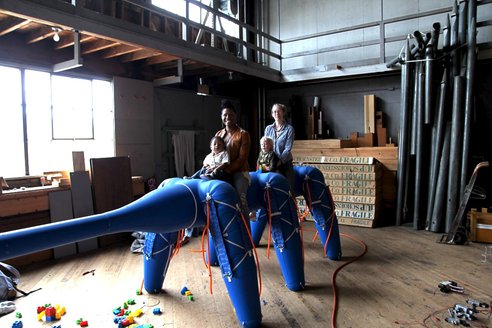
Inflatable robots provide a whole new avenue of exploration.
The 15-foot-long Ant-Roach (pictured above) really demonstrates the carrying capacity and high strength-to-weight ratios of these inflatable structures. It weighs in just under 70 lbs but it can carry up to 1000 lbs, making the payload of a few people no problem at all. The initial concept was more elephant-like but the final product came out like this anteater-cockroach hybrid, hence its name.
This huggable robot was developed by Otherlab’s Pneubotics program; a collaborative effort between the San-Francisco-based research firm, Meka Robotics, Stanford University, and DARPA…
Google figures your web browser should do it all, and that includes playing games. According to developer advocate Paul Kinlan, early next year Chrome is going to offer an even better gaming experience: by adding plug-and-play support gaming controllers…
Syneseizure, the hack that won the “People’s Choice” award
Earlier this month, Science Hack Day SF brought together 150+ scientists, designers, developers, and makers to collaborate on science-related projects. Along with US hackers, the event included participants from Brazil, Canada, Germany, Iceland, Ireland, Japan, Kenya, Mexico, and South Africa thanks to a grant from Alfred P. Sloan Foundation toInstitute for the Future. My IFTF colleague Ariel Waldman, the lead on Science Hack Day SF and the grant, posted about the insanely creative and wonderful projects that emerged from the 48 hours of science hacking: a DNA-based cocktail, a globe where the location of the International Space Station is tracked using a laser pointer, the Isodrag Typeface that rescales letters based on their aerodynamic drag, and many others…
ExoPC has released their video about a amazing product that will tease you in 2012. Its a tabletop computer, maybe you haven’t heard it before. Well, actually its a virtual table with a 40 inches high definition flat space in front of your eyes, Its awesome feature will allow you to manipulate objects by dragging it from one side to the other or by touching it. (It is much more like a tablet). ExoPC has already offered some apps to optimized this its virtual desk…
Honda’s natural gas-powered Civic has been named Green Car of the Year. Selected from five nominees, the car took the honors at a kick-off ceremony for the Los Angeles Auto Show (November 18-27).
The Green Car Journal presented the award to Honda for the car’s near-zero emissions, a 200-mile range, and combined average of 31 mpg (highways and streets) with a clean combustion engine…
FXI Technologies, a Norwegian company, showed off an amazing USB stick-sized portable computer prototype on Friday. It is code-named Cotton Candy because its 21 gram weight is the same as a bag of the confection, the tiny PC enables what itsinventor calls “any-screen computing”: the ability to turn any TV, laptop, phone, tablet, or set-top box into a dumb terminal for its Android-powered operating system.
Inventors today have got it easy. If they want to patent something, all they have to do is file some paperwork. Before 1880, however, if you wanted to patent a better mousetrap, you actually had to build it – or at least a miniature version to help patent inspectors understand why you actually deserve the patent…
While skin grafts are an essential tool for treating severe burns, Avita Medical has developed a compact kit that grows replacement skin that can be sprayed on. Which has resulted in faster healing and better cosmetic results in patient testing.
Instead of growing patches of skin that can be draped over severely burned areas, the ReCell kit uses a small sample of the patient’s keratinocytes and melanocytes skin cells that quickly reproduce in a special suspension solution…
Ultra-lightweight materials are an incredibly cool area of materials science, bringing us crazy substances like aerogel. And now, for the first time, scientists have produced a metal that’s so light it can balance on the fluff of a dandelion. Here’s why this material is revolutionary — and how it’s made…