

Water scarcity and the need for reliable drinking water sources have sparked interest in atmospheric water generators, which have the ability to extract water vapor from the air and convert it into liquid. While these devices hold immense potential for drought-stricken regions and areas lacking safe water sources, they also offer benefits for residences, commercial buildings, off-grid homes, and emergency preparedness kits. The current state of water quality and accessibility highlights the urgency of exploring alternative water production and purification methods:
Continue reading… “Harvesting Water from Thin Air: A Promising Solution for Independent Water Supply”The Evolving Landscape of News Consumption in the Digital Era
The traditional news media has long grappled with the challenges posed by the digital revolution, leading to a well-documented crisis in journalism. However, news organizations now face a more profound transformation driven by a generation that has grown up relying heavily on various digital media platforms.
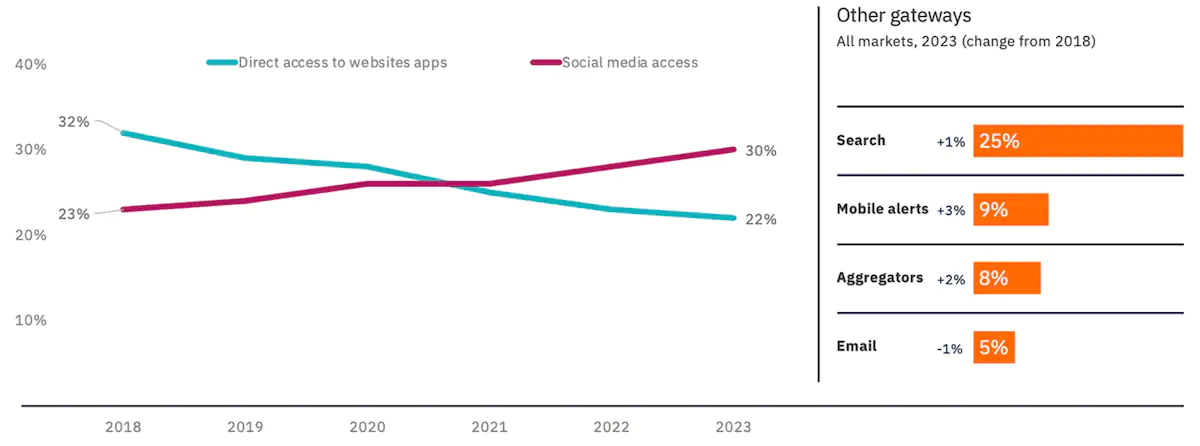
Data from this year’s Reuters Institute Digital News Report reveals an accelerated shift towards digital, mobile, and media-rich environments. Today, news content is predominantly delivered through social media and increasingly popular video-led platforms like TikTok, rather than the perceived formal and antiquated outlets of “legacy” media such as newspapers and television.
The decline in consumption of traditional television news and print formats continues unabated, while online websites struggle to engage news users, despite the tumultuous times we live in. An essential benchmark of this shift is the preferred gateway for accessing news. Across the 46 countries surveyed in our annual report, social media has steadily gained popularity each year, often at the expense of direct access through traditional news websites or apps. Access through search engines and other aggregators has also seen a slight increase. It is crucial to note that direct connection remains strong in some markets, particularly in Northern Europe, where news interest and trust are relatively high. However, in other regions, notably parts of Asia, Latin America, and Africa, social media and aggregators dominate as the primary gateways, leaving news brands heavily reliant on third-party platforms for traffic.
Continue reading… “The Evolving Landscape of News Consumption in the Digital Era”Mori3: The Versatile Modular Robot for Space Exploration
Packing a full-sized robot for space travel presents challenges due to limited space inside rockets bound for the Moon or even Mars. To overcome this obstacle, engineers from the Swiss Federal Institute of Technology Lausanne (EPFL) have developed Mori3, a modular robot that can assemble from smaller parts, forming a connected swarm with a shared intelligence.
Mori3’s design allows it to transform from a basic triangle shape into various 3D objects using polygon meshing, as detailed in a recent publication in Nature Machine Intelligence. The aim is to create an origami-like robot that can adapt its size, shape, and function based on the environment and task at hand, making it suitable for future applications in Moon colonies and potentially on Mars. Each individual module may not seem impressive on its own, but when connected, the triangle pieces operate collectively as a swarm. The Mori3 robot possesses some level of autonomy, enabling it to modify its shape, attach to different modules, and establish communication among the pieces to form functional structures.
Continue reading… “Mori3: The Versatile Modular Robot for Space Exploration”Varda Space Industries Deploys First Satellite, Pioneering Mass Production in Space

A California-based startup, Varda Space Industries, co-founded by a SpaceX veteran, made an exciting announcement as it successfully deployed its inaugural satellite, W-Series 1, into orbit. The company’s mission revolves around kickstarting the mass production of materials in space, either those impossible to manufacture on Earth or those that can be developed faster and with superior quality in microgravity conditions.
Excitement filled the air as Varda tweeted, “The world’s first space factory’s solar panels have found the sun, and it’s beginning to de-tumble,” shortly after the satellite was launched aboard SpaceX’s Transporter-8 mission on Monday, June 13.
The W-Series 1 satellite is situated within Rocket Lab’s Photon platform, a satellite solution also contracted by NASA for two upcoming Mars missions. Varda’s satellite launch is a crucial step in the company’s testing campaign to determine the feasibility of leveraging its satellite solution for pharmaceutical development in space.
The company was established by Will Bruey, a former SpaceX avionics engineer, and Delian Asparouhov from Peter Thiel’s Founders Fund. Varda’s primary objective is to enable the mass production of specific products in space. This goal has become increasingly achievable with the rise of private launch service providers like SpaceX and Rocket Lab, which have significantly enhanced accessibility to space in recent years.
Continue reading… “Varda Space Industries Deploys First Satellite, Pioneering Mass Production in Space”Gitai Raises $30 Million to Develop Space Robot Workforce

In an unprecedented move, robots may soon be competing with astronauts for space-related tasks. Gitai, a Japanese robotics startup, has secured a new funding round of ¥4 billion ($30 million) to advance its mission of creating a workforce of space robots. The Tokyo-based company aims to significantly reduce the cost of space operations and minimize the risks to human life through the development of its remote-controlled space robots, as reported by Bloomberg.
The emergence of companies like SpaceX, with their partially reusable Falcon 9 rocket, has revolutionized the space industry by substantially lowering transportation costs to orbit. Gitai’s CEO, Sho Nakanose, discussed in an interview with Bloomberg TV how the company envisions the next frontier to be a substantial reduction in the cost and risk associated with space operations through the use of robotic workforces. Nakanose explained that Gitai’s robot arms and rovers have the potential to reduce operational costs for space missions by “100 times,” making them suitable for deployment on celestial bodies such as the Moon and Mars.
Continue reading… “Gitai Raises $30 Million to Develop Space Robot Workforce”Elon Musk’s Neuralink Advances in Brain-Computer Interface Technology

Elon Musk, the visionary entrepreneur behind SpaceX, is not limiting his ambitions to space exploration. His tech startup, Neuralink, aims to venture into the realm of the human brain. Recently, the company received approval from the Food and Drug Administration (FDA) to commence trials for implanting brain chips in humans.
While the exact start date of the trials is unknown, there is considerable excitement surrounding Neuralink’s development of a brain-computer interface. In just two years, the company’s valuation has skyrocketed from $2 billion to approximately $5 billion, according to Reuters. Although it may be years before widespread implementation of Neuralink’s technology, investors remain highly interested in its potential. Analyst Daniel Ives from Wedbush Securities remarked that as Neuralink proves its use cases and execution, investor attention will likely intensify. Given Musk’s track record with successful ventures like Tesla and SpaceX, the tech world is eagerly watching Neuralink’s progress in the coming years.
Neuralink’s primary objective in conducting human trials is to eventually enable individuals with paralysis to control computers or phones solely through brain activity. The Neuralink 1 implant, about the size of a large coin, consists of multiple chips, a wireless battery, and other electronics, all hermetically sealed. The implant includes ultra-thin threads that penetrate directly into the brain. Signals from the implant are transmitted via Bluetooth to a brain-computer interface (BCI), which can facilitate tasks such as controlling an onscreen cursor or manipulating a robotic limb. Musk has likened the device to a “Fitbit in your skull with tiny wires that go to your brain.”
Continue reading… “Elon Musk’s Neuralink Advances in Brain-Computer Interface Technology”Octopuses Harness Unique RNA Editing Ability to Protect Nervous System

Octopuses have developed a remarkable defense mechanism to safeguard their delicate nervous system against extreme temperature variations. They possess the extraordinary ability to rapidly recode key proteins in their nerve cells, ensuring the uninterrupted functioning of critical neurological activities even during drastic temperature drops. This exceptional adaptation is made possible by their capacity to edit RNA on the fly, a superpower observed in select species of octopuses, squids, and cuttlefish.
Researchers at the University of Chicago’s Marine Biological Laboratory, led by marine biologist Joshua Rosenthal, have shed light on this unusual strategy through their recent study published in Cell. They highlight that while genetic information is typically considered fixed, environmental factors can influence the encoding of proteins. In cephalopods, this phenomenon occurs on a significant scale. Rosenthal explains, “RNA recoding gives organisms the option to express a diverse quiver of proteins when and where they choose. In cephalopods, most of the recoding is for proteins that are really important for nervous system function, so the natural question is, are they using this to acclimate to changes in their physical environment?”
Continue reading… “Octopuses Harness Unique RNA Editing Ability to Protect Nervous System”Scientists Create Synthetic Molecules that Mimic Organic Molecules, Revolutionizing Molecular Understanding

A team of scientists from Radboud University has achieved a groundbreaking feat by developing synthetic molecules that closely resemble real organic molecules. Led by Alex Khajetoorians and Daniel Wegner, the collaborative effort has resulted in the ability to simulate the behavior of genuine molecules using artificial counterparts. This breakthrough enables researchers to manipulate molecule properties in unprecedented ways, shedding new light on how molecules undergo changes. The team’s remarkable findings have been published in the journal Science.
Emil Sierda, the lead experimenter at Radboud University, shared the origin of their groundbreaking idea, stating, “A few years ago, we had this audacious idea of constructing a quantum simulator. Our goal was to create synthetic molecules that closely resemble real ones. To achieve this, we developed a system capable of trapping electrons. Electrons envelop a molecule like a cloud, and we utilized these trapped electrons to construct artificial molecules.” The results they obtained were astonishing, with Sierda remarking, “The similarity between our artificial creations and genuine molecules was striking.”
Continue reading… “Scientists Create Synthetic Molecules that Mimic Organic Molecules, Revolutionizing Molecular Understanding”LUX: Yale University’s Powerful Research Tool Unveils Infinite Connections

Yale University introduces LUX, a free and innovative research tool designed to lead users down a captivating rabbit hole of infinite connections surrounding their subjects of interest. Serving as a central hub, LUX offers access to a vast collection of 17 million searchable objects from Yale’s museums, archives, and libraries. While traditional search engines typically provide links to external sites, LUX goes beyond mere hits by establishing relationships between the searched object and other relevant items in the collection, revealing obscure connections.
Working in a manner akin to a search engine, LUX uncovers a wealth of information beyond the objects themselves. For instance, when searching for a specific artwork, LUX surfaces works from the same artist, pieces created during the same era or in the same location, as well as related art, books, and more. In the past, users had to visit multiple venues or conduct separate Google searches to piece together these resources. LUX consolidates these diverse elements into a single platform, simplifying research endeavors.
Continue reading… “LUX: Yale University’s Powerful Research Tool Unveils Infinite Connections”Expedia CTO Rathi Murthy Envisions AI-Powered Transformation to Revolutionize Online Travel

Expedia, the online travel service with a vast network and a multitude of data, is embracing a two-pronged transformation strategy fueled by artificial intelligence (AI) and extensive data expertise. CTO Rathi Murthy believes that the combination of AI and the company’s wealth of data will enable Expedia to drive growth by bringing more of the travel industry online.
With top brands like Travelocity, VRBO, Hotels.com, Orbitz, Trivago, Wotif, and CarRentals.com, Expedia possesses a treasure trove of data. Stored on its AWS cloud, this amounts to a staggering 70 petabytes of traveler information. Murthy emphasizes the central role of data in Expedia’s operations, serving as the foundation for driving personalized experiences for their vast ecosystem of 168 million loyalty members and 50,000 business partners.
Continue reading… “Expedia CTO Rathi Murthy Envisions AI-Powered Transformation to Revolutionize Online Travel”University of Washington Researchers Harness Atomic “Breathing” to Encode Quantum Information
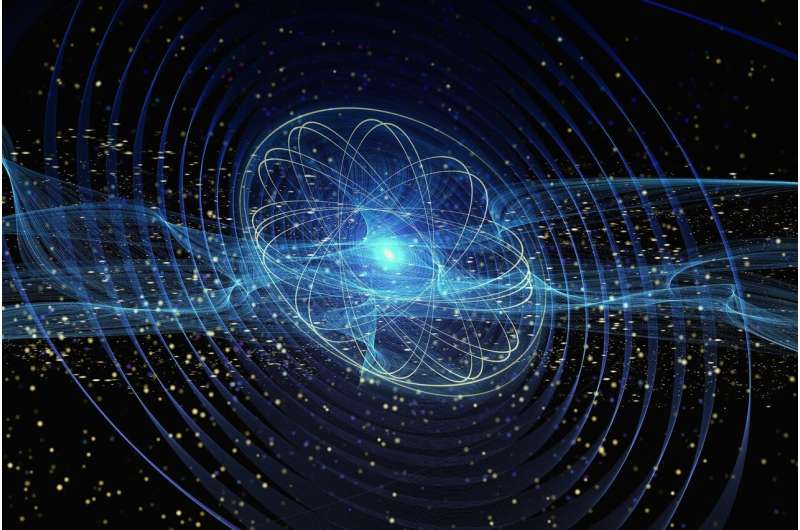
Researchers from the University of Washington have made a significant discovery, finding that they can detect the atomic “breathing” phenomenon between layers of atoms by observing the emitted light when stimulated by a laser. This breakthrough has potential implications for encoding and transmitting quantum information. Additionally, the team has developed a novel device that could serve as a fundamental building block for various quantum technologies, expected to have wide-ranging applications in computing, communications, and sensor development.
Published in Nature Nanotechnology on June 1, the study unveils an atomic-scale platform utilizing the principles of “optomechanics” to couple light and mechanical motions. The researchers believe this innovative approach offers new possibilities to control single photons within integrated optical circuits, paving the way for numerous applications.
Continue reading… “University of Washington Researchers Harness Atomic “Breathing” to Encode Quantum Information”AI-Driven Discovery: Scientists Unveil New Antibiotic Effective Against Deadly Superbug

In a groundbreaking development, scientists from McMaster University and the Massachusetts Institute of Technology have harnessed the power of artificial intelligence (AI) to discover a novel antibiotic capable of eradicating a deadly hospital superbug. The findings of their study, published in the journal Nature Chemical Biology, reveal a significant breakthrough in the fight against Acinetobacter baumannii, a critical pathogen identified by the World Health Organization.
Acinetobacter baumannii poses a severe threat to healthcare facilities, nursing homes, and vulnerable patients relying on ventilators and catheters. It can also infect individuals recovering from surgical procedures with open wounds. Known for its ability to develop resistance mechanisms and transmit genetic material to other bacteria, A. baumannii has become a grave concern in the medical community.
Continue reading… “AI-Driven Discovery: Scientists Unveil New Antibiotic Effective Against Deadly Superbug”