Japanese Researchers Develop Ultra-Compact 150 GHz Radio Module for 6G Mobile Devices

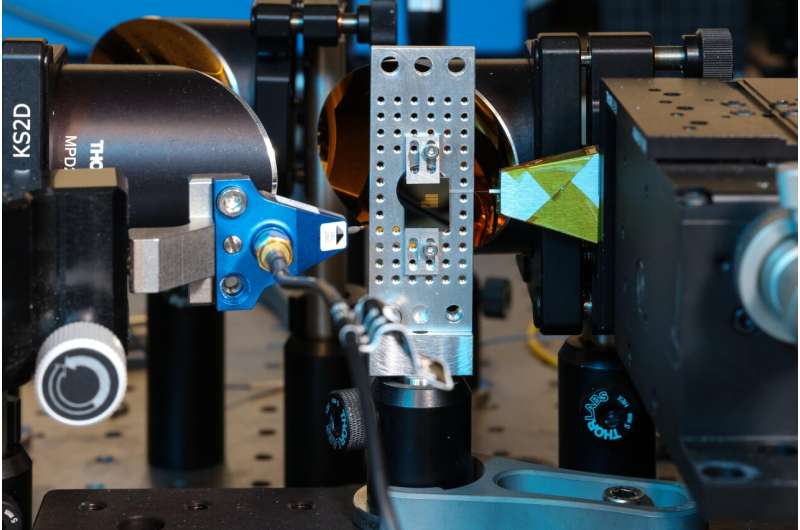
Researchers in Japan have developed an ultra-compact, low-power radio module operating in the 150 GHz band, bringing 6G wireless connectivity closer to everyday mobile devices. Designed specifically for future 6G user equipment, the new module integrates a phased-array transceiver with key innovations that overcome the technical barriers traditionally associated with sub-terahertz communication.

The team, led by Professor Kenichi Okada from the Department of Electrical and Electronic Engineering at the School of Engineering, Institute of Science Tokyo, developed the module in collaboration with the National Institute of Information and Communications Technology (NICT) and other partners. Their findings were presented at the 2025 Symposium on VLSI Technology and Circuits in Kyoto.

Continue reading… “Japanese Researchers Develop Ultra-Compact 150 GHz Radio Module for 6G Mobile Devices”

WPI Launches “Rubble to Rockets” to Turn Scrap Metal into 3D-Printed Rocket Components

Worcester Polytechnic Institute (WPI) is spearheading an ambitious initiative called Rubble to Rockets, aimed at transforming scrap metal and mixed alloys into high-performance components using additive manufacturing. The project integrates machine learning to identify unknown materials and analyze how they interact when melted and 3D printed, making it possible to manufacture reliable parts in resource-constrained environments. The project is expected to be completed by November 2027.

Led by Associate Professor Danielle Cote, the research focuses on creating high-quality components from unpredictable source materials. The team will employ artificial intelligence developed by a WPI PhD student to predict material behavior across a range of compositions. This AI system is designed to automate and optimize the material characterization process, ensuring structural integrity and performance while accelerating production timelines.

Continue reading… “WPI Launches “Rubble to Rockets” to Turn Scrap Metal into 3D-Printed Rocket Components”

Breakthrough Drug Delivery System Targets Lungs for Genetic Therapy

Scientists have achieved a significant advancement in the treatment of respiratory diseases with the development of a new drug delivery system that transports genetic therapies directly to the lungs. This innovation opens up promising possibilities for patients with conditions such as lung cancer and cystic fibrosis.

The research was led by Gaurav Sahay of Oregon State University’s College of Pharmacy in collaboration with Oregon Health & Science University and the University of Helsinki. The findings were published in Nature Communications and the Journal of the American Chemical Society.

Continue reading… “Breakthrough Drug Delivery System Targets Lungs for Genetic Therapy”

Korean Researchers Develop Catalyst-Free Strategy for Scalable Green Hydrogen Production

A research team from Seoul National University’s College of Engineering has unveiled a new approach to water electrolysis that could dramatically lower the cost and complexity of green hydrogen production. By eliminating the need for precious metal-based catalysts, this breakthrough marks a significant step toward realizing a scalable and economically viable hydrogen economy.

Published in Nature Communications on May 23, the study introduces an innovative electrolysis strategy called Electrochemical Activation (EA) operation, which enables the use of commercial nickel (Ni) electrodes—without any catalyst coating—while maintaining high efficiency and long-term performance. The project was led by Professors Jeyong Yoon and Jaeyune Ryu, in collaboration with Professor Jang Yong Lee of Konkuk University.

Continue reading… “Korean Researchers Develop Catalyst-Free Strategy for Scalable Green Hydrogen Production”

Designing Health Before Birth: New Software Offers Genetic Insights for IVF Embryos

A U.S.-based biotech company has unveiled what it claims is the world’s first genetic optimization software designed to help parents pursuing in vitro fertilization (IVF) select embryos based on predicted health outcomes, disease risks, and even traits like height and intelligence. The technology, developed by Nucleus Genomics, marks a new chapter in reproductive decision-making—and has sparked both excitement and ethical debate.

The software analyzes DNA from up to 20 embryos, screening for more than 900 inherited conditions. It uses polygenic risk scores to estimate the likelihood of diseases such as heart disease, diabetes, cancer, depression, and anxiety. Alongside health data, the tool also offers predictions for physical and cognitive traits, including eye color, hair color, height, and genetic markers linked to IQ.

Continue reading… “Designing Health Before Birth: New Software Offers Genetic Insights for IVF Embryos”

MIT Unveils Breakthrough in 3D Printing: Light-Controlled Resin Enables Recyclable, Multi-Part Designs

A research team at the Massachusetts Institute of Technology (MIT) has introduced a novel 3D printing method that significantly simplifies post-processing and reduces material waste. The innovation centers around a custom-formulated photopolymer resin whose behavior changes depending on the light wavelength used during printing. With this approach, both durable parts and easily removable support structures can be printed in a single pass.

The technique builds on vat photopolymerization, a method where layers of liquid resin are cured using specific light patterns. Traditionally, support structures made of the same resin are printed along with the object and must be carefully removed and discarded afterward. MIT’s new system avoids this waste by using UV light to cure strong, permanent parts while using visible light to create temporary support structures that dissolve easily after printing.

Continue reading… “MIT Unveils Breakthrough in 3D Printing: Light-Controlled Resin Enables Recyclable, Multi-Part Designs”

Old Phones, New Purpose: How Discarded Smartphones Could Power Tomorrow’s Data Infrastructure

Smartphones are becoming obsolete faster than ever. Most users now replace their devices every two to three years—even when the phones still function. Fueled by aggressive marketing and rapid tech advancements, this culture of constant upgrading has led to the production of more than 1.2 billion smartphones globally each year.

This cycle comes at a steep environmental cost. Manufacturing and shipping smartphones consumes vast natural resources and emits significant amounts of CO₂. While some old devices are recycled, many end up in landfills, adding to the world’s growing e-waste crisis.

Continue reading… “Old Phones, New Purpose: How Discarded Smartphones Could Power Tomorrow’s Data Infrastructure”

Nature-Inspired Soft Robot Mimics Worms and Snakes for Search-and-Rescue Missions

Researchers from the University of Southern Denmark (SDU) have developed a groundbreaking soft robot inspired by limbless creatures like snakes and earthworms. This flexible, bioinspired machine is capable of crawling across flat surfaces and navigating obstacle-laden environments, mimicking the natural locomotion of its biological counterparts.

The research, published in Cyborg and Bionic Systems, was accompanied by a video showcasing the robot in motion. In the footage, the robot bends and moves in a way that closely resembles the fluid movement of snakes and worms, highlighting the success of its biologically inspired design.

Continue reading… “Nature-Inspired Soft Robot Mimics Worms and Snakes for Search-and-Rescue Missions”

Redefining 3D Printing: How MIT CSAIL is Making Prints Smarter, Softer, and More Functional

MIT’s Computer Science and Artificial Intelligence Laboratory (CSAIL) is leading a new chapter in 3D printing—one where printed objects don’t just look good, but also feel realistic, move like living organisms, and even carry built-in electronics. These advances aren’t happening in isolation; they’re part of a larger shift toward smarter, more interactive, and more sustainable design and manufacturing.

In recent years, CSAIL has unveiled a range of projects that blend artificial intelligence, materials science, and automation to push the boundaries of what’s possible with additive manufacturing. These innovations are transforming how we interact with 3D-printed objects—making them more tactile, mobile, intelligent, and accessible.

Continue reading… “Redefining 3D Printing: How MIT CSAIL is Making Prints Smarter, Softer, and More Functional”

Uncovering How Diseases Cause Each Other Using AI and Medical Data

Researchers developed a new way to identify how diseases might cause or influence one another by analyzing scientific literature and validating the results using real-world patient data. They searched through PubMed articles for phrases suggesting that one disease leads to another, then standardized those disease names using ICD-10-CM medical codes to keep the data consistent.

To test whether these suggested relationships were credible, the team used a combination of five validation methods. They looked at how strongly diseases were statistically linked in the UK Biobank dataset, whether the timing of diagnoses followed the expected pattern (with the “cause” usually diagnosed before the “effect”), and how frequently the relationships appeared in the literature. They also tested how dependent the diseases were on each other and asked GPT-4, a powerful AI language model, to assess the plausibility of each connection. All of this information was combined into a confidence score for each relationship.

Continue reading… “Uncovering How Diseases Cause Each Other Using AI and Medical Data”

MIT Unveils High-Energy Sodium–Air Fuel Cell That Could Transform Electric Transportation

MIT researchers have developed a groundbreaking sodium–air fuel cell that could reshape the future of electric transportation. Designed to replace the heavy lithium-ion batteries currently used in aviation, marine, and rail sectors, this innovative system delivers more than three times the energy density of today’s electric vehicle (EV) batteries — potentially making electric flight a reality.

The new fuel cell, developed by a team led by MIT doctoral students Karen Sugano, Sunil Mair, Saahir Ganti-Agrawal, and Professor Yet-Ming Chiang, uses liquid sodium metal and ambient air as its core materials. Unlike traditional batteries, which are limited by their weight-to-energy ratio, this system offers a fuel cell format that can be quickly refueled and deliver sustained power output.

Continue reading… “MIT Unveils High-Energy Sodium–Air Fuel Cell That Could Transform Electric Transportation”

Veho and RIVR Launch Delivery Robots to Enhance E-Commerce Logistics

U.S.-based parcel delivery platform Veho has partnered with robotics company RIVR to enhance the efficiency and quality of e-commerce deliveries using advanced delivery robots. The collaboration aims to support human drivers rather than replace them, with robots handling part of the last-mile delivery process to boost overall speed, reduce physical strain, and improve customer satisfaction.

The pilot program has already begun in Austin, where Veho is deploying RIVR’s wheeled-legged robots to deliver parcels directly from delivery vehicles to customers’ doorsteps. These robots follow customer instructions and use the Veho app to provide photographic proof of delivery.

Continue reading… “Veho and RIVR Launch Delivery Robots to Enhance E-Commerce Logistics”
Discover the Hidden Patterns of Tomorrow with Futurist Thomas Frey
Unlock Your Potential, Ignite Your Success.

By delving into the futuring techniques of Futurist Thomas Frey, you’ll embark on an enlightening journey.

Learn More about this exciting program.