Japan is getting serious about flying cars

 car

The country’s once-envied government skunk works has set its sights on speeding up the arrival of aerial taxis and trucks.

Japan often appears stuck in yesterday’s vision of tomorrow. Flip phones are common enough that they’re cited as the exemplar of a phenomenon called Galapagos Syndrome, referring to the country’s tendency to stick with technologies endemic only to its islands. Another anachronism, Yahoo, remains wildly popular. Tokyo of the 1980s may have inspired the futuristic cityscape of Blade Runner, complete with flying cars, but the fax machines that were cutting-edge when the film came out remain ubiquitous tools today.

Ensuring Japan doesn’t fall behind the technological curve has for decades been the job of the Ministry of Economy, Trade, and Industry, a powerful agency housed in a squat modern office block in Tokyo’s orderly government quarter, a few blocks south of the jagged moat surrounding the Imperial Palace. The building is orthogonal in every respect, a uniform stack of concrete threaded with long, featureless corridors. The bureaucrats here guided Japan’s postwar economic miracle, a boom that gave the world the transistor radio, the Walkman, and the Prius—and almost no transformative innovations since. None of the automakers championed by METI are today on the leading edge of robotic driving. For the most part, Japan’s faded tech companies can’t lay claim to either smartphone or internet greatness.

Continue reading… “Japan is getting serious about flying cars”

Boeing’s flying car has taken off

Boeing’s Driverless Flying Taxi Completes Test Flight.

A Boeing Co. flying car designed to whisk passengers over congested city streets and dodge skyscrapers completed its first test flight on Tuesday, offering a peek into the future of urban transportation the aerospace giant and others are seeking to shape.

A prototype of its autonomous passenger air vehicle completed a controlled takeoff, hover and landing during the test conducted in Manassas, Virginia, the maker of military and commercial jets said in a statement Wednesday. Propelled by electricity, the model is designed for fully autonomous flight, with a range of as much as 50 miles, Boeing said.

The Chicago-based plane maker and arch rival Airbus SE are among a slew of companies racing to stake a claim on flying cars and parcel-hauling drones, which have the potential to be the next disruption to sweep the aerospace industry. Boeing’s push was boosted by a 2017 acquisition of Aurora Flight Sciences, whose projects include a new flying taxi it is developing with Uber Technologies Inc.

Continue reading… “Boeing’s flying car has taken off”

Amazon Go, one year old, has attracted a lot of cashierless imitators

 1000x-1

Mighty AI spent much of its first five years building software that helps self-driving cars recognize real-world objects. The Seattle startup went so far as to open a Detroit office to cozy up to the auto industry.

Then last February, Mighty AI’s sales team received an unusual request: Instead of identifying pedestrians and cars, could they track items plucked from store shelves by shoppers? A few months later, Mighty AI signed a deal to do just that, joining the race to help brick-and-mortar retailers keep pace with Amazon.com Inc.

A year ago, the e-commerce giant opened a cashierless convenience store called Amazon Go, marking its biggest effort yet to change the way people shop in the physical world. Today a fleet of companies are working to replicate elements of Go or invent other ways of streamlining store operations.

Many are startups like Mighty AI, but established giants are wading in, too. Walmart has been testing Go-style technology, and Kroger and Microsoft recently announced a joint venture to bring elements of the e-commerce shopping experience to the grocery store.

Continue reading… “Amazon Go, one year old, has attracted a lot of cashierless imitators”

UPS and Latch are expanding in-building deliveries to 10 more cities

latch-ups-1

After launching apparently successful pilot runs in San Francisco and New York, UPS announced today plans to expand its in-building delivery service to 10 additional U.S. cities. In mid-2019, the parcel service will be adding Atlanta, Chicago, Los Angeles, Houston, Dallas, Washington, D.C., Philadelphia, Boston, Miami and Seattle.

Continue reading… “UPS and Latch are expanding in-building deliveries to 10 more cities”

China reportedly made an app to show people if they’re standing near someone in debt — a new part of its intrusive ‘social credit’ policy

B110B9A0-AB8E-4E53-90CB-778849E515D5

A province in northern China developed an app to tell users whether they are within a 500-meter radius of someone in debt, state media said.

  • It’s called a “map of deadbeat debtors,” the China Daily state-run newspaper reported.
  • It hopes to get citizens to monitor the so-called debtors and report them to authorities if they seem “capable of paying their debts.”

It’s part of China’s invasive “social credit” system, designed to judge a person’s trustworthiness. People have already been punished by it.

Continue reading… “China reportedly made an app to show people if they’re standing near someone in debt — a new part of its intrusive ‘social credit’ policy”

Millions of Chinese tourists are spurring the growth of mobile pay overseas

105689525-1548033515576woodwechatalipay.530x298

  • Just as overseas luxury stores have hired Mandarin-speaking staff to serve Chinese tourists, more tourist destinations may feel the need to accept Chinese mobile payment such as Alipay and WeChat Pay.
  • Three-fourths of supermarkets and convenience stores in Singapore, Malaysia and Thailand now accept Chinese mobile payment, according to a Nielsen survey released Monday in cooperation with Alipay.
  • The adoption rate has increased rapidly in the last two years, and last year more Chinese tourists used mobile pay abroad than cash, the report said.

Continue reading… “Millions of Chinese tourists are spurring the growth of mobile pay overseas”

Airlander 10: prototype of world’s longest aircraft retired

4252

The Airlander 10 in flight at Cardington airfield in Bedfordshire in 2016.

UK firm behind plane-airship hybrid says it will ‘rethink the skies’ to build new model.

A prototype of the world’s longest aircraft, the Airlander 10, will not be rebuilt but engineers are set to “rethink the skies” with a production-ready model.

Hybrid Air Vehicles (HAV), the Bedford-based company that created Airlander 10, has already received Civil Aviation Authority (CAA) approval, and it is hoped the new airship model will take to the skies by the early 2020s.

“Our focus is now entirely on bringing the first batch of production-standard, type-certified Airlander 10 aircraft into service with customers,” said Stephen McGlennan, the company’s chief executive.

Continue reading… “Airlander 10: prototype of world’s longest aircraft retired”

Hyundai and Kia unveil driverless car-charging and parking concept

dcx_doc73htoju4ets3pmv8we

The companies intend to launch this technology when electric vehicles reach level 4 autonomy, which is expected around 2025. — Hyundai

This week Hyundai Motor Company and Kia Motors Corporation shared a video outlining the features of EV wireless charging and automated valet parking concept systems that could park your car without you or any other driver.

Continue reading… “Hyundai and Kia unveil driverless car-charging and parking concept”

India’s first solar-powered, driverless bus has made its maiden journey

India-First-Solar-Powered-Bus

Students of Lovely Professional University (LPU) at Jalandhar has designed this bus with the uses of GPS and Bluetooth for navigation

Jalandhar (Urban Transport News): India’s first solar-powered, driverless bus made its maiden journey at the Indian Science Congress in last week Thursday. A team of students of Lovely Professional University (LPU) at Jalandhar has designed this bus with the uses of GPS and Bluetooth for navigation.

According to the project head Mandeep Singh, the camera installed on top of the bus allows for image processing. It senses the road pattern and the bus moves accordingly.

“We have been working on this project for the last five years. Around 300 students, from departments of electronics, electrical and civil and mechanical engineering, have been part of it. It was a huge project and bringing everyone together itself was a huge challenge,” said Mandeep Singh.

Continue reading… “India’s first solar-powered, driverless bus has made its maiden journey”

AUTONOMOUS CARS: ALTERING ONE IN NINE JOBS

 Self-Driving-Interior_ummeax

It seems clear that driverless vehicles are coming, although the timeline for their arrival remains unclear. David Beede, Regina Powers and Cassandra Ingram of the Economics and Statistics Administration at the US Department of Commerce look at one aspect, “The Employment Impact of Autonomous Vehicles,” in ESA Issue Brief #05-17 (August 11, 2017). They set the stage this way:

“In September 2016, the U.S. Department of Transportation and the National Highway Traffic Safety Administration (NHTSA) published policy guidelines for AVs [autonomous vehicles], recognizing their potential as “the greatest personal transportation revolution since the popularization of the personal automobile nearly a century ago” (NHTSA 2016). … The worldwide number of advanced driver-assistance systems (ADAS), such as backup cameras and adaptive cruise control, increased from 90 million to 140 million units between 2014 and 2016. Consumers have indicated a willingness to pay $500-$2,500 per vehicle for ADAS. Sensor technologies are rapidly advancing to provide sophisticated information to vehicle operating systems about the surrounding environment, such as road conditions and the location of other nearby vehicles. However, slower progress has been made in developing software that can mimic human driver decision-making, so that fully autonomous vehicles may not be introduced for another ten or more years …”

Continue reading… “AUTONOMOUS CARS: ALTERING ONE IN NINE JOBS”

Despite Uber and Lyft, urban car ownership is growing

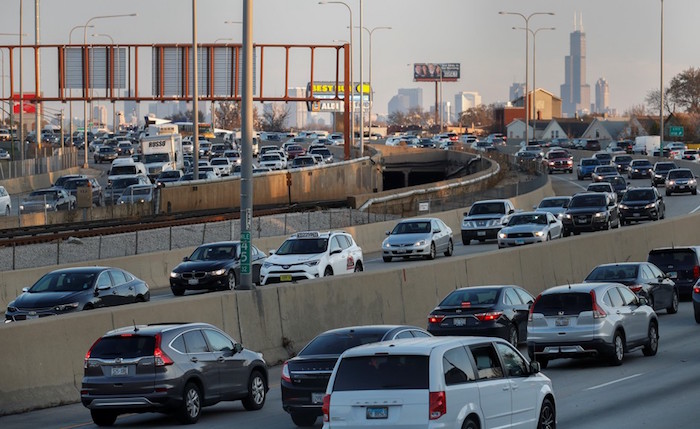
Travelers are stuck in a traffic jam as people hit the road before the busy Thanksgiving Day weekend in Chicago, Illinois

In a Reversal, ‘Car-Rich’ Households Are Growing

Despite ride-hailing’s promise, vehicle ownership (and traffic) is on the rise in America’s biggest, most transit-oriented cities. So how is mobility really changing?

There is no doubt that ride-hailing services like Uber and Lyft are remaking how people get around major American cities. The growing availability of shared bikes, e-bikes, and e-scooters is further changing the personal mobility story. The transformation is partly personal, offering a wealth of options for getting around town. It’s also supposed to be societal, ameliorating clogged traffic and boosting transit ridership.

Continue reading… “Despite Uber and Lyft, urban car ownership is growing”

Discover the Hidden Patterns of Tomorrow with Futurist Thomas Frey
Unlock Your Potential, Ignite Your Success.

By delving into the futuring techniques of Futurist Thomas Frey, you’ll embark on an enlightening journey.

Learn More about this exciting program.