High power wireless charging efficiency reaches 97%.
The Department of Energy’s Oak Ridge National Laboratory (ORNL) upgraded its previous 20 kW wireless charging system to 120 kW, and through a new design and a silicon carbide power electronic device, it was able to achieve 97% efficiency.
It’s dorm life for adults: A PodShare co-living building in Venice Beach, Calif., where dorm beds go for about $1,400 per month with shared kitchens and bathrooms.
The cost of housing is out of reach for many residents in cities such as Los Angeles and Seattle. One solution is called co-living, and it looks a lot like dorm life. Co-living projects are trying to fill a vacuum between low-income and luxury housing in expensive housing markets where people in the middle are left with few choices.
Nadya Hewitt lives in a building in Los Angeles run by a company called PodShare, where renters (or “members,” in company lingo) occupy “pods.” The grand tour of 33-year-old Hewitt’s home takes place sitting on her bed as she points out the various things she keeps within arm’s reach: a lamp, sunglasses, a water bottle, a jar of peanut butter.
The synthetic material is faster to make than natural wood.
A new lightweight substance is as strong as wood yet lacks its standard vulnerabilities to fire and water.
To create the synthetic wood, scientists took a solution of polymer resin and added a pinch of chitosan, a sugar polymer derived from the shells of shrimp and crabs. They freeze-dried the solution, yielding a structure filled with tiny pores and channels supported by the chitosan. Then they heated the resin to temperatures as high as 200 degrees Celsius to cure it, forging strong chemical bonds.
GE Aviation engineers have unveiled Affinity, a new family of supersonic jet engines for civilian aircraft.
GE Aviation has given impetus to the revival of civilian supersonic flight by revealing a new family of engines designed to fly faster than the speed of sound. Called the Affinity, the new engine will be incorporated into the Aerion AS2 supersonic business jet, which is being developed in partnership with Lockheed Martin, GE Aviation and Honeywell, and could cut the time of a transatlantic flight by three hours.
Today, 790 million people — 11 percent of the world’s population — live without access to clean water.
Two years ago, XPrize, an international nonprofit organization, announced a global competition enticing innovators to find a sustainable and affordable way to bring potable water to those who aren’t privileged enough to have it now.
Skeptics told the competition organizers that it was impossible.
Nearly 100 submissions later, and XPrize found precisely what they were looking for — entrepreneurs who could design a minimalistic device that could reliably extract 2,000 liters of water from the atmosphere per day for no more than two cents per liter all using 100 percent renewable energy.
For about 200,000 years, modern humans have relied on our eyes and ears to separate truth from lies and fact from fiction. Even if we ignore the rise of fake news (and how difficult it is to do anything about it), technology (like deep learning) is on the verge of making it impossible to know if what you are seeing and hearing is real or fake.
The half-finished letters are designed to make us more engaged with what we’re reading, which increases memory retention.
Could the shape of the words also shape your ability to remember them? MIT
Cramming for exams, learning new languages, and remembering your to-do list can be tough — but a team of Australian researchers think they can help. They’ve developed a font called “Sans Forgetica” that uses the principles of cognitive science to help readers better remember their typed notes.
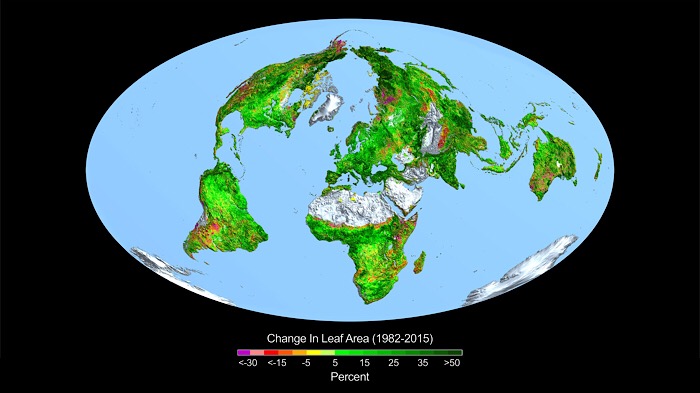
From a quarter to half of Earth’s vegetated lands has shown significant greening over the last 35 years largely due to rising levels of atmospheric carbon dioxide, according to a new study published in the journal Nature Climate Change on April 25.
An international team of 32 authors from 24 institutions in eight countries led the effort, which involved using satellite data from NASA’s Moderate Resolution Imaging Spectrometer and the National Oceanic and Atmospheric Administration’s Advanced Very High Resolution Radiometer instruments to help determine the leaf area index, or amount of leaf cover, over the planet’s vegetated regions. The greening represents an increase in leaves on plants and trees equivalent in area to two times the continental United States.
A team of researchers from IBM, the University of Waterloo, and the Technical University of Munich (TUM) today published the results of an experiment proving a quantum computer can do things a classical one cannot. This may be a watershed moment in the history of computer science.
It’s all about stopping the flow of plastic into the marine environment.
Plastic Bank uses blockchain and cryptocurrency technology to give people living in impoverished areas an incentive to recycle.
The world’s oceans are awash in plastic, and the problem is only getting worse. Each year, 8 million metric tons of plastic debris ends up in the oceans, and that’s on top of the 150 million metric tons already in marine environments. The debris ensnares seabirds, starves whales and infiltrates the entire marine food chain — including humans, too, when we eat seafood.
Blue Origin’s aim is to lower the cost of access to space, Jeff Bezos said during a surprise appearance at Wired’s 25th anniversary conference.
Amazon and Blue Origin founder Jeff Bezos provides the keynote address at the Air Force Association’s Annual Air, Space & Cyber Conference in Oxen Hill, MD, on September 19, 2018.
Blue Origin founder and Amazon CEO Jeff Bezos predicts we’ll have 1 trillion humans in the solar system one day — and he laid out Monday how the rocket company plans to help get there.
“I won’t be alive to see the fulfillment of that long-term mission,” Bezos said at the Wired 25th anniversary summit in San Francisco. “We are starting to bump up against the absolute true fact that Earth is finite.”
Blue Origin’s aim is to lower the cost of access to space, Bezos said. He will spend a “little more” than $1 billion next year to support Blue Origin, he said.
The more bosses try to keep track of their workers, the more precious time employees waste trying to evade them.
Jason Edward Harrington spent six years working the luggage-screening checkpoint at O’Hare International Airport in Chicago. A college graduate and freelance writer, he initially took the job as a stopgap, but found that he enjoyed meeting passengers from all over the world, some of whom showed a real interest in him. But while working for the TSA, Harrington noticed that his bosses were following and video-recording his every move, a practice they said was at least in part for his protection: If, perchance, a traveler’s iPad went missing, the videotapes would prove that Harrington was not to blame. Harrington was on board with that. His problem, he told me, was that supervisors would also view the tapes to search for the slightest infraction—anything from gum chewing to unauthorized trips to the bathroom. Eventually, these intrusions led him to quit. “If they trusted us, respected us, you could really enjoy the job,” Harrington told me. “But they didn’t.”