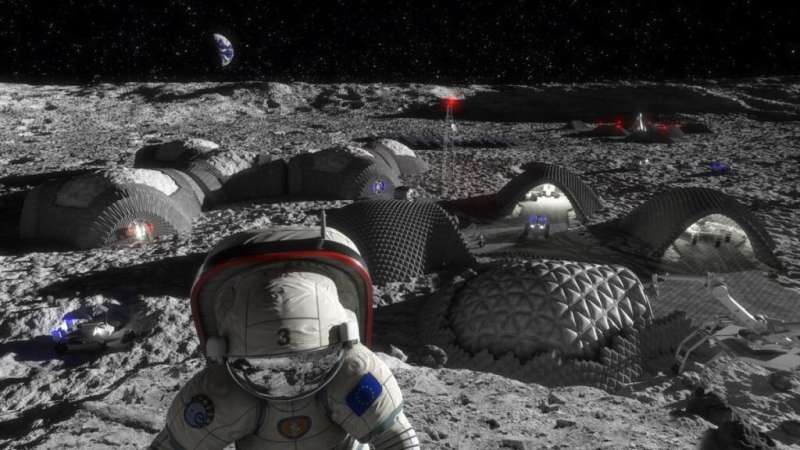
New advancements in space technologies continue to emerge, originating from both established and emerging companies. In 2020, Airbus, one of the largest players in the aerospace industry, unveiled a groundbreaking technology with significant implications for future lunar exploration missions. The Regolith to OXYgen and Metals Conversion (ROXY) system, developed by Airbus, has the potential to revolutionize the utilization of lunar resources over the next decade.
ROXY employs the regolith, the abundant lunar surface material, to produce vital resources such as oxygen, crucial for human survival and rocket fuel, along with metals that can be utilized for manufacturing tools, equipment, and even structures on the Moon. This innovative process bears similarities to MOXIE, an experiment carried by the Perseverance rover during its 2021 landing on Mars. However, when Airbus announced the successful test of ROXY in October 2020, MOXIE was still unproven and en route to Mars.
A key advantage of ROXY over MOXIE is its ability to generate metals, facilitating on-site production of tools, containers, and other essential objects on the Moon, eliminating the need to transport them from Earth. This aligns seamlessly with the ongoing efforts to introduce 3D printing technologies to lunar exploration, attracting the attention of multiple companies actively pursuing these endeavors.
In addition to its metal-making capabilities, ROXY also offers relatively eco-friendly processes compared to existing methods employed on Earth. Airbus highlighted in a press release that ROXY’s emission-free approach could replace the use of perfluorocarbons, a potent greenhouse gas, in traditional metal extraction processes. The development of this system required collaboration among Airbus, renowned universities, research institutions like Fraunhofer, and the expertise of a team at Boston University.
In a recent development, Airbus formed a partnership with the Mexican Space Agency in September 2021 to incorporate ROXY into the Mexican In-situ Resources Utilization program. This collaboration also involves the integration of technologies from Dereum Labs, a Mexican start-up specializing in in-situ resource utilization (ISRU). Despite limited updates or information regarding ROXY’s further development in the past three years, the collaboration with the Mexican Space Agency suggests ongoing progress in utilizing this groundbreaking technology.
It is essential to ensure that this potentially transformative technology does not get overshadowed amidst the multitude of solutions aimed at fostering the new space economy. While the lack of media attention may raise concerns, it is important to recognize the vast array of options available for harnessing lunar regolith into practical applications. With continued support and recognition, Airbus’ ROXY system has the potential to shape the future of space exploration by unlocking the vast resources available on the Moon.
By Impact Lab