
Election Cycles, Demographic Tides, Economic Long Waves — The Social Future Is Already in the Numbers
By Futurist Thomas Frey
One Shot in Sarajevo
On the morning of June 28, 1914, a nineteen-year-old Bosnian Serb nationalist named Gavrilo Princip stepped off a curb in Sarajevo and fired two shots at a passing car. The first struck Archduke Franz Ferdinand, heir to the Austro-Hungarian throne. The second struck his wife, Sophie. Both were dead within the hour.
What followed from those two bullets is almost impossible to hold in a single frame of comprehension. Within six weeks, the major powers of Europe were at war. By November 1918, when the guns finally stopped, 20 million people were dead, four empires had collapsed, the map of Europe had been redrawn from scratch, and the conditions had been set — the humiliation of Germany, the punishing terms of Versailles, the economic chaos of the 1920s — for the rise of Adolf Hitler, the Second World War, the Holocaust, the Cold War, the founding of Israel, the partition of Korea, the creation of the modern Middle East, and the geopolitical architecture that still shapes the world you woke up in this morning.
Two bullets. One morning. A century of consequences still propagating.
This is the butterfly effect made historically concrete, and it illustrates the third category of signal this series is tracing: the human waves. Not cosmic. Not geological. But social, demographic, economic, and political forces already in motion — already set, already traveling, already carrying consequences that will arrive whether or not we have built instruments to receive them.
The Demographics Are Not Debatable
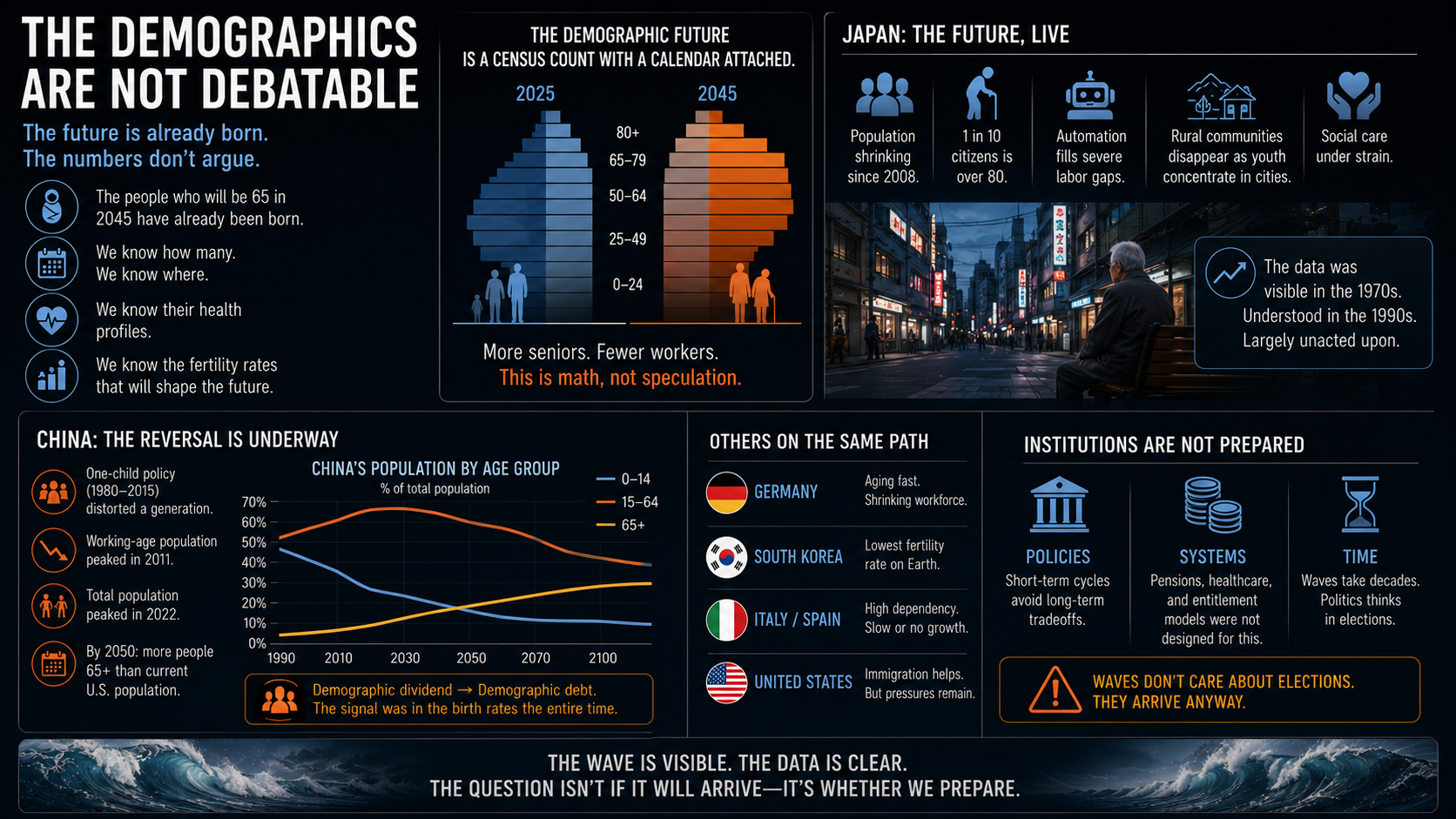
Of all the human waves currently in motion, demographic shifts are the most calculable and the most consistently underestimated by the institutions they will reshape.
The people who will be sixty-five years old in 2045 have already been born. We know approximately how many of them there are. We know where they live. We know their health profiles relative to previous generations at the same age. We know the fertility rates that will determine how many younger workers will exist to support them. The demographic future of every developed nation on Earth for the next three decades is not a forecast. It is a census count with a calendar attached.
Japan has been living in this future for longer than most. Its population has been shrinking since 2008. Its workforce has been aging for thirty years. One in ten Japanese citizens is now over eighty years old. The consequences — labor shortages so severe that convenience stores operate entirely on automation, rural communities disappearing as young people concentrate in cities, a social care system straining under a dependency ratio that no policy adjustment has adequately addressed — are not the result of poor planning in the abstract. They are the arrival of a demographic wave that was clearly visible in the birth rate data of the 1970s, fully understood by Japanese demographers in the 1990s, and largely unacted upon by a political system structurally allergic to the difficult choices the data demanded.
China is now entering its own version of this reckoning, on a scale that dwarfs Japan’s. The one-child policy, enforced from 1980 to 2015, produced a demographic distortion whose full consequences are still propagating. China’s working-age population peaked in 2011. Its total population peaked in 2022. By 2050, the United Nations projects that China will have more people over sixty-five than the entire current population of the United States. The economic miracle that made China the world’s second-largest economy was built on a demographic dividend — a bulging working-age population relative to dependents — that is now reversing into a demographic debt. The signal was in the birth rate data the entire time.
Germany, South Korea, Italy, and Spain face versions of the same trajectory at varying stages of arrival. The United States is partially insulated by immigration but faces its own demographic pressures as the Baby Boom generation moves fully into retirement and the political economy of Social Security and Medicare reaches its structural stress point. These are not crises that will arrive by surprise. They are waves that have been visible on every demographer’s chart for decades, traveling toward institutions that have repeatedly chosen not to prepare.
The Long Wave Nobody Teaches in Business School
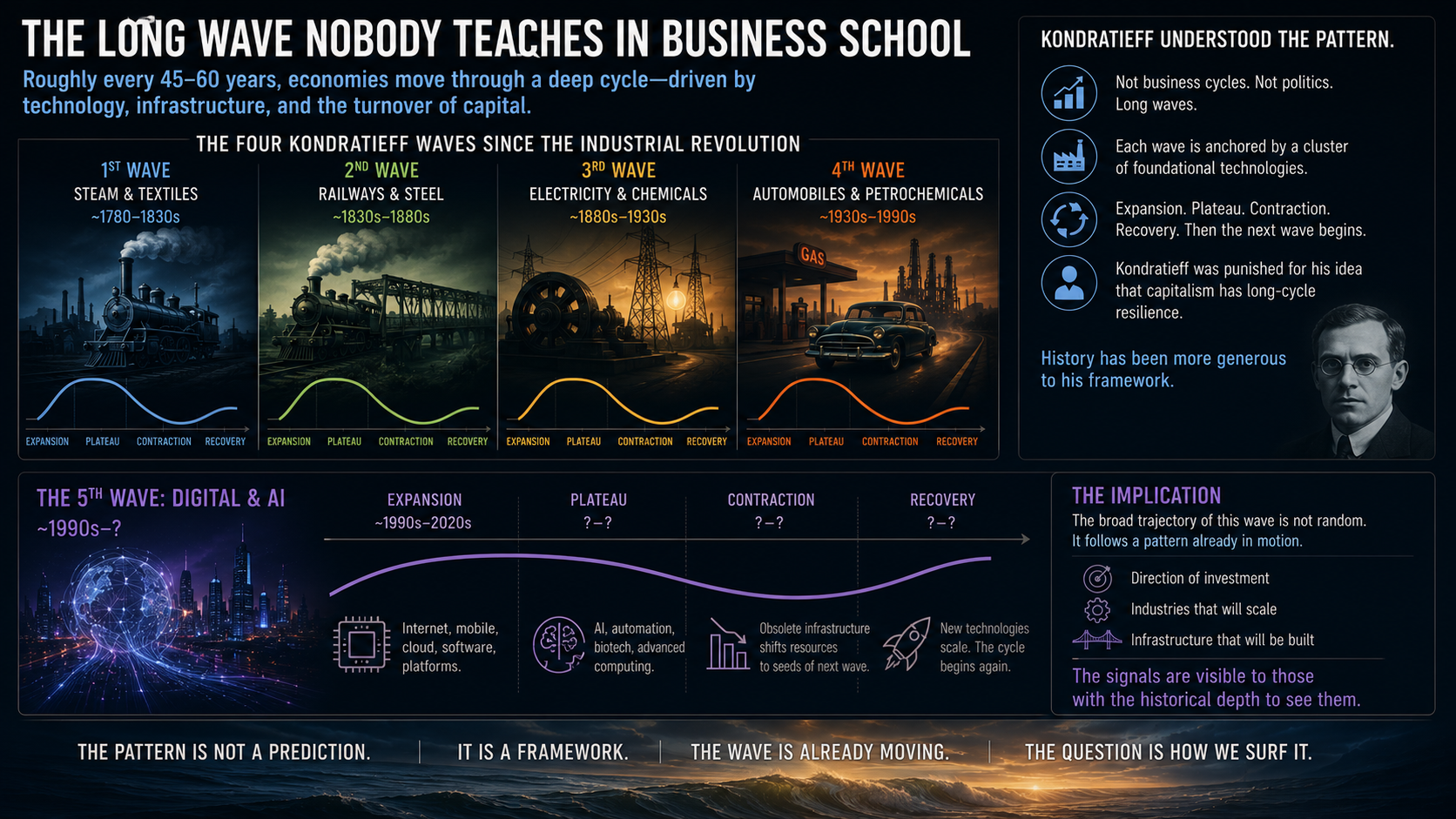
In the 1920s, a Russian economist named Nikolai Kondratieff published research identifying a pattern in capitalist economies that nobody had noticed before: roughly every forty-five to sixty years, the major economies appeared to move through a complete cycle of expansion, plateau, contraction, and recovery — driven not by business cycles or political decisions but by the long rhythms of technological adoption, infrastructure investment, and generational turnover of capital.
Kondratieff identified four such waves since the industrial revolution, each anchored by a cluster of foundational technologies: steam and textiles in the first, railways and steel in the second, electricity and chemicals in the third, automobiles and petrochemicals in the fourth. Each wave followed a similar pattern — a period of rapid deployment and economic expansion as the foundational technology spread, followed by a plateau as the technology matured and its productivity gains were fully absorbed, followed by a contraction as the old infrastructure became economically obsolete and investment shifted toward the seeds of the next wave.
The theory was controversial enough in Stalin’s Soviet Union that Kondratieff was eventually arrested and executed, partly for the implication that capitalism had long-cycle resilience rather than inevitable collapse. History has been more generous to his framework.
If Kondratieff’s waves are real — and the empirical record is substantial enough that most serious economic historians take them seriously — then the current period, anchored by the digital revolution and now accelerating through artificial intelligence, represents a fifth wave whose expansion phase has been underway since roughly the 1990s and whose full deployment and eventual plateau are still ahead. The implication is not that recessions won’t happen. It is that the broad trajectory of this wave — the direction of investment, the industries that will scale, the infrastructure that will be built — is not random. It is following a pattern already in motion, already visible to those with the historical depth to recognize it.
The Values Your Parents Formed Are Still Running the World
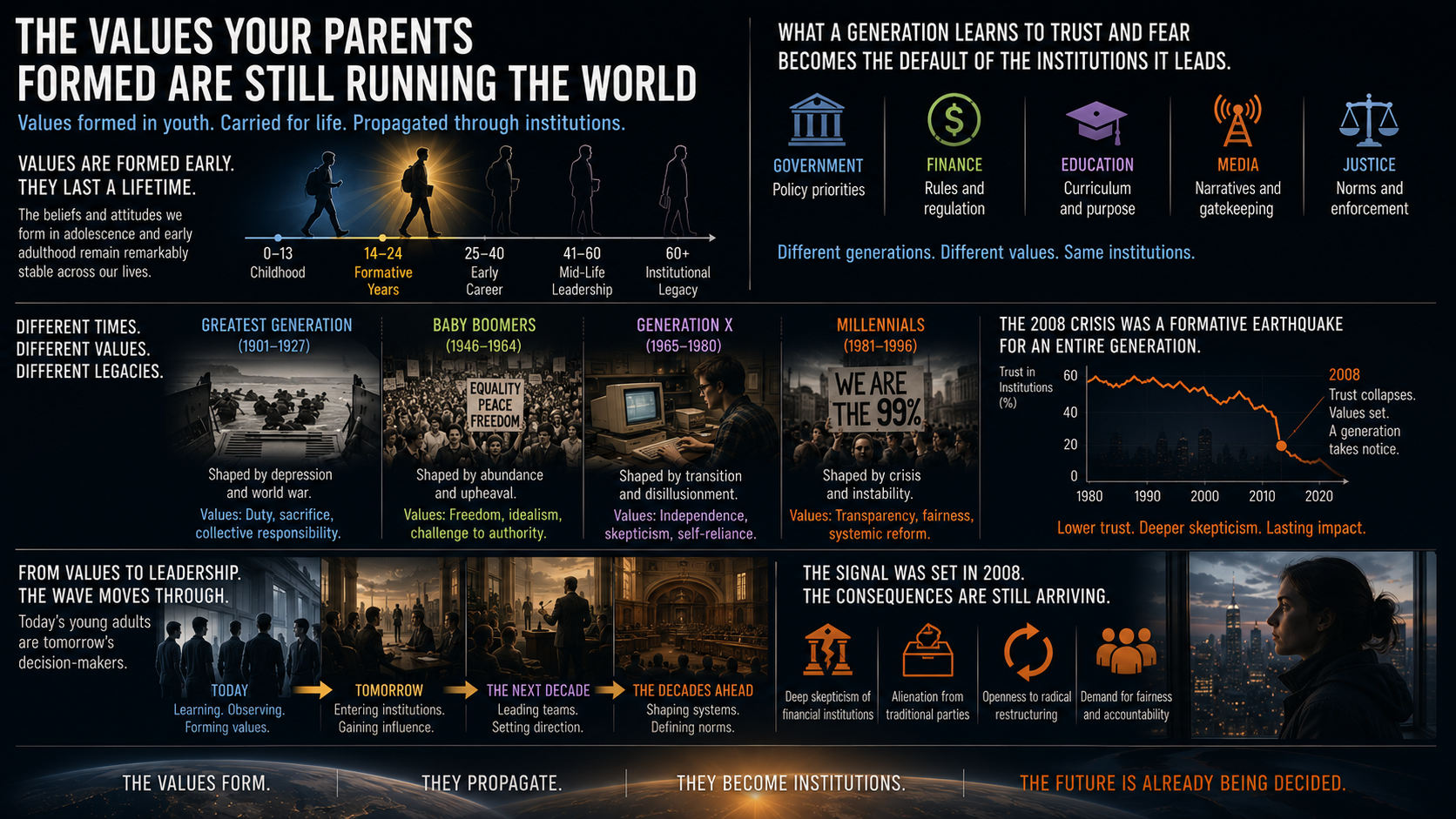
There is a third human wave less often discussed in quantitative terms but equally powerful in its consequences: the generational propagation of values formed during the period when a generation comes of age.
Political scientists and social psychologists have documented consistently that the values, political attitudes, and institutional trust levels formed during a person’s late adolescence and early adulthood — roughly ages fourteen to twenty-four — prove remarkably stable across the rest of their lifetime. A generation shaped by depression and world war carries those formative experiences into its institutional leadership for decades. A generation shaped by economic abundance and social upheaval carries different values into the same institutions. The specific values matter less than the mechanism: what a generation learns to trust and fear during its formative decade propagates through every institution it eventually leads, for as long as that generation holds leadership positions.
The generation that came of age during the 2008 financial crisis — watching institutions fail, watching rules bend for the powerful and break for everyone else, watching homeownership and financial security evaporate for their parents — is now entering positions of institutional authority. The values formed in that crucible — deep skepticism of financial institutions, alienation from traditional political parties, openness to radical restructuring of economic arrangements — are not attitudes they grew out of. They are the formative bedrock of a cohort that will be running major institutions for the next thirty years. The signal was set in 2008. The full institutional consequences are still arriving.
The Wave You Are Already Riding
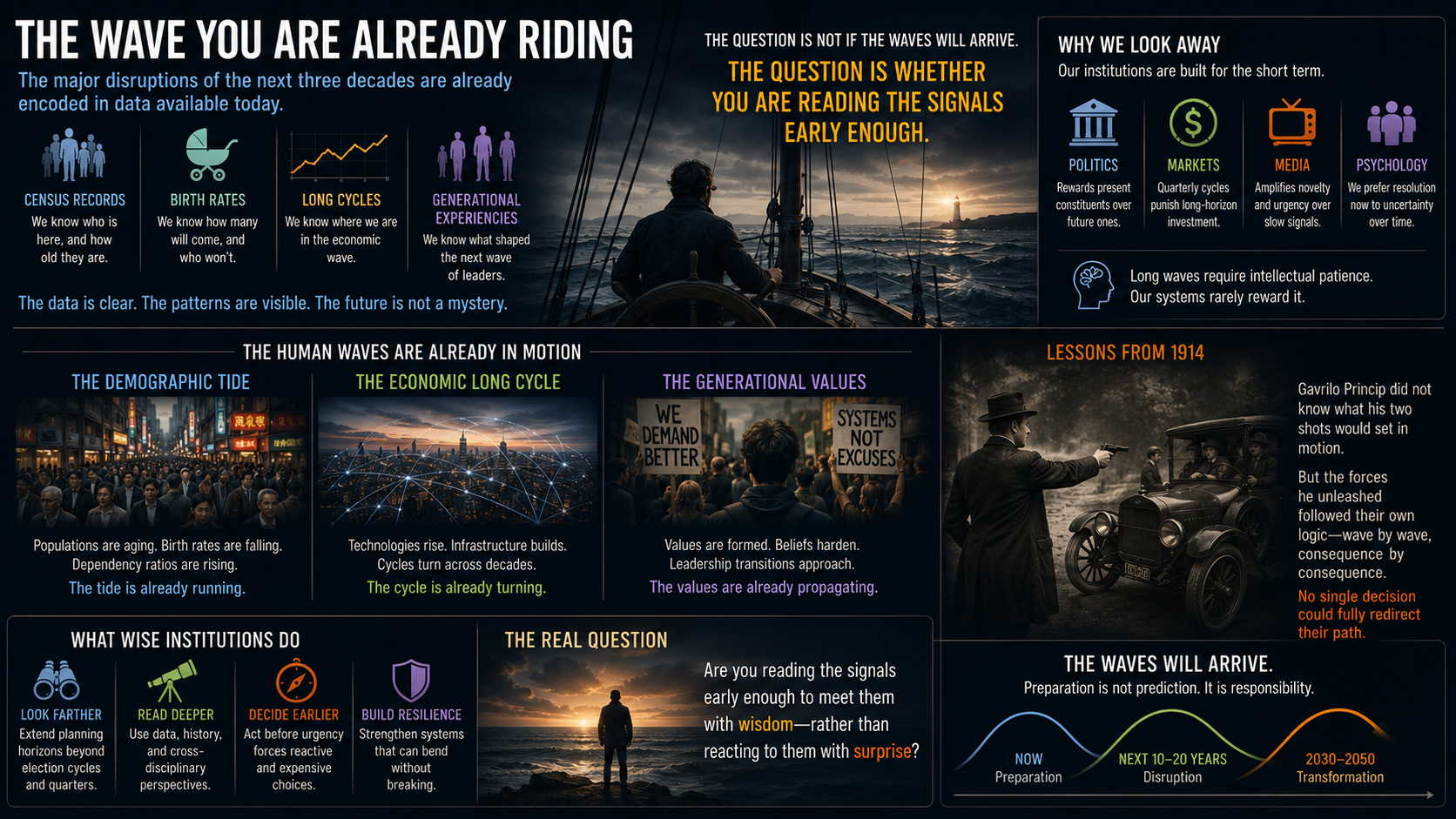
The hard question this column asks is one that most institutions answer with uncomfortable honesty only in retrospect: if the major demographic, economic, and generational disruptions of the next three decades are already encoded in data available today — in census records, in birth rates, in Kondratieff cycle positioning, in the formative experiences of generational cohorts already identified — why do our planning horizons remain so stubbornly short?
The answer is partly structural. Political systems reward responsiveness to present constituents over preparation for future ones. Quarterly earnings cycles punish long-horizon investment. Media environments amplify novelty and urgency over the slow-moving signals that carry the largest eventual consequences. The incentive structures of most human institutions are systematically misaligned with the timescales on which the most consequential waves operate.
But the answer is also partly psychological. Long-wave signals require sitting with uncertainty for long periods without the satisfaction of resolution. They require holding a demographic projection from 2030 in the same mental frame as a quarterly operational decision in 2026, and understanding how they connect. They require the intellectual discomfort of acting on what the data says rather than what current experience confirms.
Gavrilo Princip did not know what his two shots would set in motion. But the forces those shots unleashed followed their own logic, wave by wave, consequence by consequence, with a relentlessness that no subsequent decision could fully redirect.
The human waves are no different. They are already in motion. The demographic tide is already running. The economic long cycle is already turning. The generational values already formed are already propagating toward the institutions that will one day be asked to hold them.
The question is never whether these waves will arrive. They will. The question is always the same: are you reading the signals early enough to meet them with wisdom rather than surprise?
Related Articles
United Nations Department of Economic and Social Affairs — World Population Ageing 2023: Demographic Trends Shaping the Next Thirty Years https://www.un.org/development/desa/pd/content/world-population-ageing-2023
Harvard Business Review — The Long Wave: What Kondratieff Got Right About the Rhythm of Economic History https://hbr.org/kondratieff-long-wave-economic-cycles
Pew Research Center — How Generations Are Shaped by the World They Come of Age In https://www.pewresearch.org/social-trends/generations-formative-experiences-values