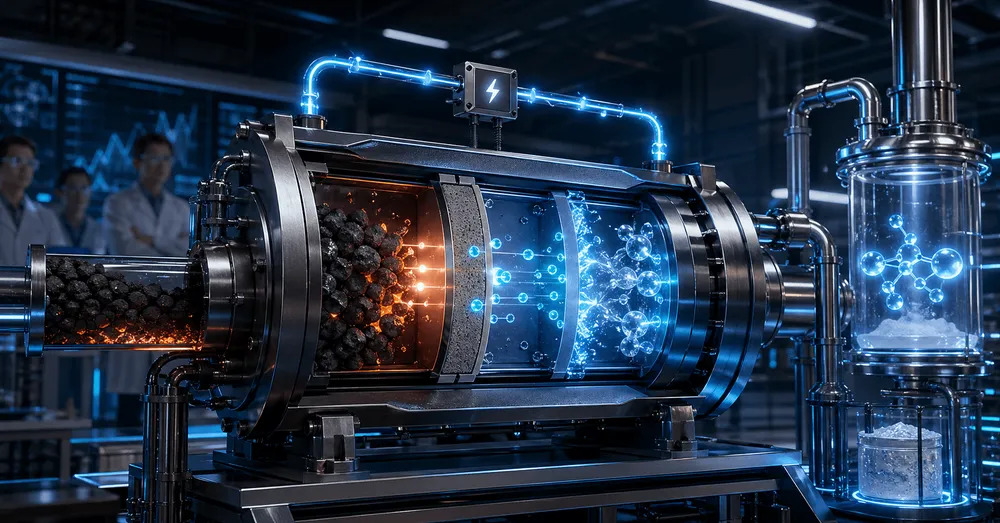
China Just Rewired One of History’s Dirtiest Fuels
By Futurist Thomas Frey
For 200 years, the story of coal has been simple and brutal: dig it up, set it on fire, capture the heat. The process powers civilization, but it also chokes it. Every kilowatt of coal-fired electricity comes loaded with carbon dioxide, sulfur, and a long trail of environmental regret.
Now a team of Chinese researchers has done something that sounds almost impossible — they’ve found a way to pull electricity directly from coal without ever striking a match.
This isn’t a cleaner smokestack. It’s a fundamentally different relationship with one of the world’s most abundant, and most controversial, energy sources.
What the ZC-DCFC Actually Does
The device is called a Zero-Carbon-Emission Direct Coal Fuel Cell, or ZC-DCFC. It was developed by a team led by Xie Heping, a member of the Chinese Academy of Sciences at Shenzhen University.
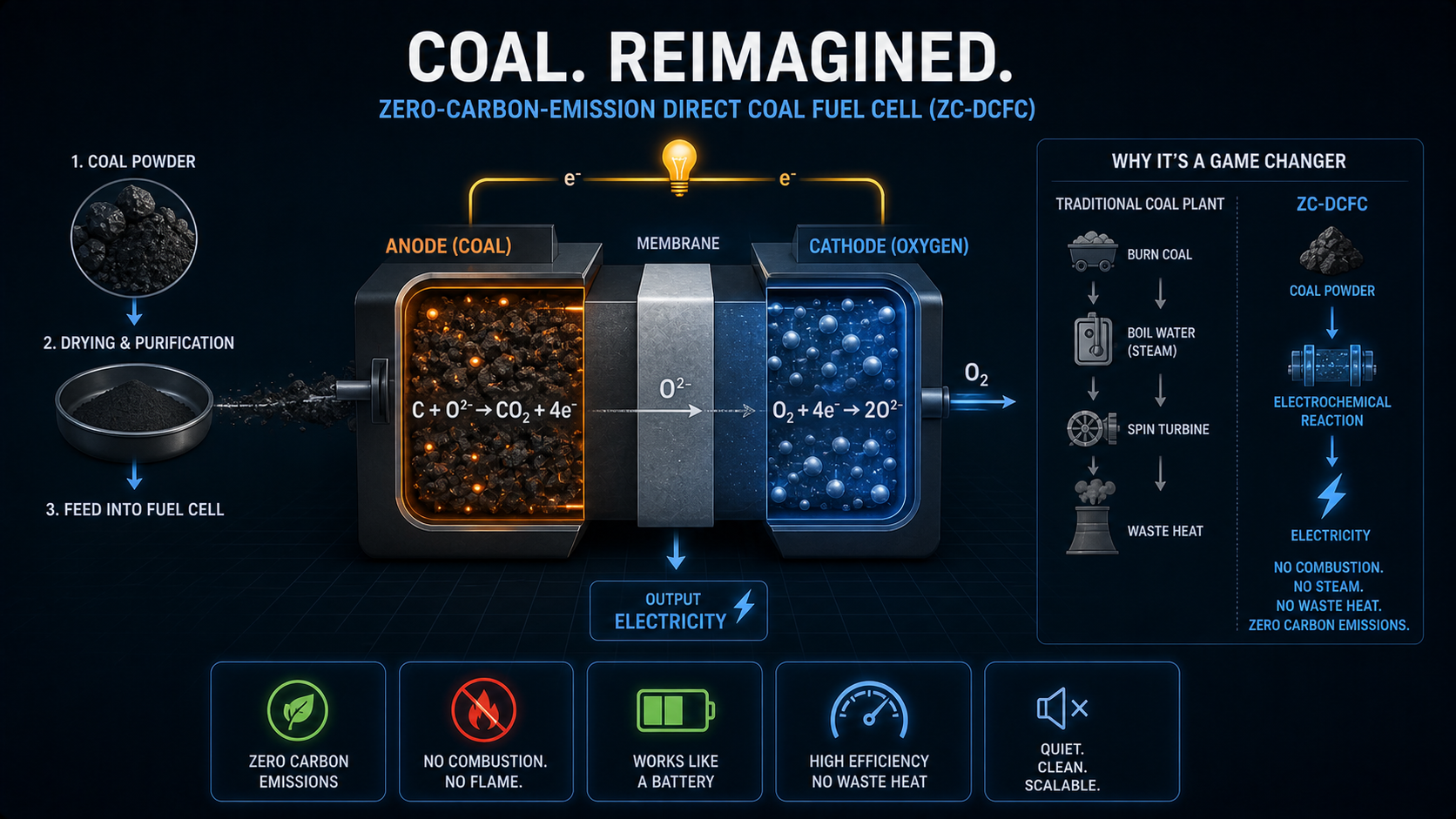
The concept is elegant in its simplicity — once you see it. The system works by converting coal into a fine powder that is dried and purified before being introduced into the fuel cell. Oxygen is supplied at a separate electrode, allowing the coal to undergo electrochemical oxidation across a membrane.
Think of it like a battery, but one that runs on coal dust instead of lithium. In a conventional AA battery, chemicals react inside a sealed environment and electrons flow through a wire to power your flashlight. Nobody sets anything on fire. The ZC-DCFC does something conceptually similar — coal reacts with oxygen across a membrane, electrons move, electricity is generated. Clean. Quiet. No flames.
Crucially, this approach eliminates the need for conventional power-generation stages such as steam production and mechanical turbines, which are typically central to coal-fired plants. If you’ve ever stood near a coal plant and felt the heat radiating from cooling towers, you’ve experienced the inefficiency of the old model firsthand. All of that escaping heat is wasted energy. The ZC-DCFC bypasses it entirely.
The Physics Advantage: Breaking the Carnot Ceiling
Here’s where it gets exciting for energy engineers — and for anyone who pays an electricity bill.
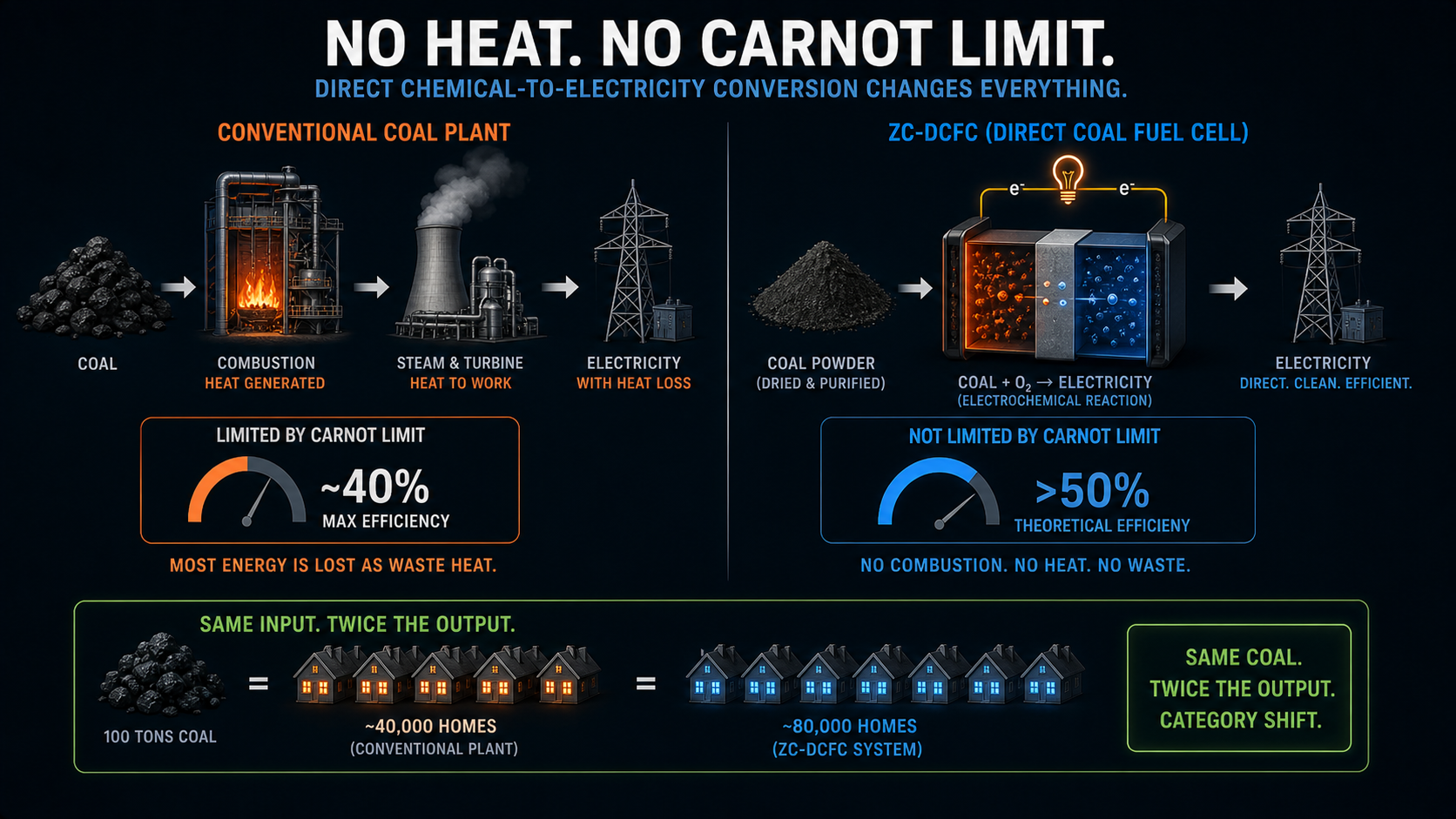
Every heat engine in history, from a steam locomotive to a modern gas turbine, runs up against something called the Carnot limit. It’s a thermodynamic ceiling that caps how efficiently you can convert heat into work. Xie noted that conventional coal-fired power plants are limited by thermodynamic constraints, with efficiency capped at around 40 percent due to Carnot cycle constraints.
Because the ZC-DCFC never creates heat in the first place — it converts chemical energy directly into electrical energy — the Carnot ceiling simply doesn’t apply. By avoiding combustion and the Carnot cycle limit, the ZC-DCFC could theoretically surpass the 33–45% efficiency of conventional coal plants, potentially exceeding 50%.
To put that in real-world terms: if a traditional coal plant feeds 100 tons of coal into its furnace, it might generate enough electricity to power 40,000 homes. The same 100 tons fed into a scaled ZC-DCFC system could potentially power 80,000. Same coal. Twice the output. That’s not an incremental improvement — that’s a category shift.
The Carbon Capture Built Right In
The most controversial part of coal has always been what comes out of the smokestack. Carbon dioxide doesn’t just disappear when we capture it at the source — it has to go somewhere. Traditional carbon capture systems bolt expensive scrubbing equipment onto existing plants, which is costly, energy-hungry, and never fully efficient.
The ZC-DCFC handles this differently. At the anode outlet, the high-purity carbon dioxide generated by the reaction is captured in situ and catalytically converted into valuable chemical feedstocks such as synthesis gas, or mineralized into compounds like sodium bicarbonate.
This is a crucial distinction. The CO₂ doesn’t drift into a diluted gas stream that has to be laboriously separated later. It emerges in concentrated, high-purity form right at the source, ready for reuse. Sodium bicarbonate — baking soda — is used in food production, pharmaceuticals, and industrial processes. Synthesis gas is a building block for plastics, fertilizers, and clean hydrogen. The “waste” product becomes a feedstock product.
Picture a future coal facility that generates electricity, captures its own carbon, and simultaneously produces industrial chemicals — all in a single closed-loop system. That’s the vision baked into this research.
China’s Strategic Calculus
It’s worth pausing to ask: why is China leading this particular breakthrough?
Coal still supplies roughly 60% of China’s electricity, underpinning millions of jobs. China cannot simply switch off coal overnight without destabilizing its economy and the communities that depend on it. At the same time, China has made sweeping commitments to carbon neutrality by 2060. Those two facts are in direct tension.
The ZC-DCFC offers a potential third path: keep the coal, eliminate the emissions. Scientists hope future studies can help identify suitable application scenarios for ZC-DCFCs in the energy sector, noting that shallow coal reserves are currently being rapidly depleted worldwide, driving coal extraction beyond depths of 2,000 meters. The research team is also exploring the possibility of generating electricity in-situ — directly at the coal seam, deep underground, without ever bringing the coal to the surface. If that vision materializes, future “coal plants” might be nothing more than a cluster of pipes and electrodes sunk into the earth, with electricity flowing up and CO₂ being mineralized below.
The Hard Questions That Remain
Honest futurism means asking the difficult questions alongside the exciting ones.
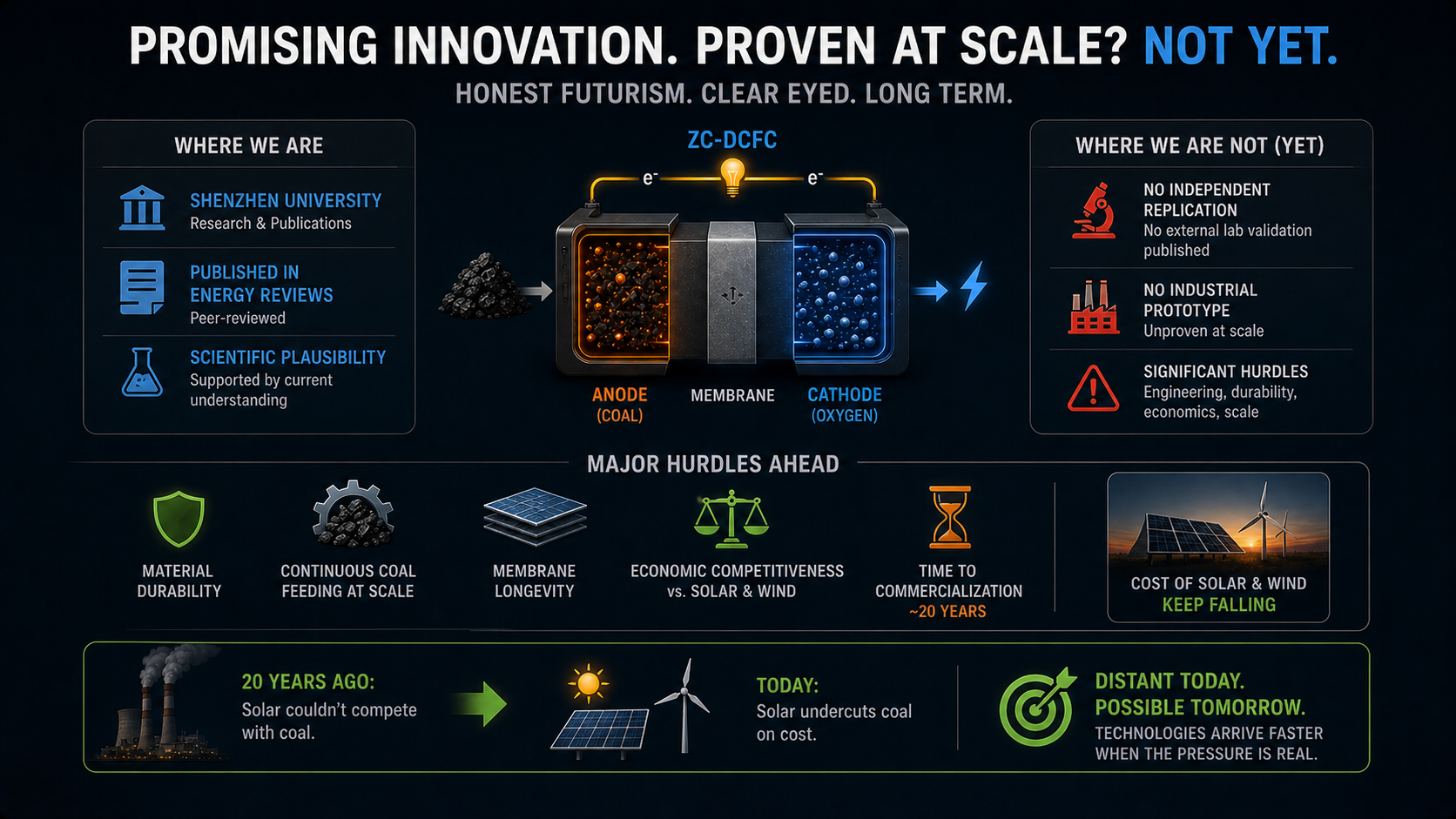
All publicly available information about the ZC-DCFC traces back to Shenzhen University and the research team’s own publications. No independent laboratory has reported testing or replicating the results. The study appeared in the peer-reviewed journal Energy Reviews, which confirms scientific plausibility — but peer review is not the same as a working industrial prototype.
While promising, the concept remains unproven at industrial scale and faces significant engineering and economic hurdles. Material durability, continuous coal feeding at scale, membrane longevity, and economic competitiveness against rapidly falling solar and wind costs are all genuine unknowns. Commercialization is expected to take about 20 years.
Twenty years is not tomorrow. But twenty years ago, no one believed solar panels would undercut coal on cost alone. Technologies that seem distant have a way of arriving faster than expected when the economic pressure is strong enough — and the pressure on coal’s carbon footprint has never been stronger.
A New Category of Energy Thinking
What excites me most about the ZC-DCFC isn’t just the technology — it’s the conceptual leap. For generations, we’ve treated coal as something to be burned. This team at Shenzhen University looked at the same black rock and asked a completely different question: what if we treat coal as an electrochemical medium instead of a fuel?
That kind of reframing is how paradigms shift. The same thinking turned silicon from sand into the foundation of the digital economy. It turned sunlight from something we squinted at into our fastest-growing electricity source. If coal can be reimagined as a clean electrochemical energy carrier — with carbon captured, efficiency doubled, and combustion removed entirely — then the map of global energy gets redrawn in ways we haven’t fully imagined yet.
The fire was never the point. The electrons were.
Related Articles
Interesting Engineering — China’s Electrochemical System Converts Coal into Electricity with No Direct Carbon Emission https://interestingengineering.com/energy/chinas-converts-coal-into-electricity
South China Morning Post — China Unveils World’s First Coal Fuel Cell That Can Produce Electricity with Zero Emission https://www.scmp.com/news/china/science/article/3351241/china-unveils-worlds-first-coal-fuel-cell-can-produce-electricity-zero-emission
Business Today — China Unveils Tech That Converts Coal Directly into Electricity Without Burning https://www.businesstoday.in/latest/trends/story/china-unveils-tech-that-converts-coal-directly-into-electricity-without-burning-heres-how-it-works-528528-2026-05-02