By Futurist Thomas Frey
I have spent decades doing something my colleagues find equal parts fascinating and slightly unhinged: I treat the future as a living force. Not a destination. Not a deadline. A force — as real and as powerful as gravity, as indifferent to our preferences as a river deciding which way to run.
People ask me all the time why anyone should study something that hasn’t happened yet. My answer is always the same. You are going to spend the rest of your life in the future. That alone seems like sufficient reason to understand how it works.
What follows are twelve laws I have developed over decades of watching the future arrive. They are not predictions. They are operating principles — the physics of what is coming, whether we are ready or not.
Law 1: The Future Is One of Nature’s Most Powerful Forces
The entire universe — every galaxy, every atom, every human heartbeat — is being pulled forward in time simultaneously. You cannot opt out. You cannot slow it down. The pace is constant, relentless, and has never once asked for our permission.
The future doesn’t care about your five-year plan. It is already ten years ahead of it.
What makes this law important is not the observation itself but what follows from it: since we cannot stop the future, our only meaningful choice is how we orient ourselves to its arrival.
Law 2: The Present and the Future Are Separated by a Field of Knowability
Everything in the present is knowable. You can touch it, measure it, photograph it, argue about it. But just across an invisible threshold lies a veil of understanding we don’t yet possess. Not because the future is random — it isn’t — but because the information required to know it hasn’t been generated yet.
Think of it like the edge of a spotlight on a darkened stage. Inside the light, everything is visible. Just outside it, shapes move. You can sense them. You can reason about them. But you cannot see them clearly until they step into the light.
The job of a futurist is to study the edges of that spotlight.
Law 3: Each of Us Experiences the Future Differently
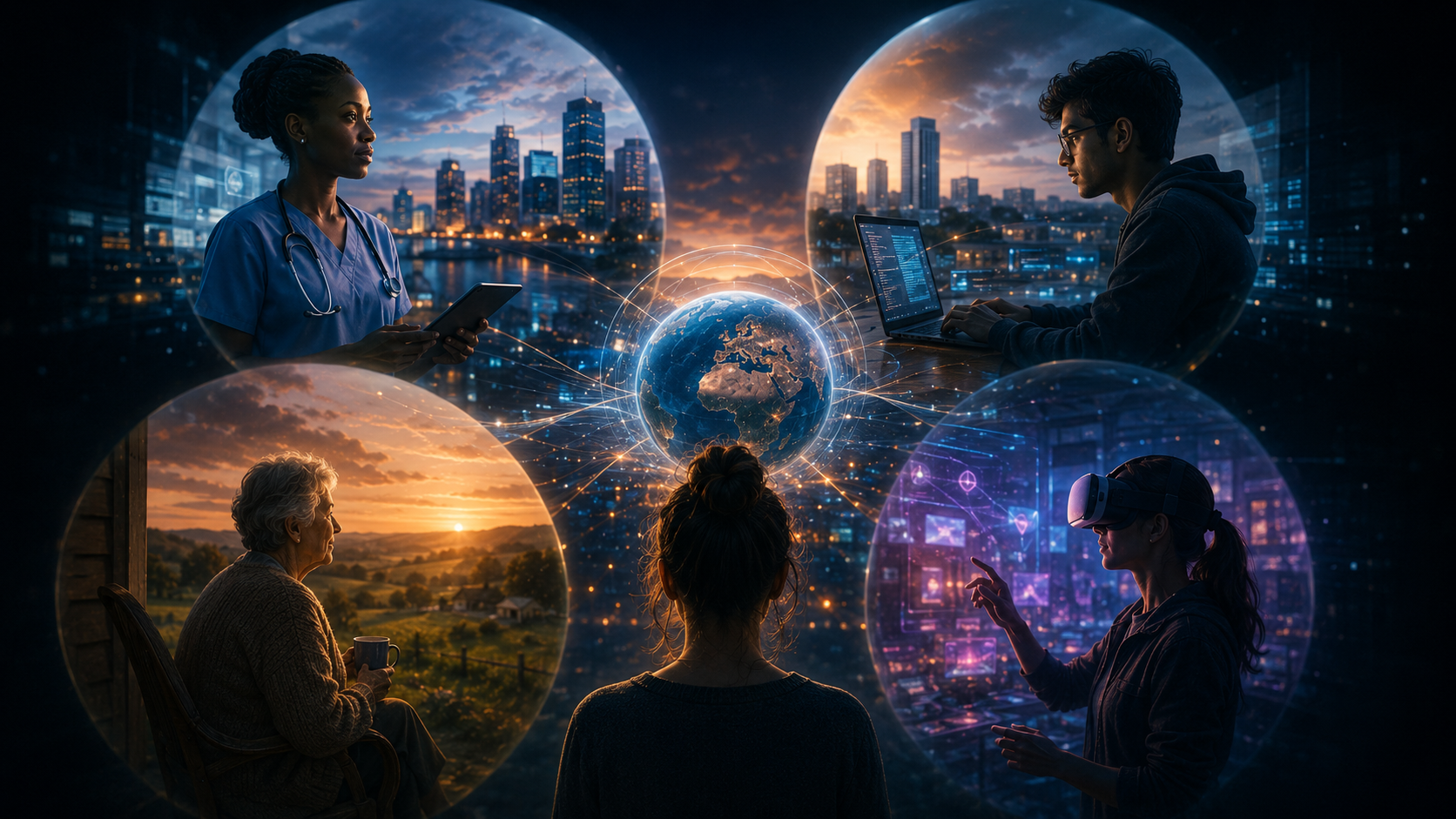
We often speak about the future as though it arrives the same way for everyone at once. It doesn’t. A forty-year-old nurse in Lagos, a nineteen-year-old coder in Bangalore, and a retired teacher in rural Ohio are each living in a dramatically different version of the unfolding present — and each is moving toward a dramatically different version of what comes next.
The future is not a single film everyone watches at the same time. It is eight billion simultaneous private screenings.
This is why empathy is a futurist tool. To understand the future broadly, you have to be able to imagine many different futures at once.
Law 4: We Do Not Control the Future, but We Create Our Approach Vectors
The future doesn’t exist until it arrives — but the inertia we build in the present shapes which futures become possible. Think of a spacecraft launched toward Jupiter. The exact trajectory is set years before arrival. Every small correction made early has enormous consequences later. Every correction ignored early becomes nearly impossible to make later.
The decisions being made right now — in boardrooms, laboratories, legislative chambers, and living rooms — are setting trajectories that will define the next fifty years. The future will arrive regardless. The question is which approach vector we are on when it does.
Law 5: The Future Unfolds Against a Backdrop of Competing Inertias
No single force shapes the future alone. Changing weather is an inertia. Demographic aging is an inertia. The explosive growth of artificial intelligence is an inertia. Geopolitical fragmentation is an inertia. Each pushes in its own direction, and the actual future is the product of all of them colliding simultaneously.
Understanding the future requires holding multiple trajectories in your mind at once — and being comfortable with the fact that they are all moving at the same time.
This is why simple predictions so often fail. They isolate one inertia and ignore the rest. The real world doesn’t offer that luxury.

Law 6: The Unknowability of the Future Is Not a Bug. It Is the Feature.
If the future were fully knowable, human motivation would collapse. We act because we believe our actions matter — that what we do today changes what happens tomorrow. Remove that uncertainty and you remove the engine of human civilization: the belief that effort, creativity, and courage make a difference.
The mystery of the future is what makes ambition rational. It is why a twenty-two-year-old starts a company. Why a scientist runs one more experiment. Why any of us bother.
Law 7: Most of the Future Is Already Predictable — We Just Ignore the Stable Parts
We are drawn to volatility and disruption. But the vast majority of what will be true in twenty years is already true today. People will still need food, shelter, connection, meaning, and health. The sun will rise at a predictable time. Supply chains will still follow the logic of cost and distance. Social trust will still determine whether institutions function.
The future is not built entirely on the exotic. It is built on the reliable, with the exotic arriving at the edges.
The forecaster who ignores the stable underestimates continuity. The one who ignores disruption underestimates change. The discipline is knowing which parts of the world move fast, and which parts barely move at all.
Law 8: The Future Is Not Human-Centric
Nature does not optimize for human comfort. Climate systems, disease vectors, tectonic plates, and the trajectories of competing technologies all operate according to their own logic, not ours. The future, as a raw force, is as indifferent to our preferences as a hurricane.
Only humans care whether the future is good for humans. The future itself does not.
This is not cause for despair. It is cause for seriousness. It is the reason we need foresight, frameworks, and the willingness to prepare for futures we would not have chosen.

Law 9: The Future Is Ours to Create — Within the Inertias That Exist
We do not have direct control over the future. But we have something almost as powerful: the ability to create new inertias and redirect existing ones. A single research breakthrough changes a trajectory. A law passed today reshapes an industry for decades. A generation of children taught to think critically about technology changes what that technology eventually becomes.
We are not passengers. We are navigators operating inside a system far larger than ourselves.
The goal is not to control the future. The goal is to create conditions in which the futures worth having become more likely.
Law 10: Thinking About the Future Changes It
The act of imagining a future is itself an act of creation. When a city planner envisions a transit corridor that doesn’t exist yet, that vision shapes the decisions made today, which shapes the city that will exist in thirty years. When a generation of engineers grows up reading science fiction, they build the things they read about.
The future you think about is the future you begin, however subtly, to build.
This is why futures thinking matters not just as analysis but as practice. The more fluently a society thinks about the future, the more agency it has over which futures arrive.
Law 11: The Future Is Filled with Extraordinary Power and Energy
Every technological revolution in human history has released energy that its inventors could not fully anticipate. The printing press was a way to copy books. It became a way to reshape civilization. Electricity was a curiosity in a laboratory. It became the foundation of the modern world. Artificial intelligence is currently a way to generate text and images. What it becomes is still being decided.
The future contains more power than any generation before us has held. The question is not whether we can access it. The question is whether we are wise enough to use it without destroying what we most care about.

Law 12: Every Avalanche Begins with a Single Snowflake
The most transformative forces in history began as something almost invisible. A pamphlet. A conversation in a coffee house. A student who asked the wrong question. A small experiment that suggested something impossible might not be.
You do not need to move the whole mountain. You need to find the right snowflake.
Our ability to shape the future is not reserved for the powerful or the well-resourced. It belongs to anyone who thinks carefully, acts deliberately, and understands that small initial conditions have enormous downstream consequences.
The future is vast. It is already in motion. And it is, to a degree we often underestimate, ours to design.
“The future is where our children live.” — Thomas Frey
Related Articles
IEEE Spectrum “The Art and Science of Technology Forecasting” https://spectrum.ieee.org/the-art-and-science-of-technology-forecasting
World Economic Forum “These Are the Biggest Risks Facing the World in the Next 10 Years” https://www.weforum.org/stories/2024/01/global-risks-report-2024-biggest-risks-facing-the-world/
Nature — Futures “Foresight in Science and Technology Policy: Building Bridges Between Research and Decision-Making” https://www.nature.com/articles/palcomms201682