The Universe Has Been Sending Us Messages for Countless Years. Most of Them Haven’t Arrived Yet.
By Futurist Thomas Frey
A Message Sent Before Earth Existed
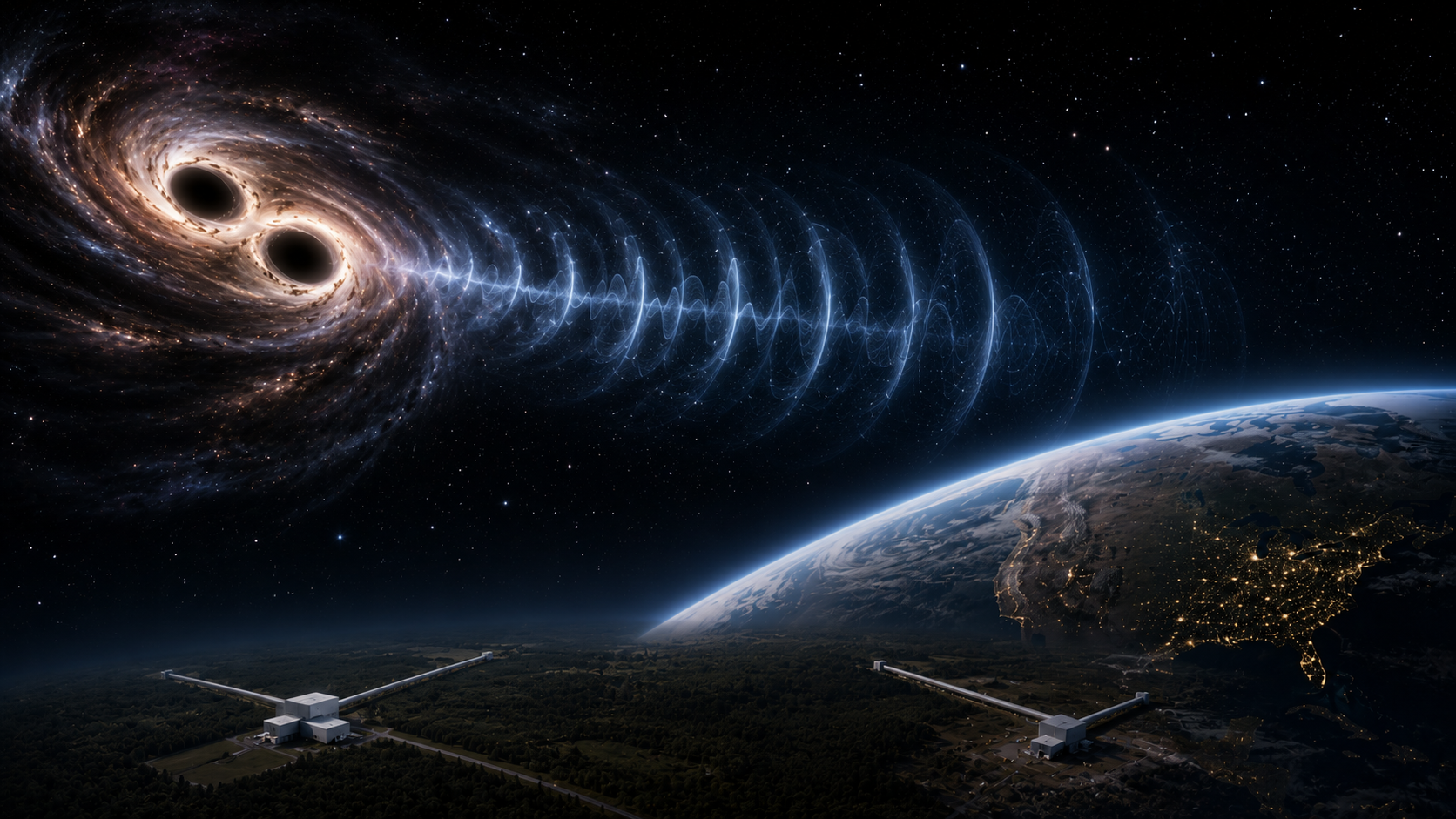
On September 14, 2015, a pair of detectors in Louisiana and Washington State registered a disturbance so small it measured a fraction of the width of a proton. The instruments — two L-shaped tunnels each four kilometers long, built at a cost of over a billion dollars and decades of scientific labor — had detected a ripple in the fabric of spacetime itself. The signal had traveled 1.3 billion light-years to reach us. It was generated by two black holes, each roughly thirty times the mass of the sun, spiraling into each other and merging in a collision of incomprehensible violence. That event happened when the most complex life on Earth was a single-celled organism drifting in a shallow sea. The signal from that collision spent more than a billion years crossing the universe before it passed through the Louisiana pine forests and registered on a human-built instrument for the first time in history.
We called it GW150914. We called it a discovery. But it wasn’t a discovery in the conventional sense. The event had already happened. The signal was already in transit. What changed on that September morning was not the universe — it was us. We finally built an instrument sensitive enough to receive what had been traveling toward us for longer than multicellular life has existed on this planet.
That is the foundational insight of this series, stated in its most cosmic form: the future is not something that happens to us. It is something already traveling toward us. Our relationship to it is determined entirely by the quality of our instruments and the sophistication of our ability to read what those instruments receive.
The Spectrum We Cannot Yet See
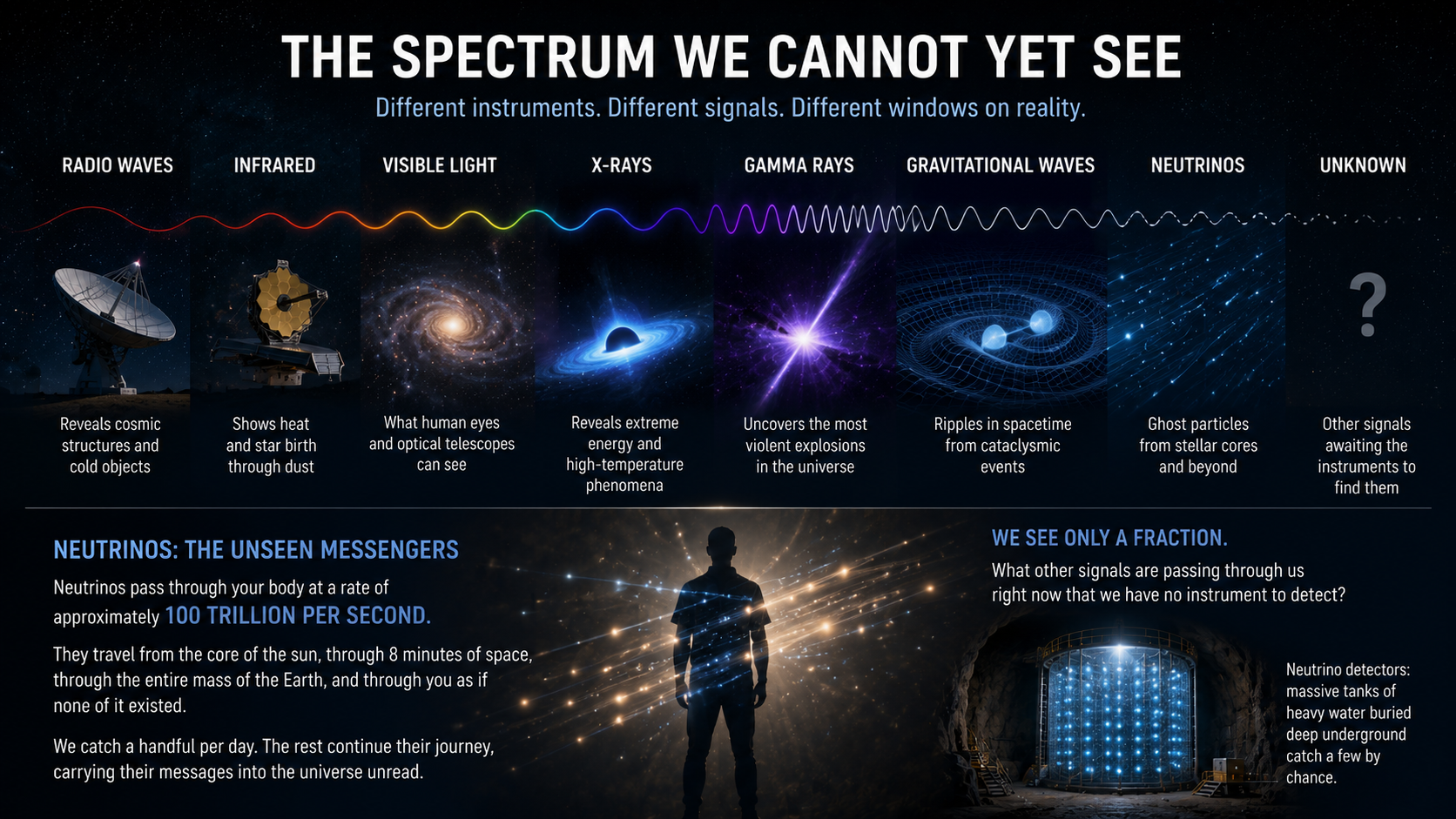
The gravitational wave detection by LIGO was extraordinary not just for what it found, but for what it implied about everything we are still missing. For most of human history, our window onto the universe was limited to visible light — the narrow sliver of the electromagnetic spectrum that human eyes evolved to detect. The invention of radio telescopes opened a new frequency. X-ray observatories revealed violent processes invisible to optical instruments. Infrared astronomy showed us the heat signatures of star formation hidden behind dust clouds. Each new instrument didn’t just add information to what we already knew. It revealed entire categories of reality that had been present all along, transmitting continuously, and completely invisible to every instrument that came before.
Neutrinos pass through your body at a rate of approximately 100 trillion per second. They travel from the core of the sun, through eight minutes of space, through the entire mass of the Earth, and through you as if none of it existed. We know they carry information about nuclear processes in stellar interiors that light cannot escape. We have built detectors — massive tanks of heavy water buried deep underground in mines in Japan and Canada — that catch perhaps a handful of these particles per day out of the trillion-trillion that pass through. The rest continue their journey, carrying their messages into the universe unread.
What other categories of signal are passing through us right now that we have no instrument to detect? This is not a mystical question. It is a scientific one, and the history of physics suggests the answer is: many. Every generation of scientists has discovered that reality contains more channels of transmission than the previous generation suspected. There is no rational basis for believing our current generation has found them all.
The Universe as Message System
Here is the philosophical reframe that changes everything about how you think about the future: the universe is not a collection of objects. It is a system of relationships propagating through spacetime, and every event generates signals that travel outward in all directions at speeds determined by the physics of the medium carrying them. Light travels at the speed of light. Gravitational waves travel at the speed of light. Sound travels at roughly 340 meters per second through air. A tsunami generated by a Pacific earthquake travels at the speed of a commercial jet. A shift in ocean circulation propagates its thermal consequences over decades.
Everything that has happened is still, in some sense, happening — its signal still traveling outward, still carrying information about the event that generated it, still capable of influencing whatever it eventually reaches. The light arriving at your eye from the Andromeda Galaxy left its source 2.5 million years ago, before our species existed. You are, right now, receiving a message from the deep past of a neighboring galaxy. The Andromeda of today — whatever it looks like after 2.5 million years of stellar evolution — is currently invisible to us. Its present is a signal still in transit.
Scaled down to the human and earthly, the principle holds with equal force. Every action generates consequences that propagate outward through the systems they touch. Some arrive quickly. Some take generations. Some, as we will explore in the columns that follow, arrive on geological timescales. The future is not a clean slate awaiting our decisions. It is the accumulated arrival of signals generated by everything that has already happened, at every scale, in every system connected to us.
What We Are Learning to Hear
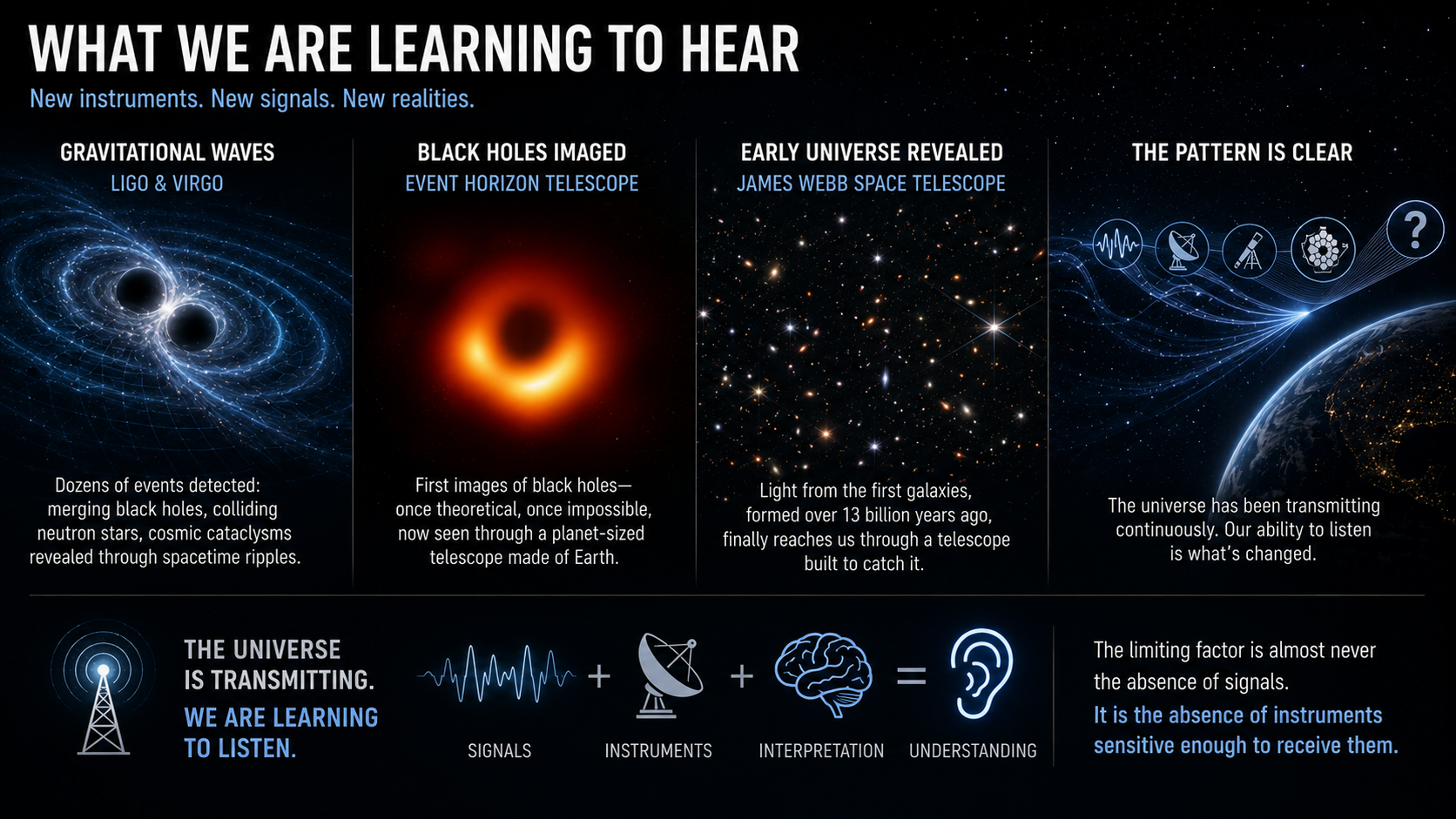
The last decade has been, quietly, one of the most extraordinary periods in the history of human signal detection. LIGO and its partner observatory Virgo have now detected dozens of gravitational wave events — merging black holes, colliding neutron stars, signals that carry information about the most violent processes in the universe. The Event Horizon Telescope, a planet-spanning array of radio observatories functioning as a single instrument the size of Earth, has produced the first images of black holes — objects whose existence was mathematically predicted a century ago and whose direct observation was considered impossible a decade ago.
The James Webb Space Telescope is receiving light from galaxies that formed within the first few hundred million years after the Big Bang — signals that have been traveling for over 13 billion years and are only now reaching an instrument capable of receiving them. Each image from Webb is a message from a universe so young that the Earth did not yet exist, arriving now because we finally built a receiver capable of catching it.
What this pattern tells us is not just scientifically exciting. It is philosophically instructive for anyone thinking about the future. The limiting factor in our relationship with reality is almost never the absence of signals. It is the absence of instruments sensitive enough to receive them. The universe has been transmitting continuously and comprehensively since the moment of its origin. We are the variable. Our instruments, our attention, our interpretive frameworks — these determine what portion of the available signal we can actually use.
The Instrument You Are Building Right Now
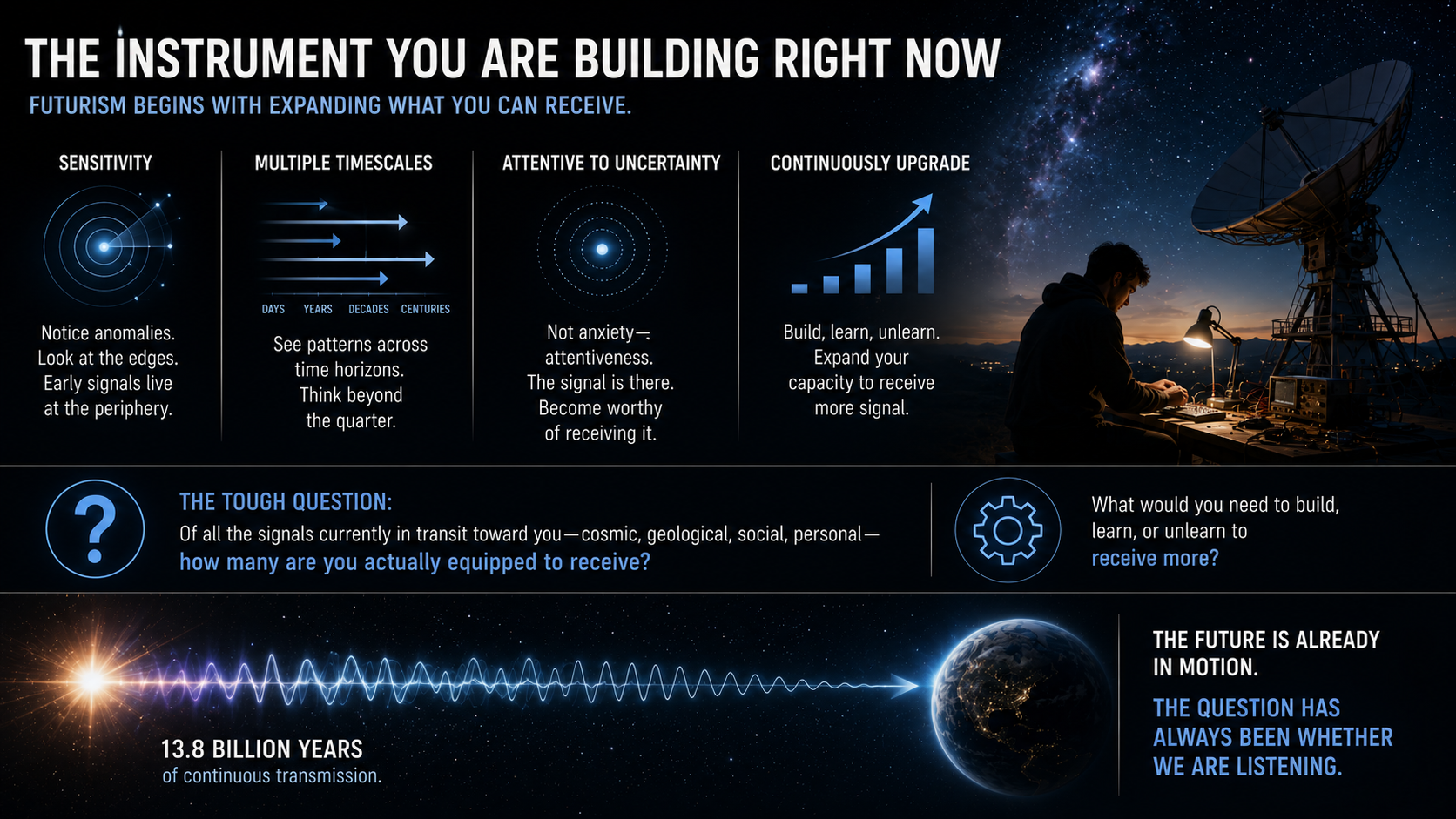
The futurist’s practice begins here. Not with predictions, not with trend extrapolations, not with scenario planning in a conference room. It begins with the discipline of instrument-building — the deliberate expansion of what you are capable of receiving.
That means developing sensitivity to signals at the periphery of your attention, where the anomalies live and where the earliest indicators of large-scale change almost always appear first. It means building interpretive frameworks that span multiple timescales simultaneously, so that a signal operating on a fifty-year cycle is not invisible to a mind trained to think in quarters. It means cultivating a relationship with uncertainty that is not anxiety but attentiveness — the stance of a person who knows the signal is there and is working to become worthy of receiving it.
The tough question worth sitting with is this: of all the signals currently in transit toward you — cosmic, geological, social, personal — how many are you actually equipped to receive? And what would you need to build, learn, or unlearn to receive more?
The universe has been transmitting for 13.8 billion years. Most of what it has sent, we have never heard.
The future is already in motion. The question has always been whether we are listening.
Related Articles
LIGO Scientific Collaboration — GW150914: The First Direct Detection of Gravitational Waves https://www.ligo.org/detections/GW150914.php
NASA James Webb Space Telescope — Webb’s First Deep Field: Receiving Light From the Universe’s Earliest Galaxies https://www.nasa.gov/webbfirstimages
Scientific American — What Neutrinos Are Telling Us About the Universe — If We Can Learn to Listen https://www.scientificamerican.com/article/neutrinos-universe-signal-detection