
By Futurist Thomas Frey
Peter Diamandis and Salim Ismail have a name for what is happening to organizations right now. They call it the Organizational Singularity — the point at which AI agents, AI-native workflows, and recursive self-improvement restructure companies faster than traditional hierarchy can adapt. It is not a future event. According to Ismail, it is already underway, and the companies that survive it will be one hundred times more performant than the ones that don’t.
One hundred times. Not ten percent better. Not twice as productive. One hundred times.
That number should reframe every conversation happening in boardrooms, city halls, and small business back offices right now. Because it means the question is no longer whether to adapt. It is whether you can adapt fast enough to remain relevant at all.
The Organizational Singularity doesn’t ask for your permission. It asks for your attention — and it is running out of patience.
Five business model developments from just this past week reveal exactly how the singularity is already reshaping the architecture of value creation. Taken together, they are not isolated experiments. They are the early structure of the economy that replaces the one we currently inhabit.

The Fiduciary Wedge Is Cracking Every Industry Open
Diamandis and Ismail identify what they call the Fiduciary Wedge — the growing gap between what human judgment can process and what AI can now do faster, cheaper, and more accurately. Every industry has one. Most industries are pretending it doesn’t exist.
The wedge shows up in five stories from this week alone.
OpenAI and Anthropic are moving toward enterprise joint ventures where large customers co-own AI deployment infrastructure and participate in AI governance — not as software licensees, but as quasi-equity partners in shared AI operations. This is the fiduciary wedge made contractual. When a hospital system or national bank recognizes that its AI infrastructure is too strategically important to outsource to a subscription agreement, it stops buying intelligence and starts aligning around it — the way nations align around defense treaties.
Companies don’t merely buy intelligence anymore. They align strategically around it — the way nations align around defense treaties.
Travis Kalanick’s company Atoms is folding its ghost kitchen operation into a robotics platform. The kitchens were never the business. They were the training environment — controlled, repeatable, measurable physical spaces generating the data needed to teach robotic systems how to operate in the real world. The restaurant was a classroom. The food was homework. The robots were always the graduation. The fiduciary wedge here is stark: human kitchen labor costs a certain amount per hour. Robotic systems, once trained, cost a fraction of that and never call in sick.
Uber is transforming its driver network into a distributed sensor grid — millions of human operators whose vehicles simultaneously map roads, scan conditions, and feed training data to autonomous vehicle companies. The driver earns a wage. Uber earns a data licensing fee. The autonomous vehicle company earns a competitive advantage worth billions. Three parties in the transaction. Only two fully understand what is being exchanged. This is behavioral infrastructure monetization — and it is the fiduciary wedge applied to human mobility itself.
A startup called e4n is acquiring local IT service businesses and centralizing their operations using AI agents. The acquisition target isn’t the customer base. It is the operational inefficiency — the manual processes and redundant workflows that AI can automate across a portfolio of similar businesses simultaneously. HVAC companies, bookkeeping practices, insurance agencies, medical billing operations, legal support firms, local logistics providers. Every one of these fragmented, inefficient industries is sitting on a fiduciary wedge that an AI-powered micro-private-equity firm can monetize at scale. Not glamorous. Potentially enormous.
And Tether, the stablecoin company, is investing in humanoid robotics — because the future of machine-to-machine economic transactions requires physical AI labor, autonomous agents, and settlement infrastructure all aligned under one strategic roof. The future bank may also own the robots. That sounds absurd today. So did Amazon owning airplanes twenty years ago.

The Middle 60% Problem Nobody Is Talking About
Ismail identifies what he calls the Middle 60% Problem — the vast majority of knowledge workers and mid-level managers whose roles are neither at the creative frontier nor in physical trades, but in the processing layer in between. These are the people who coordinate, synthesize, report, and approve. They are also the people whose functions AI agents now perform faster, more accurately, and without organizational politics.
The local accountant whose practice rests on tax preparation and annual filings is living inside the Middle 60% Problem. AI systems now handle routine reconciliation, compliance checks, and standard filings with greater accuracy than most human practitioners. The accountant who joins the emerging studio economy and levels up becomes a fractional CFO serving fifteen companies simultaneously — a strategic financial architect amplified by AI tools rather than replaced by them. The one who waits for the disruption to pass is not waiting for a storm. They are waiting for a new climate.
The general counsel faces the same reckoning. AI handles first-pass contract review, compliance monitoring, intellectual property filings, and legal research at a scale no human team can match on price. The attorney who repositions as a legal architect — building compliance infrastructure for a portfolio of ventures, designing the frameworks that new companies need at founding — survives. The one who competes with AI on volume and speed does not.
Local government sits squarely in the Middle 60%. Municipal administrations are under relentless pressure — more services demanded, tighter budgets, aging systems, constituents whose expectations are set by consumer technology that processes requests in seconds. The AI-native city government — one that has automated permitting, budget modeling, citizen services, and infrastructure maintenance prediction — does not need the same organizational structure as its predecessor. The civil servants who understand this and help build those systems will shape the city of the future. The ones who defend existing processes will watch their departments shrink around them.
The Middle 60% is not a demographic. It is a choice — between becoming AI-native or becoming redundant.
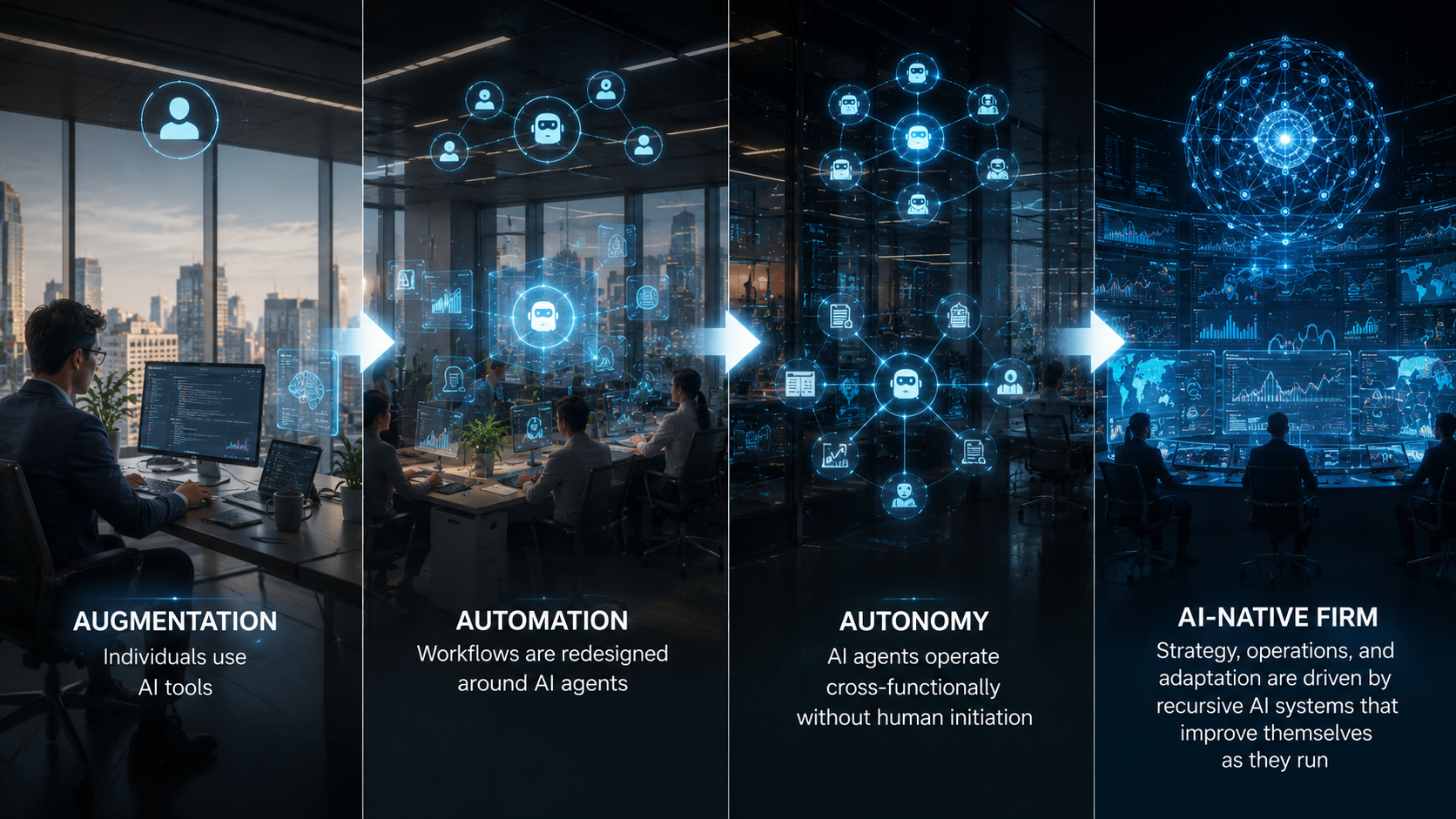
The Four Phases and the 2036 Firm
Ismail’s framework for organizational transformation describes four phases of becoming AI-native: augmentation, where individuals use AI tools; automation, where workflows are redesigned around AI agents; autonomy, where AI agents operate cross-functionally without human initiation; and the full AI-native firm, where strategy, operations, and adaptation are driven by recursive AI systems that improve themselves as they run.
The five business models described above are each operating somewhere in that sequence. The ghost kitchen turned robotics company is in autonomy. The AI joint venture model is reaching for the AI-native firm. The stablecoin-to-humanoid-robot pipeline is building the infrastructure layer the fully autonomous firm will eventually run on.
By 2036, Ismail projects, the AI-native firm will be one hundred times more performant than its traditional counterpart. Not in every dimension simultaneously — but in the dimensions that determine survival: speed of decision, cost of operation, quality of output, and capacity to adapt.
The companies that survive the Organizational Singularity won’t be the largest or the oldest. They will be the ones that rewrote themselves before they had to.

The Boundary Collapse That Changes Everything
Step back from each of these five developments and the pattern is unmistakable. The boundaries that organized business thinking for a century are dissolving simultaneously — infrastructure and software, labor and data, finance and physical systems, software and governance. The most unusual companies right now are hybrids operating across categories that used to be distinct.
This is the deeper signal beneath the surface of each story. Not that new companies are doing interesting things — that has always been true. But that the architecture of value creation itself is being redesigned from first principles, at speed, by organizations that no longer accept the inherited boundaries of their industries as permanent.
Every business leader, every professional, every public institution faces the same question: what are you actually exchanging, with whom, and on what terms — in a world where the answer to all three is changing faster than your org chart can update?
The most dangerous assumption in business right now is that your industry’s boundaries still mean what they used to mean.
The Organizational Singularity is not coming. It is already restructuring the companies around you. The only remaining question is whether you are building the new architecture — or becoming its raw material.
Related Articles
Peter Diamandis & Salim Ismail — YouTube “The Organizational Singularity: How AI Will Restructure Every Company” https://www.youtube.com/watch?v=I9c8STV7Hnw
MIT Sloan Management Review “The AI-Native Organization: Rethinking Structure for the Age of Agents” https://sloanreview.mit.edu/article/the-age-of-continuous-connection/
World Economic Forum “These Business Models Are Shaping the Fourth Industrial Revolution” https://www.weforum.org/stories/2021/03/business-models-fourth-industrial-revolution/