
Why isolation is the enemy of the vow — and why the community that forms around it must be built with eyes open
By Futurist Thomas Frey
Part 5 of 6: The Community
There is a specific kind of loneliness that the statistics don’t fully capture.
It is the loneliness of a woman who has made the most consequential decision of her life — to bear and raise children as her primary vocation — and who finds that the world around her was not designed for what she’s trying to do. Her professional peers have followed a different path. Her neighborhood was built for commuters, not caregivers. Her extended family is scattered. The civic organizations that once created the connective tissue of community life in her grandparents’ generation have atrophied. And the social infrastructure of her daily life — the coffee shop, the group chat, the open-plan office — was designed for adults without young children, for whom she is now, in some quiet and unacknowledged way, a different category of person.
This loneliness is not incidental to the demographic crisis. It is one of its primary causes.
Before we can talk about what the Vitalist community is, we have to be honest about what it’s responding to — because the community is not an amenity added to the Vitalist vocation as a quality-of-life enhancement. It is load-bearing infrastructure. Without it, the vow is isolated. Isolated vows break.
The Loneliness Epidemic — and Why It Hits Mothers Hardest
The research on loneliness in the developed world has produced numbers that should be treated as a public health emergency. The United States Surgeon General issued a formal advisory in 2023 declaring loneliness an epidemic, citing data showing that approximately half of American adults report measurable loneliness, with the health consequences — elevated mortality risk, cognitive decline, immune suppression — comparable to smoking fifteen cigarettes a day. The United Kingdom appointed a Minister for Loneliness in 2018. Across the OECD, the trend lines are consistent: people are more connected than ever by technology and more isolated than ever in the ways that actually matter for human wellbeing.
The group that experiences the sharpest acute form of this epidemic is new and young mothers. The transition to full-time caregiving in an era of atomized suburban life and weakened community institutions produces a social dislocation that is almost structurally guaranteed. The professional identity disappears overnight. The daily social contact that work provided — imperfect, instrumental, but real — is gone. The parenting culture that replaced the extended family and the neighborhood network is mediated almost entirely through screens. And the specific combination of physical exhaustion, emotional intensity, and social isolation that characterizes the early years of full-time caregiving is one that the surrounding culture has no adequate language for and no reliable systems to address.
The Vitalist who takes the vow without a community to sustain her is not making a bold choice. She is making a brittle one.
Dunbar’s Number as a Design Constraint
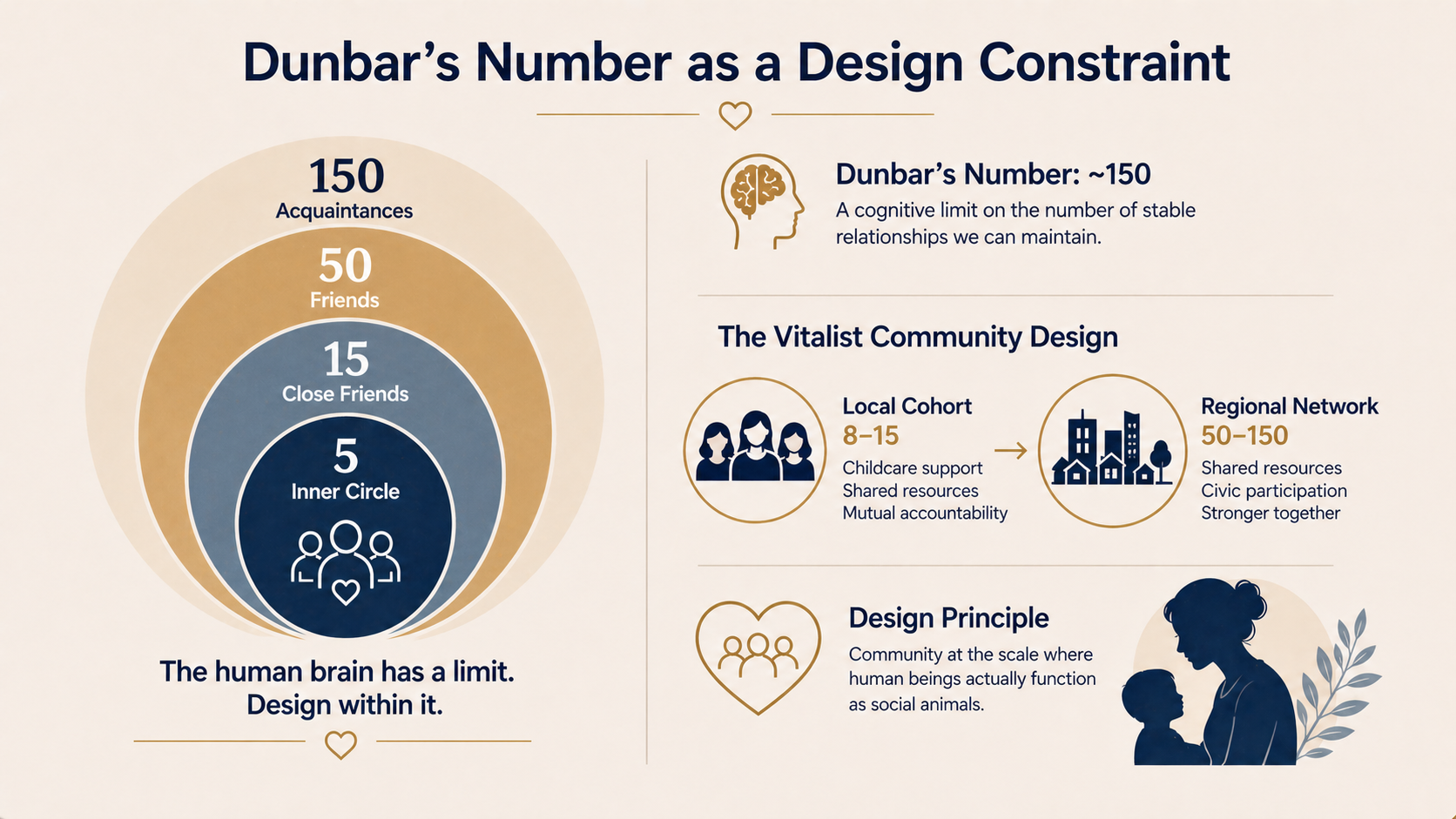
In 1992, British anthropologist Robin Dunbar published research that has proved remarkably durable across subsequent decades of criticism and elaboration. Examining the relationship between neocortical size and social group size across primates, Dunbar proposed that the human brain has a cognitive limit on the number of stable social relationships it can maintain — approximately 150 people, now widely known as Dunbar’s Number. Within that 150, the research suggests a nested structure: roughly 5 people in the innermost circle of intimate support, 15 in the next ring of close friends and trusted advisors, 50 in a broader circle of genuine friends, and 150 in the outer layer of meaningful acquaintances.
This structure is not a curiosity. It is a design constraint — a fact about human cognitive architecture that any community structure must respect if it wants to produce the outcomes it intends rather than the dysfunctions it didn’t plan for.
The Vitalist community is designed around Dunbar’s Number with unusual deliberateness. Its primary functional unit is not the individual household and not the large institutional network, but the local cohort — a group of 8 to 15 Vitalists in geographic proximity who share childcare support, developmental resources, community volunteer coordination, and mutual accountability for the vow they have each made. This cohort size is not arbitrary. It is calibrated to fall within the 15-person ring of Dunbar’s structure — close enough for genuine trust, small enough for genuine accountability, large enough to distribute the load of mutual support across enough people that no single relationship bears the full weight.
Several cohorts, in turn, form a regional network — a community of roughly 50 to 150 that shares larger resources, organizes civic participation, coordinates with local institutions, and provides the broader social fabric within which the cohorts operate. This structure respects the outer rings of Dunbar’s model while preserving the intimate core that makes genuine support possible.
The design principle behind all of this is simple and important: community at the scale where human beings actually function as social animals, not at the scale that makes for impressive organizational charts.
What the Community Actually Does
The Vitalist community is not a support group. It is not a playdate network. It is not a religious congregation, though it may incorporate elements of spiritual practice. It is a functional civic institution with specific roles, specific responsibilities, and a specific relationship to the broader community it exists within.
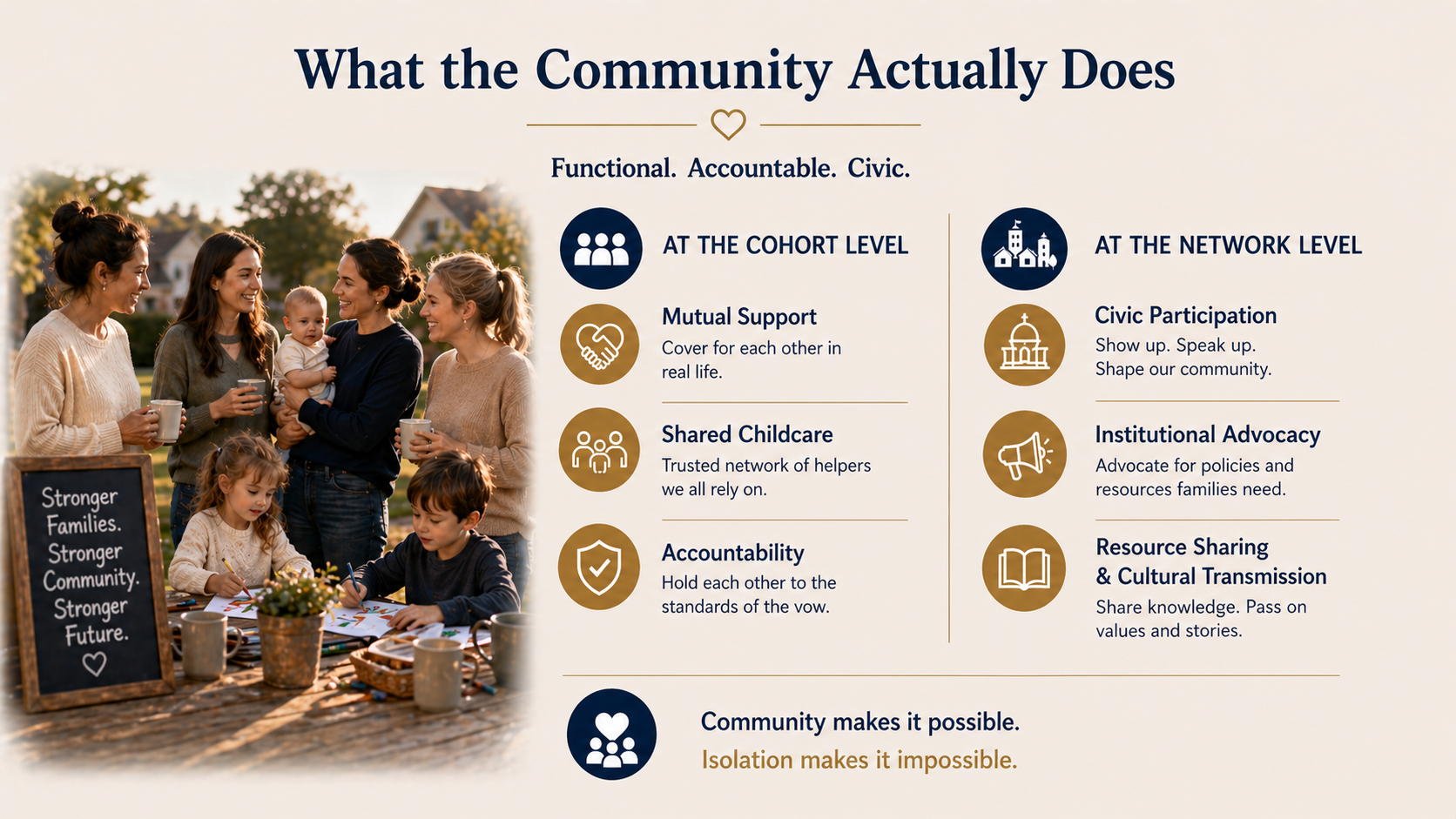
At the cohort level, the primary functions are mutual support, shared childcare, and accountability. Cohort members cover for each other during illness, emergency, and necessary personal development time. They share the volunteer network that each household depends on, coordinating the retired teachers, the available grandparents, the civic-minded neighbors who want to participate in the raising of children and need an organized structure to do so through. They hold each other accountable to the standards of the vow — not through surveillance or judgment, but through the honest, caring, peer-level conversation that genuine community makes possible and isolation makes impossible.
At the network level, the functions expand to civic participation, institutional advocacy, resource sharing, and cultural transmission. The Vitalist network is an organized constituency — a body of citizens who share a commitment and who are capable of collective action in support of the policy environment their vocation requires. They are the people who show up at the school board meeting. They are the people who advocate for the housing policy that families need. They are the people who, by their visible presence and their organized contribution to community life, communicate to the surrounding culture that this vocation is real, serious, and worthy of recognition.
The Community-Versus-Cult Distinction
I want to address this directly, because it is the objection that serious people raise first when I describe the Vitalist community, and it deserves a serious answer.
Any intentional community organized around a shared commitment and a shared identity carries the risk of becoming something that functions less like a community and more like a closed system — a group whose shared purpose curdles into shared isolation, whose mutual accountability becomes mutual surveillance, whose identity cohesion comes at the expense of individual members’ freedom to think, question, and dissent. This is not a theoretical risk. It is the documented history of intentional communities across many contexts, and dismissing it because the Vitalist community has good intentions would be naive.
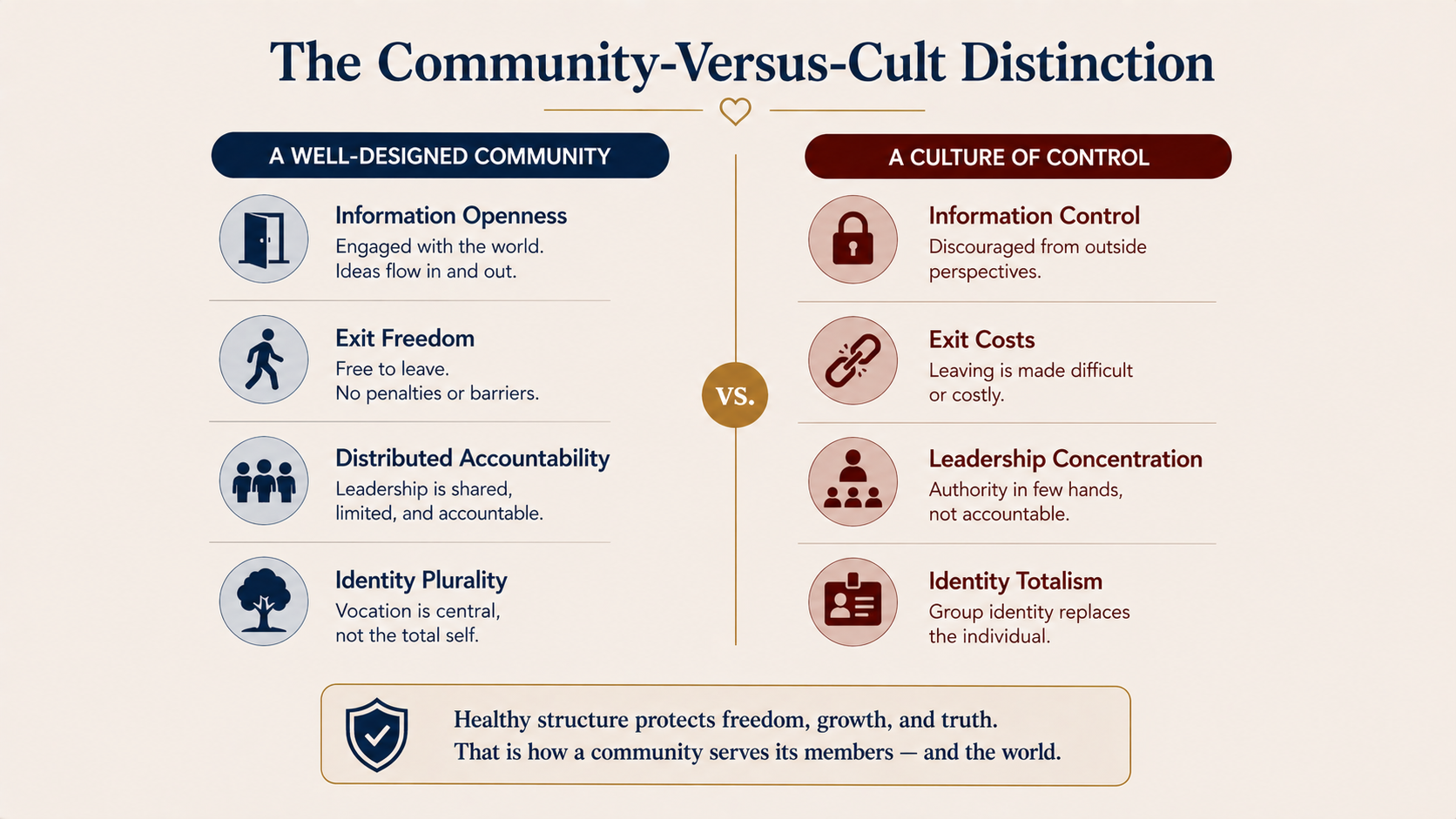
The distinction between a community and a cult is not primarily a matter of content — of whether the shared commitment is admirable or destructive. It is a matter of structure. Cults share a specific set of structural features:
- Information control — members are discouraged or prevented from engaging with perspectives outside the group
- Exit costs — leaving the community is made socially, financially, or psychologically prohibitive
- Leadership concentration — authority is held by individuals who are not accountable to the group they lead
- Identity totalism — membership in the group becomes the total frame for individual identity, leaving no legitimate self outside the group’s definition
A well-designed community has structural defenses against each of these failure modes, and the Vitalist community must be designed with those defenses built in from the beginning rather than bolted on after problems emerge.
Information openness is the first defense. The Vitalist community is not a closed system. Its members are engaged with the world — with professional development, with civic life, with friendships and relationships outside the cohort, with the full range of ideas and perspectives available in a free society. The community amplifies and supports the individual; it does not replace her.
Exit freedom is the second. A Vitalist who decides that the vow is not right for her, or that this particular community is not the right fit, must be able to leave without losing her financial standing, her professional status, or her social world. This requires explicit design — transition support structures, portable credentials, and a cultural norm that treats departure as a legitimate outcome rather than a failure or a betrayal.
Distributed accountability is the third. The Vitalist community has no charismatic leader whose authority is derived from personal magnetism rather than merit and accountability. It has coordinators, mentors, and experienced members in positions of responsibility — but those positions are defined by function, limited by term, and answerable to the community they serve. The community governs itself.
Identity plurality is the fourth. The Vitalist vocation is a central and defining commitment, but it is not the total frame of a woman’s identity. The community actively supports the individual development of its members — their intellectual growth, their civic participation, their personal relationships, their evolving sense of who they are beyond the role of mother. A woman who is only her vocation is not a fully realized person. A community that produces only that has failed regardless of its fertility rate.
These are not soft commitments. They are hard structural requirements that must be built into the governance design of every Vitalist community at every level — cohort, network, and institution. The difference between a Vitalist community and a cult is not a matter of good intentions. It is a matter of design.

The Community That Changes the Neighborhood
There is a final dimension to the Vitalist community that deserves to be named, because it is the dimension that makes it something more than a support system for a specific vocational choice.
A Vitalist community, operating within a neighborhood, changes the neighborhood. Not through proselytizing. Not through organized pressure campaigns. Simply through presence — through the visible demonstration that a different way of organizing community life is possible and is producing outcomes that the surrounding culture finds compelling.
Children who grow up knowing their neighbors. Adults who look out for children who are not their own. Retired teachers who have a meaningful role in community life. Civic organizations that have a reliable constituency of engaged, committed participants. A neighborhood culture that treats the raising of children as a shared project rather than a private matter.
These are not radical innovations. They are the normal features of functioning community life as it existed, in various forms, across human history before the specific atomization of late-twentieth-century suburban development dismantled them. The Vitalist community is not inventing a new social technology. It is recovering a very old one — and adapting it to the conditions of the twenty-first century with the deliberateness that those conditions require.
The loneliness epidemic is real. Dunbar’s Number is a real constraint. The community-versus-cult distinction is a real design challenge. None of these are reasons to abandon the community model. They are reasons to build it carefully, with clear eyes, and with the structural humility to acknowledge that good intentions have never been sufficient to produce good institutions.
The vow the Vitalist makes is a commitment to her children and to civilization. The community is the architecture that makes that commitment sustainable — not for a season, not for the early years when the motivation is fresh and the challenges are visible, but for the full arc of the work.
That sustainability is not automatic. It is designed.
Next: Part 6 — The Vitalist Colony. Every transformative idea eventually stops being a philosophy and becomes a place. What does a purpose-built community organized entirely around the Vitalist vocation actually look like — its physical design, its governance, its economics, and the founding cohort ready to build it? And what is the single most powerful thing that any woman, investor, civic institution, or government serious about this framework can do right now? Come and see.
Related Reading
Our Epidemic of Loneliness and Isolation: The U.S. Surgeon General’s Advisory
U.S. Department of Health and Human Services — The formal public health declaration that loneliness constitutes an epidemic in America, with the epidemiological data on health consequences and the structural analysis of why community dissolution is a systemic rather than individual failure
Coevolution of Neocortical Size, Group Size and Language in Humans
Behavioral and Brain Sciences · Robin Dunbar — The original peer-reviewed research establishing the cognitive limits on human social group size that undergird Dunbar’s Number — the foundational design constraint for any community architecture that intends to function at human scale
The Characteristics of Totalist Groups — and the Structural Defenses Against Them
Brookings Institution — A rigorous sociological examination of the structural features that distinguish healthy intentional communities from totalist systems, and the governance design principles that protect communities from the failure modes their good intentions cannot prevent