What Separates the People Who See What’s Coming From Everyone Else
By Futurist Thomas Frey
Everything This Series Has Been Building Toward
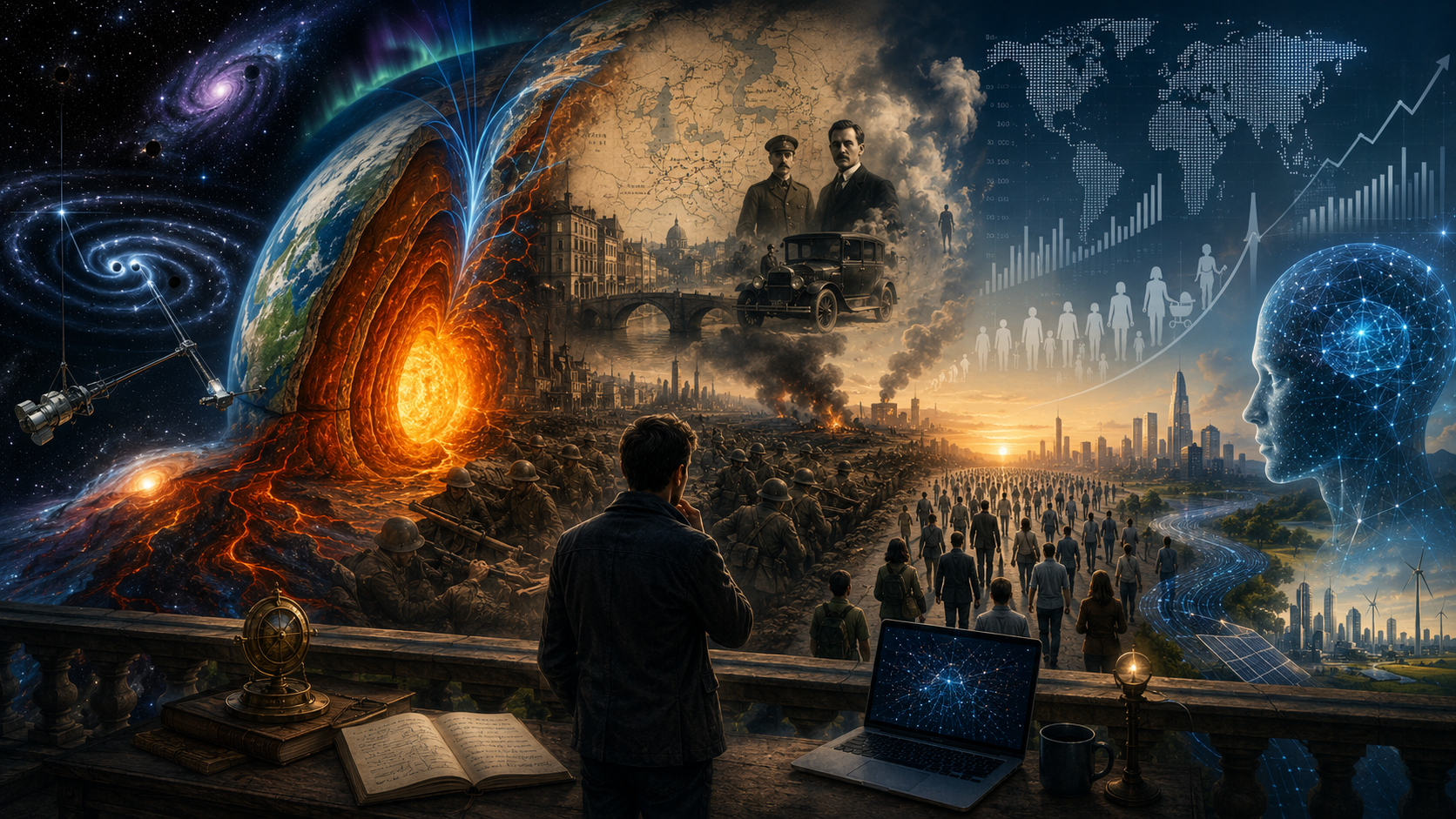
Over the past three columns, we have traveled from the edge of the observable universe to the fluid dynamics of Earth’s molten core to the birth rate statistics of countries whose demographic futures are already sealed. We have watched gravitational waves carry billion-year-old messages across the cosmos, tracked magnetic poles accelerating toward Siberia on a schedule no human authority can renegotiate, and traced the consequences of two bullets fired in Sarajevo in 1914 still propagating through geopolitical institutions today.
The through-line connecting every signal in this series is the same: the future is not an empty space awaiting our decisions. It is a populated space, already in motion, already carrying consequences, already transmitting at frequencies ranging from the subatomic to the civilizational. The question this final column addresses is both the most practical and the most personal in the series: what does it actually mean to be a reader of those signals? What do the people who see what’s coming do differently from everyone else? And in an age when artificial intelligence can process more data than any human mind will ever hold, what remains irreplaceably human about the act of genuine foresight?
The Difference Between Prediction and Signal Reading
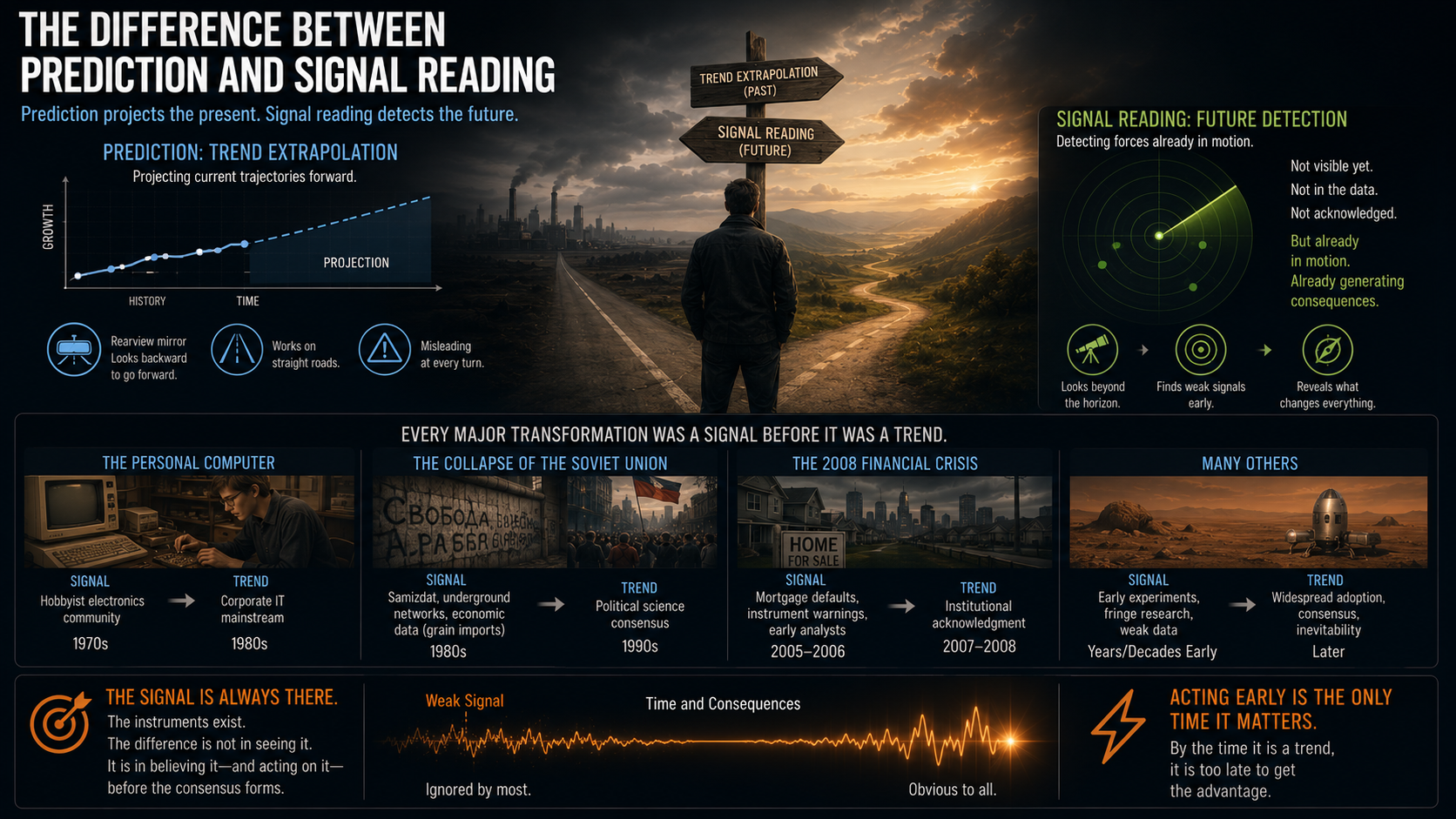
Most of what passes for futures thinking in the world is not signal reading. It is trend extrapolation — the projection of current trajectories forward in time, dressed in the language of foresight. A trend extrapolator looks at the growth rate of a technology, draws a line, and says: if this continues, here is where we will be in ten years. Sometimes this produces useful analysis. More often it produces the intellectual equivalent of driving by looking only in the rearview mirror — accurate enough on a straight road, catastrophically misleading at every turn.
Signal reading is categorically different. It is the detection of forces not yet visible in current data, not yet reflected in current trends, not yet acknowledged by current institutions — but already in motion, already generating consequences that will eventually be impossible to ignore. The signal reader is not projecting the present forward. She is detecting the future already traveling toward the present.
The distinction matters enormously in practice. Every major transformation of the last century was a signal before it was a trend. The personal computer was a signal in the hobbyist electronics community years before it was a trend in corporate IT. The collapse of the Soviet Union was a signal in the samizdat literature and the underground church networks and the economic data on grain imports years before it was a trend in political science journals. The 2008 financial crisis was a signal in the mortgage default rates of 2005 and 2006 and in the warnings of a handful of analysts who were reading instruments that institutional consensus was ignoring.
In each case, the signal was present. The instruments to detect it existed. What was missing was the willingness to take it seriously before the consensus had formed — which is the only time acting on it actually matters.
The Peripheral Vision Problem
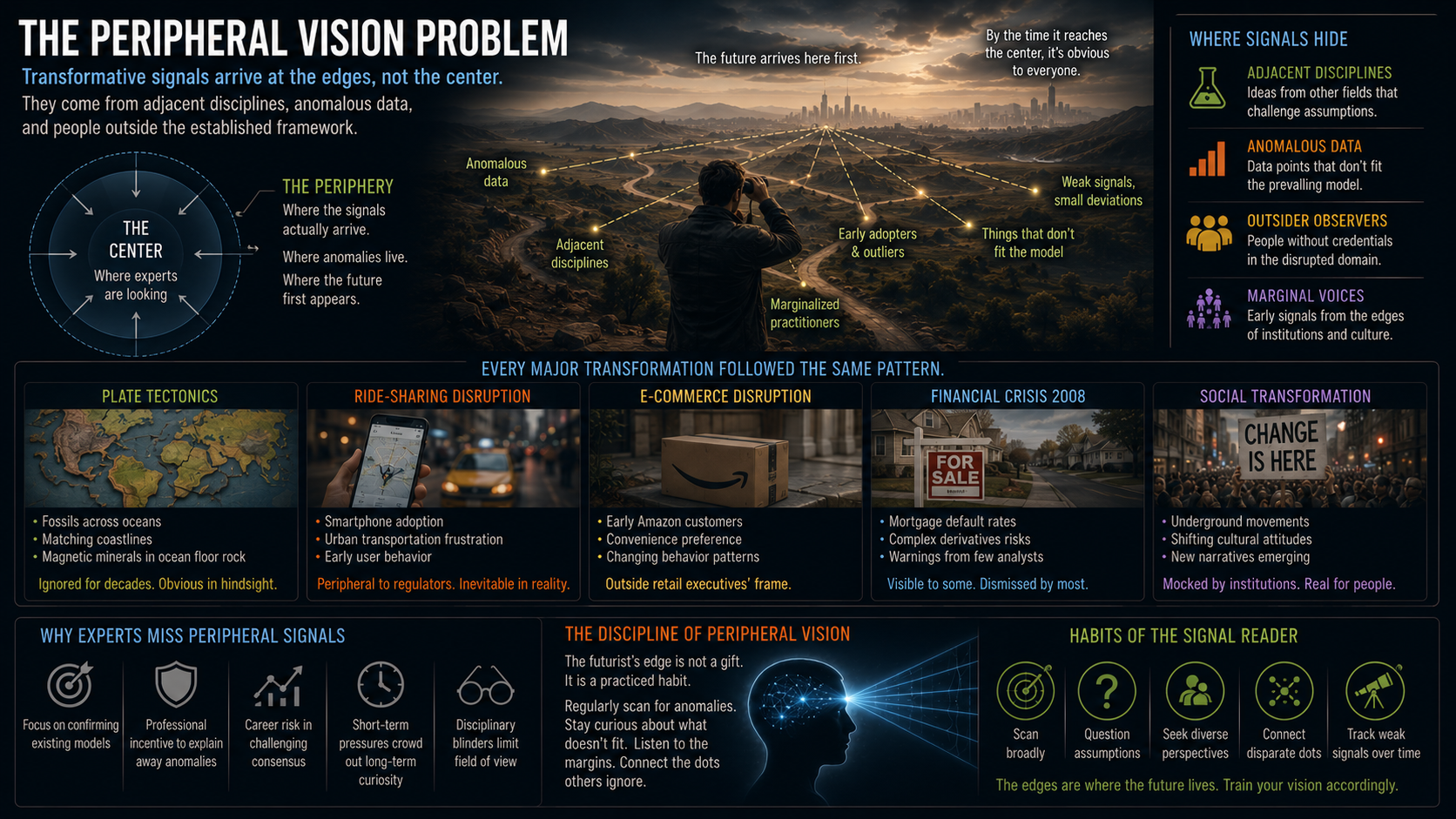
There is a consistent pattern in how transformative signals are missed, and it is worth naming directly: they almost never arrive at the center of the field where established experts are looking. They arrive at the periphery — in adjacent disciplines, in anomalous data points that don’t fit the prevailing model, in the observations of people who are not credentialed authorities in the domain being disrupted.
The signal that would eventually become the theory of plate tectonics arrived as an anomaly in the distribution of fossils across continents separated by oceans, in the strange matching of coastlines that looked as if they had once been joined, in the behavior of magnetic minerals in ocean floor rock that didn’t make sense if the seafloor was static. The geologists who were looking at the center of the field — at the composition of rock formations, at the mechanics of mountain building within a fixed-continent framework — missed it for decades. It was visible only to people willing to look at the edges of what the established framework could explain.
The same pattern appears in technology disruption, in social transformation, in economic crisis. The disruption of the taxi industry by ride-sharing was visible years in advance to anyone watching smartphone adoption rates and the frustration expressed in urban transportation forums. The disruption of traditional retail by e-commerce was visible in the behavior of early Amazon customers who never went back to stores. The signals were peripheral — outside the frame that established retail executives and taxi regulators were using — and peripheral signals require a specific intellectual posture to detect: you have to be genuinely curious about the things that don’t fit, rather than professionally motivated to explain them away.
The futurist’s peripheral vision is not a gift. It is a discipline. It is the practiced habit of regularly scanning the edges of your attention for anomalies, for things that shouldn’t be happening according to the current model, for the early adopters and the outliers and the marginalized practitioners who are living in a future the mainstream hasn’t yet acknowledged.
Holding Multiple Timescales Simultaneously
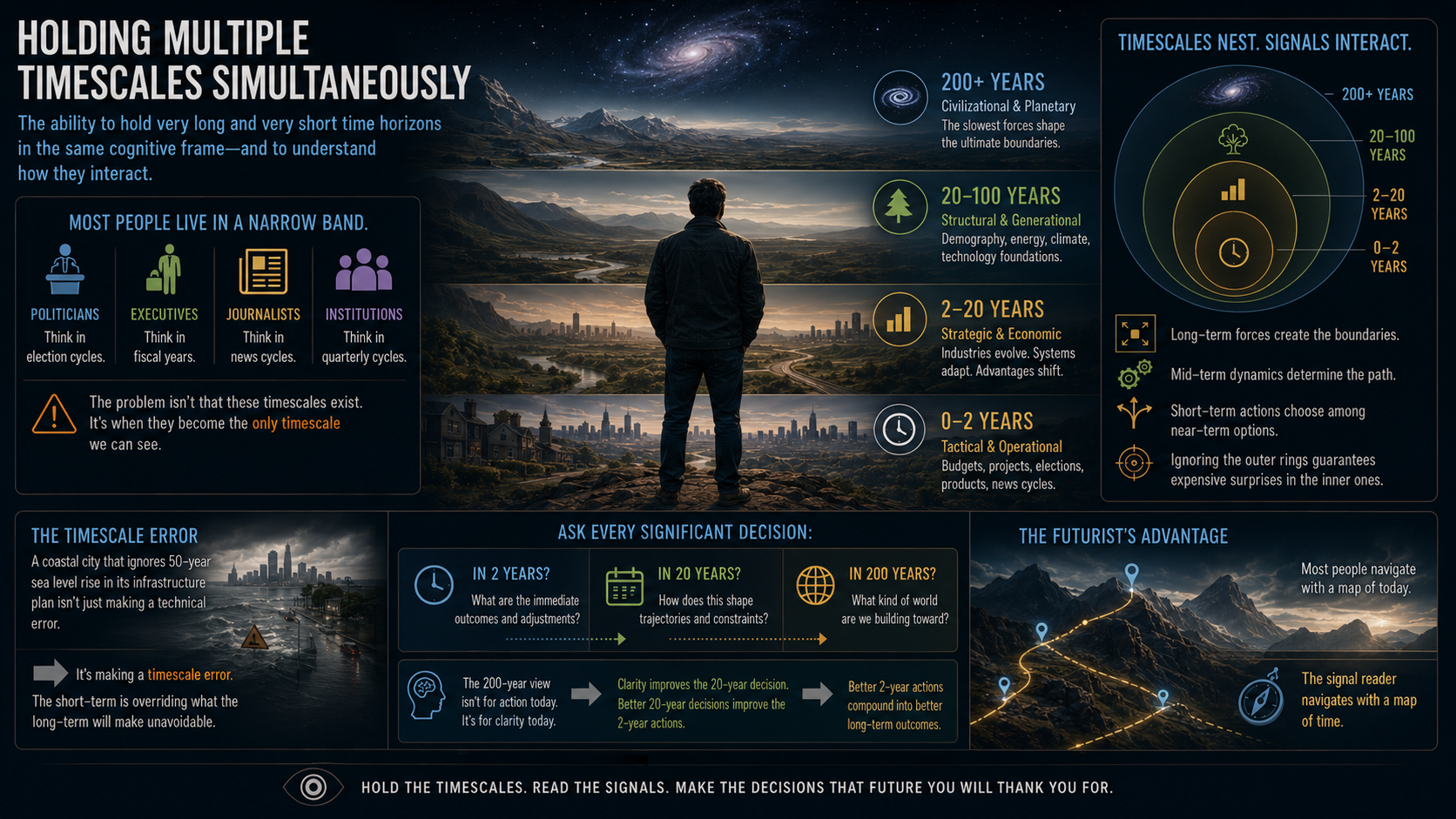
The second distinguishing capability of genuine signal readers is temporal range — the ability to hold very long time horizons and very short ones in the same cognitive frame simultaneously, and to understand how they interact.
Most human cognition, and virtually all institutional planning, operates within a narrow temporal band. Politicians think in election cycles. Executives think in fiscal years. Journalists think in news cycles. Each of these timeframes is real and operationally necessary. The problem is not that they exist. The problem is when they become the only timescale a person or institution can inhabit — when the four-year political horizon becomes genuinely invisible to the forty-year demographic wave that is the actual context within which political decisions will play out.
The geological signals from Column Two and the demographic signals from Column Three are not relevant only to geologists and demographers. They are the operating environment within which every economic decision, every infrastructure investment, every political choice is being made. A coastal city that plans its storm surge infrastructure without incorporating sea level rise projections on a fifty-year horizon is not making a purely technical error. It is making a timescale error — letting the short-term dominate a decision whose consequences will be measured in the long-term.
Holding multiple timescales simultaneously means being able to answer, for any significant decision: what does this look like in two years, in twenty years, and in two hundred years? Not because the 200-year answer is directly actionable today, but because the awareness of it changes the quality of the twenty-year decision — which changes the quality of the two-year decision. The timescales nest. The signals interact. The futurist who can hold all of them at once is navigating a richer map than anyone operating in a single temporal band.
What AI Can and Cannot Do
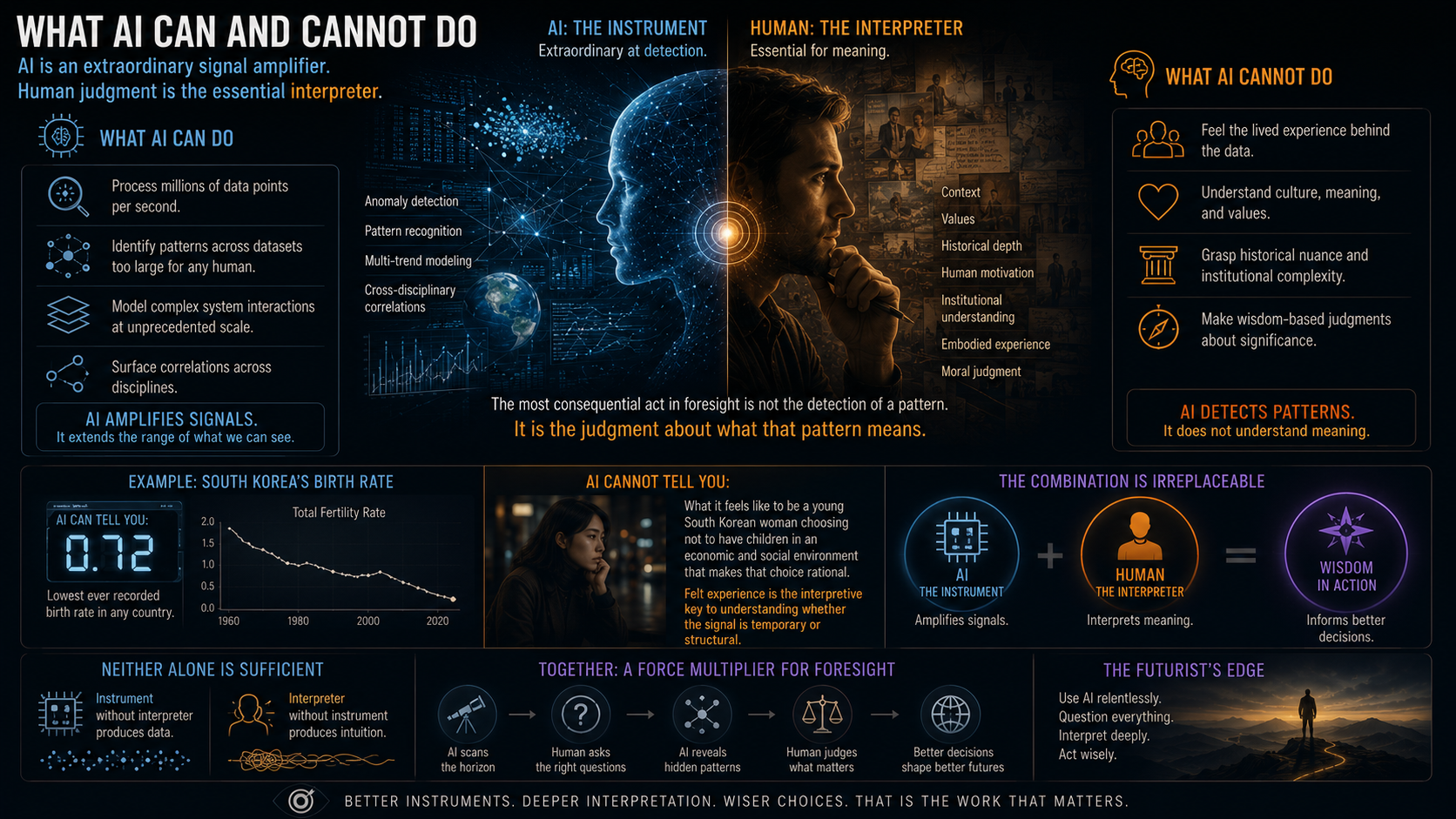
There is a question that shadows every conversation about foresight in the current moment: if artificial intelligence can process millions of data points per second, identify patterns across datasets too large for any human to read, and model complex system interactions with a speed and comprehensiveness that no individual analyst can match — what exactly is the irreplaceable human contribution to signal reading?
The answer is more nuanced than either the AI utopians or the AI skeptics typically acknowledge. AI is an extraordinary signal amplifier. It can identify statistical anomalies in datasets that would take human analysts years to review. It can model the interaction of multiple long-wave trends simultaneously. It can surface correlations across disciplines that no single human expert would have the range to notice. These are genuine and significant capabilities, and the futurist who does not use them is working with a fraction of the available instrumentation — the equivalent of doing astronomy with the naked eye in an age of space-based telescopes.
But signal amplification is not signal interpretation. The most consequential act in foresight is not the detection of a pattern. It is the judgment about what that pattern means — which requires context, values, historical depth, and the kind of embodied understanding of human motivation and institutional behavior that comes from living in the world as a participant, not observing it as an algorithm. An AI can tell you that birth rates in South Korea have fallen to 0.72 — the lowest ever recorded for any country. It cannot tell you what it feels like to be a young South Korean woman choosing not to have children in an economic and social environment that makes that choice rational — and that felt experience is the interpretive key to understanding whether the signal represents a temporary disruption or a permanent structural shift.
The most powerful foresight practice in the coming decade will be the combination: AI as the instrument, human judgment as the interpreter. Neither alone is sufficient. The instrument without the interpreter produces data. The interpreter without the instrument produces intuition. Together, they produce something closer to genuine wisdom.
The Practice of Living in the Future
There is a final discipline that separates the signal reader from the trend extrapolator, and it is the most difficult to describe and the most important to cultivate: the practice of actually inhabiting a future orientation rather than merely analyzing the future as an external object.
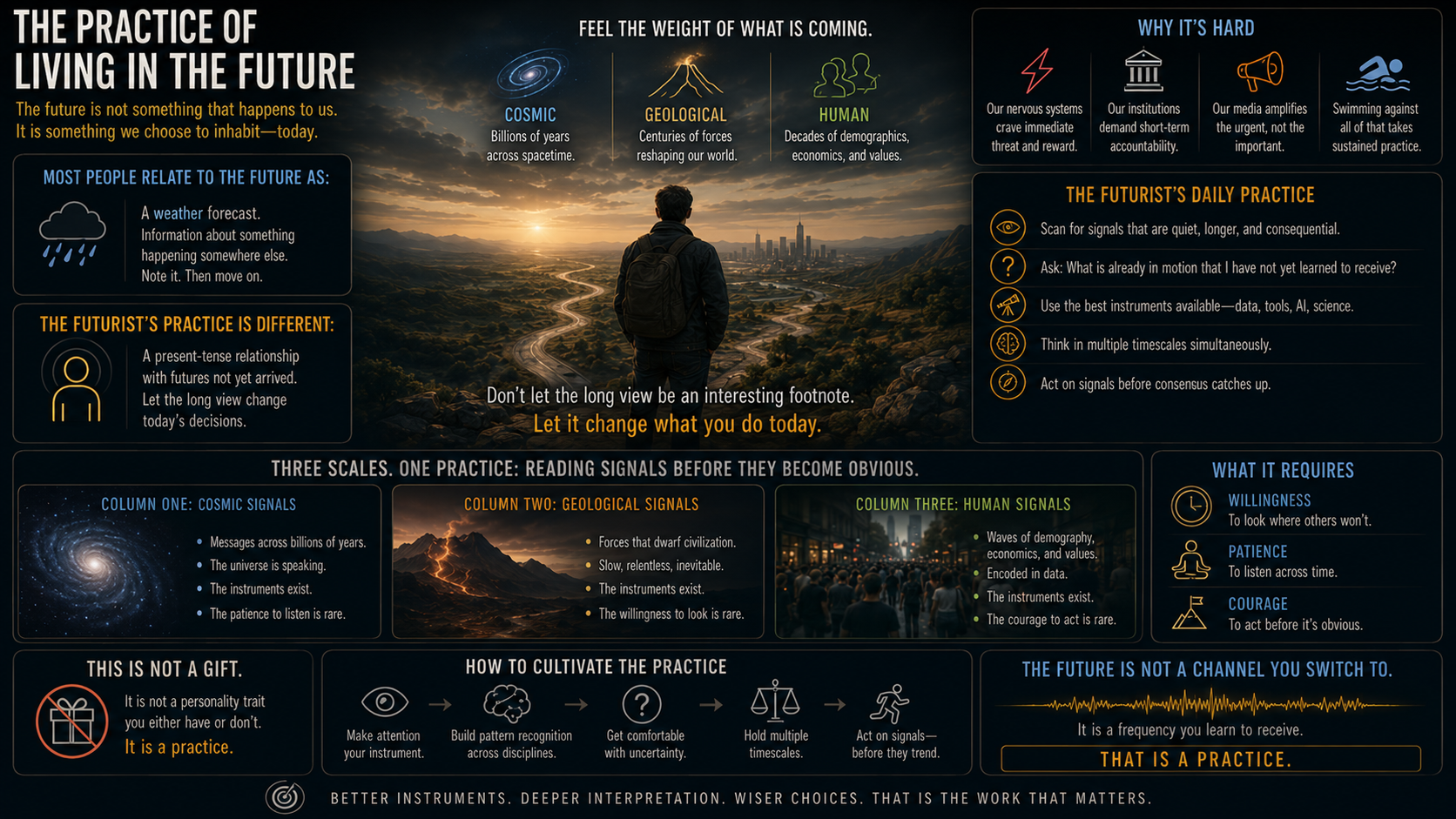
Most people relate to the future the way they relate to a weather forecast — as information about something happening somewhere else, to be noted and then set aside while current reality reasserts its dominance. The futurist’s practice is different. It is the cultivation of a present-tense relationship with futures that have not yet arrived — the discipline of feeling the weight of a demographic wave that is twenty years away, of taking seriously a geological signal that operates on centuries, of letting the long view actually change today’s decisions rather than serving as an interesting footnote to them.
This is harder than it sounds. Our nervous systems are calibrated for immediate threat and immediate reward. Our institutions are structured around short-term accountability. Our media environment relentlessly amplifies the urgent at the expense of the important. Swimming against all of that requires not occasional reflection but a sustained practice — a daily renegotiation of what counts as real and what counts as relevant, in favor of the signals that are quieter, longer, and ultimately more consequential than the noise surrounding them.
The three previous columns in this series offered signals at three scales: the cosmic messages still traveling toward us across billions of years of spacetime, the geological forces operating on timescales that dwarf human civilization, and the human waves of demography and economics and generational value already encoded in data available to anyone willing to read it. In each case, the signal was not hidden. The instruments to detect it existed. What was required was the willingness to look, the patience to listen, and the intellectual courage to act on what the signals said before the consensus caught up.
That willingness. That patience. That courage. These are not personality traits you either have or don’t. They are practices, developed deliberately, over time, through the sustained discipline of asking — about every significant system you inhabit — what is already in motion that I have not yet learned to receive?
The future is not a channel you switch to. It is a frequency you learn to receive. The instruments are attention, pattern recognition, comfort with uncertainty, and the discipline to act on signals before they become obvious.
That is not a gift.
It is a practice.
And it begins, always, with the recognition that the future you want to understand is already, in every meaningful sense, on its way.
Related Articles
MIT Sloan Management Review — The Art of Seeing What’s Coming: Signal Detection in Complex Systems https://sloanreview.mit.edu/article/the-art-of-seeing-whats-coming-signal-detection
Harvard Business Review — How to Make Sense of Weak Signals Before They Become Trends https://hbr.org/weak-signals-foresight-strategic-planning
Institute for the Future — The Futures Thinking Toolkit: From Trend Extrapolation to Signal Reading https://www.iftf.org/futures-thinking-toolkit-signal-reading