
By Futurist Thomas Frey
For decades, cities have been built like static machines. We zone them, finance them, construct them—and then we wait. We hope businesses show up. We hope talent sticks around. We hope downtown revitalization plans somehow take hold.
Hope is not a strategy.
What cities actually need is a system that doesn’t just exist—but one that continuously creates new economic life from within itself. That’s where the Von Neumann Engine comes in.
Borrowed from the idea of self-replicating systems, the Von Neumann Engine isn’t a piece of hardware. It’s a way of thinking about cities as living systems—systems designed to generate startups, attract talent, and reinvent themselves over and over again.
Cities Were Never Designed to Evolve This Fast
Downtowns were built for a different era. An era where jobs were stable, companies lasted decades, and innovation moved at a predictable pace.
Today, AI is compressing everything. Entire industries are forming and disappearing in just a few years. Skills go obsolete faster than ever. And the traditional anchors of downtown—banks, law firms, retail—no longer provide the same economic gravity.
So cities fall back on the usual playbook. They offer incentives, build nicer spaces, host events, and try to rebrand the district. But these are surface-level fixes. They don’t address the core issue.
Cities don’t have a built-in way to continuously regenerate their economies.
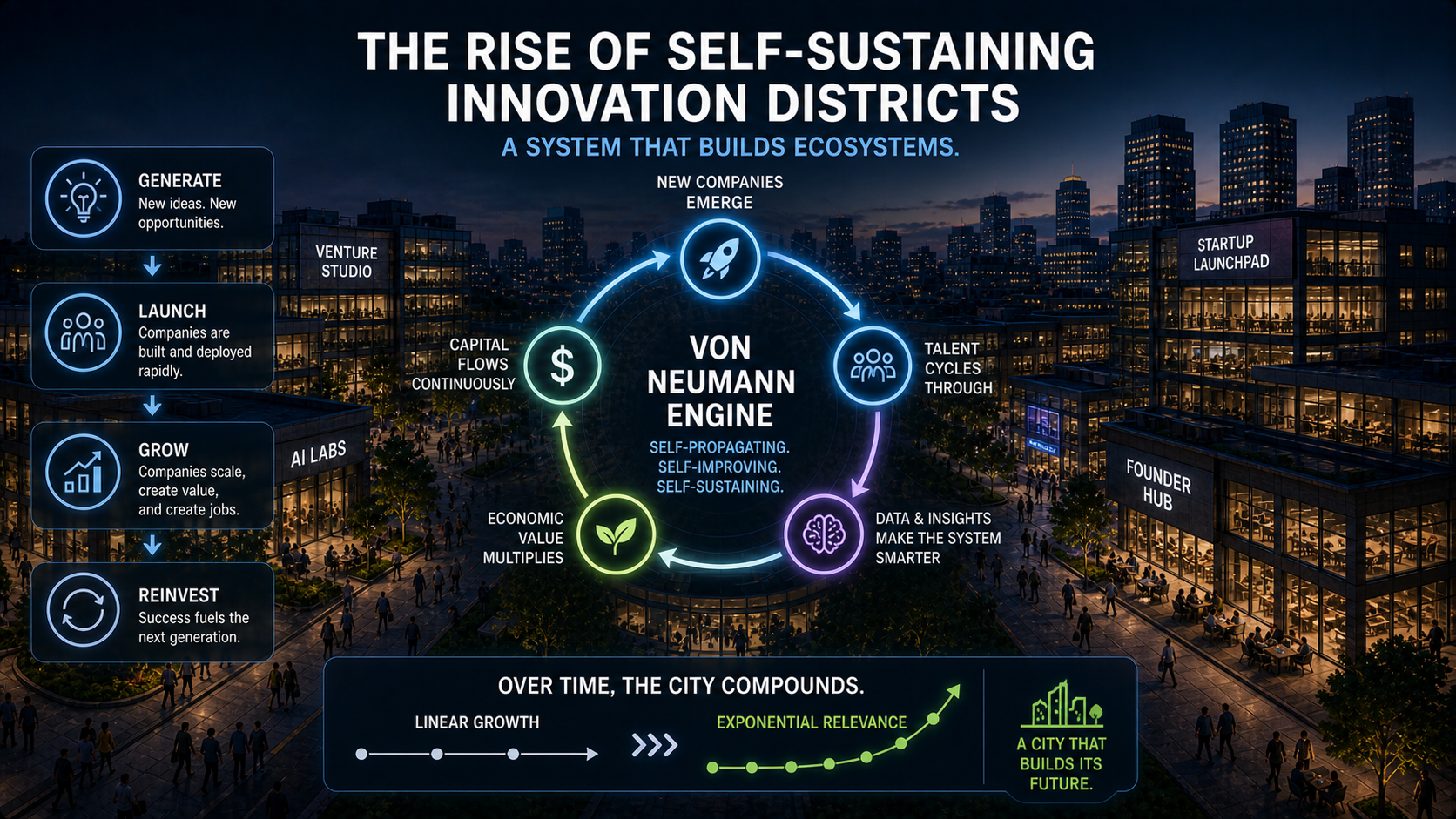
The Von Neumann Engine: A City That Builds Companies
Now imagine a downtown where the primary function isn’t retail or office space. It’s company creation.
At the center is a new kind of venture studio—not one that launches a handful of startups, but one designed to systematically produce them at scale.
AI systems constantly scan for new opportunities—market gaps, inefficiencies, emerging tech, regulatory changes. Ideas are no longer the bottleneck. Execution is.
Instead of founders starting from scratch, ventures are assembled quickly. Business models are pre-validated. Market insights are generated instantly. Branding, prototypes, even code can be created in days. What used to take a year can now happen in weeks.
Talent becomes fluid. Entrepreneurs, operators, and creators cycle through the system—building one company, then moving to the next. The city becomes a place where careers evolve continuously, not a place where people hold a single job.
Capital changes too. Instead of being a gatekeeping event, funding becomes part of the infrastructure—flowing continuously into new ventures through smarter, faster allocation models.
And most importantly, every success and failure feeds back into the system. The engine learns. It improves. It accelerates.
Why This Changes Everything for Downtowns
This flips the entire purpose of a city center. Instead of asking how to attract companies, cities start asking how to build a system that creates them.
That one shift changes everything.
Economic resilience improves because the system isn’t dependent on a few large employers. When one company fails, others are already forming.
Talent is drawn to opportunity density. People no longer move for a job—they move to be where things are happening.
Real estate gets reimagined. Empty office buildings become venture labs, AI studios, startup launch centers, and hybrid living-working spaces.
And the identity of downtown changes. It’s no longer just a place you visit. It becomes a place where the future is actively being built.
The Rise of Self-Sustaining Innovation Districts
This isn’t just about creating a startup ecosystem. It’s about creating a system that builds ecosystems.
A true Von Neumann Engine doesn’t rely on a single industry or a handful of founders. It becomes self-propagating. Each generation of companies creates the conditions for the next. Each success strengthens the system. Each failure makes it smarter.
Over time, the city doesn’t just grow—it compounds.
That’s the difference between linear growth and exponential relevance.
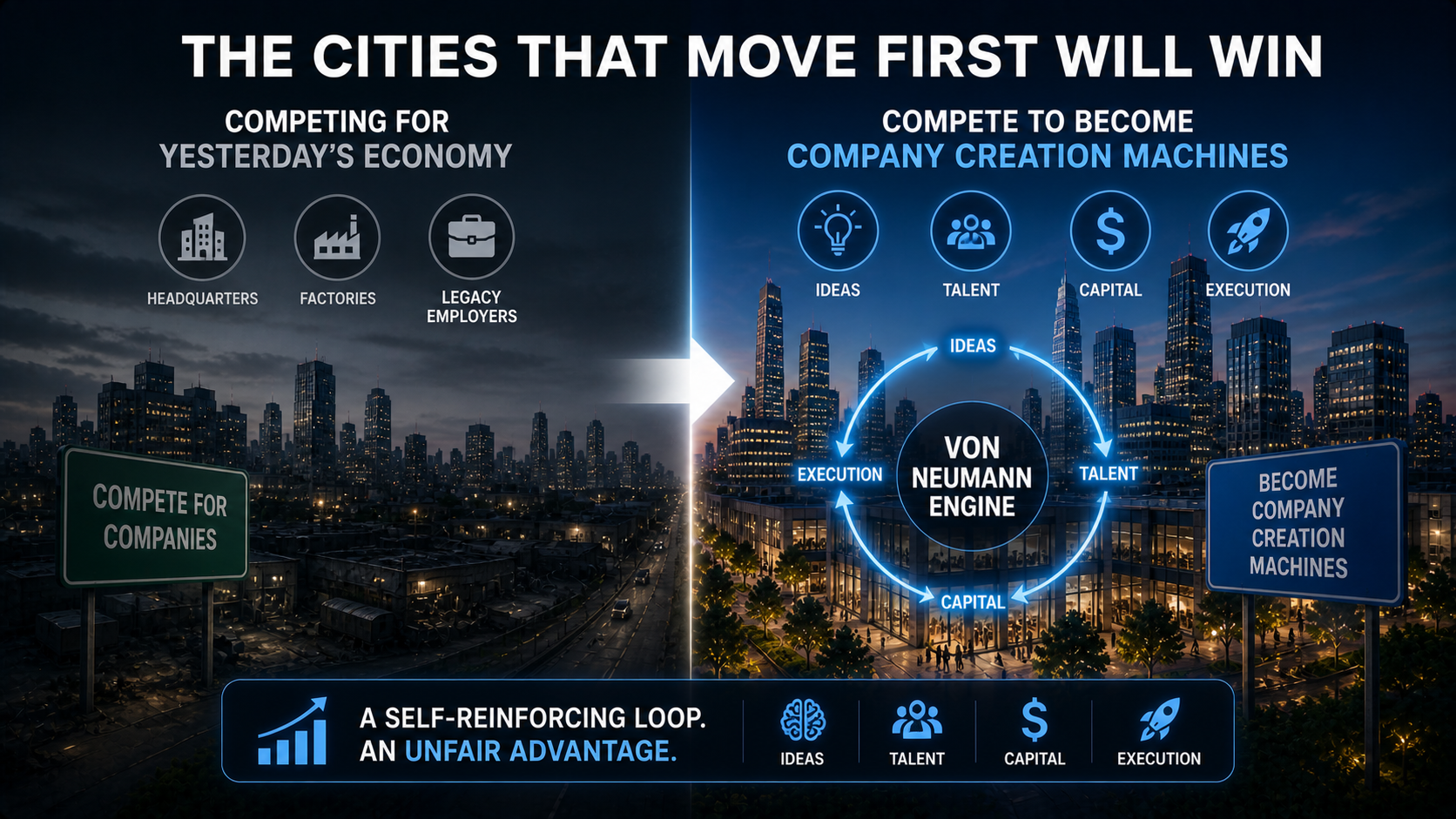
Winning cities won’t attract companies—they’ll create them. Self-reinforcing loops of ideas, talent, capital, and execution become the new competitive advantage.
The Cities That Move First Will Win
Most cities are still competing for yesterday’s economy. They’re chasing headquarters, factories, and legacy employers.
But the next generation of winning cities won’t compete for companies. They’ll compete to become company creation machines.
Once a city installs a functioning Von Neumann Engine, it gains something incredibly difficult to replicate—a self-reinforcing loop of ideas, talent, capital, and execution.
That loop becomes its competitive advantage.
The Real Question
Every city leader should be asking a simple question.
If we were starting from scratch today—knowing what we know about AI, talent mobility, and startup velocity—would we design our downtown the way it exists now?
Or would we design a system that continuously builds the future?
Because the cities that figure this out first won’t just revitalize downtowns.
They’ll redefine what cities are for.
Related Reading
- Source: Harvard Business Review
Title: How Venture Studios Are Changing the Startup Model
Link: https://hbr.org/2022/01/how-venture-studios-are-changing-the-startup-model - Source: McKinsey & Company
Title: The Future of Cities: How AI and Technology Will Reshape Urban Life
Link: https://www.mckinsey.com/featured-insights/future-of-work/the-future-of-cities - Source: Brookings Institution
Title: Innovation Districts: A New Geography of Innovation in America
Link: https://www.brookings.edu/research/innovation-districts/