
Amazon Just Launched a 30 Minute Delivery Service and, in Doing so, Declared That Waiting Is a Design Flaw.
By Futurist Thomas Frey
The Clock Just Reset
There is a threshold in consumer psychology that rarely gets named directly — the point at which delivery speed stops being a logistical convenience and starts replacing the decision to go somewhere yourself. For most of retail history, that threshold was measured in days. Amazon spent two decades systematically dismantling it: two days, then one day, then same day, then hours. On Tuesday, with the official launch of Amazon Now, the threshold collapsed to thirty minutes — and when it crosses that line, something fundamental changes about how people relate to physical stores, to planning, and to the nature of need itself.
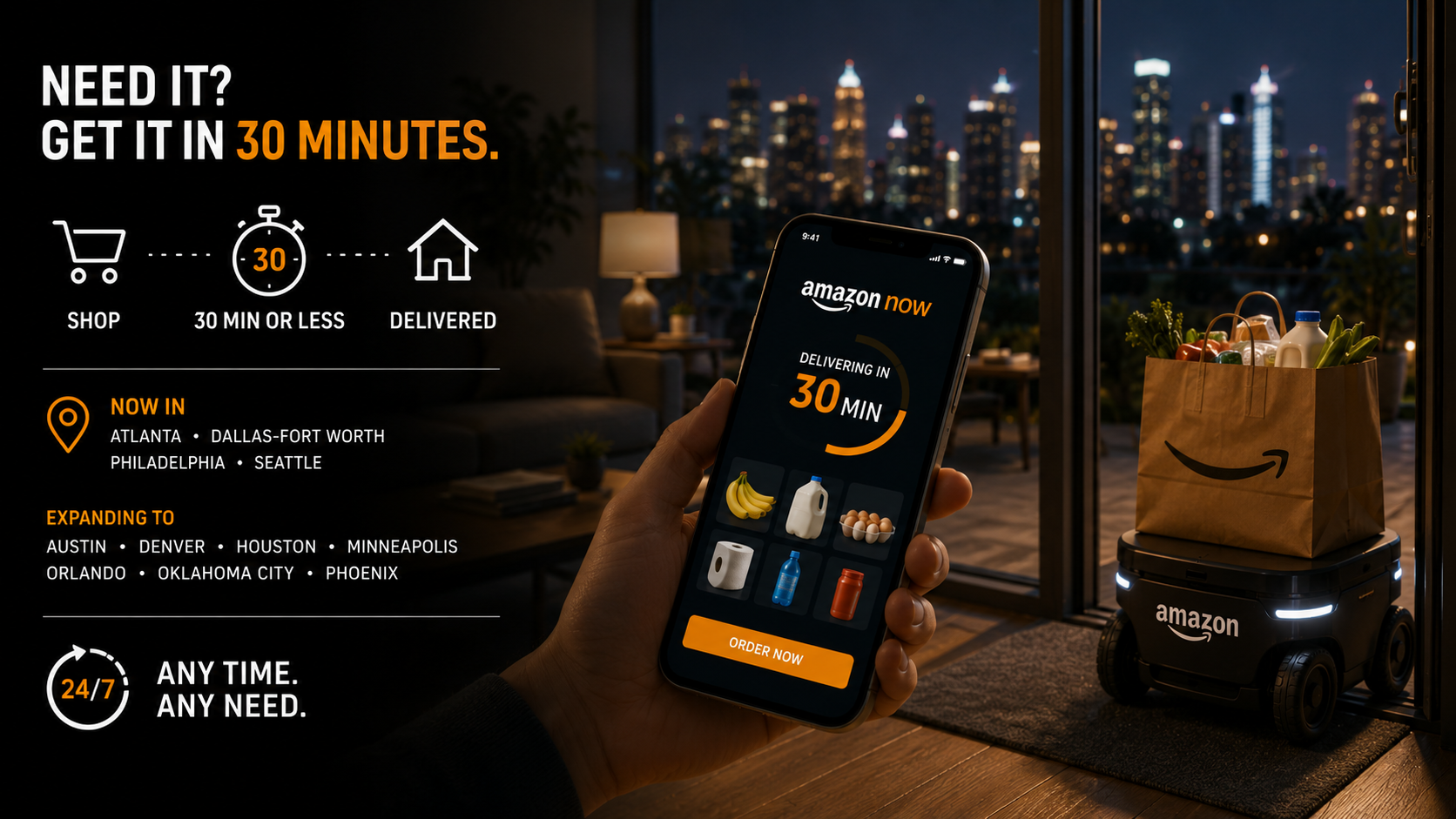
Amazon Now allows customers to shop across thousands of items, including fresh groceries, household essentials, and other locally relevant items, with delivery in 30 minutes or less. This is not an incremental improvement in shipping speed. It is a category shift — the moment delivery becomes faster than driving.
What Just Launched and Where
At launch, Amazon Now is widely available in Atlanta, Dallas-Fort Worth, Philadelphia, and Seattle, and is expanding in areas that include Austin, Denver, Houston, Minneapolis, Orlando, Oklahoma City, and Phoenix. By year-end, Amazon expects to bring the service to tens of millions of customers in these and other cities as the rollout continues across the U.S.
The geographic footprint matters. This is not a coastal tech-city experiment or a limited pilot for a narrow demographic. It is a deliberate rollout across the American mainstream — Sunbelt metros, Midwest cities, markets where car culture dominates and where the idea of staying home instead of driving to the store represents a genuine behavioral shift. Amazon began pilot tests of 30-minute deliveries in Seattle and Philadelphia in December, a move that pitted the retailer against other quick-delivery services like DoorDash, Uber Eats, and Instacart. Five months of pilot data, then a national expansion. Amazon does not move at that pace unless the numbers are compelling.
In most areas, the option will be available 24 hours per day. That detail is easy to overlook and worth sitting with. The 2 a.m. realization that you’re out of infant formula. The midnight fever that needs medicine now. The pre-dawn flight that needs earbuds. Amazon Now has removed time of day as a variable in the equation of need.
The Infrastructure Behind the Promise
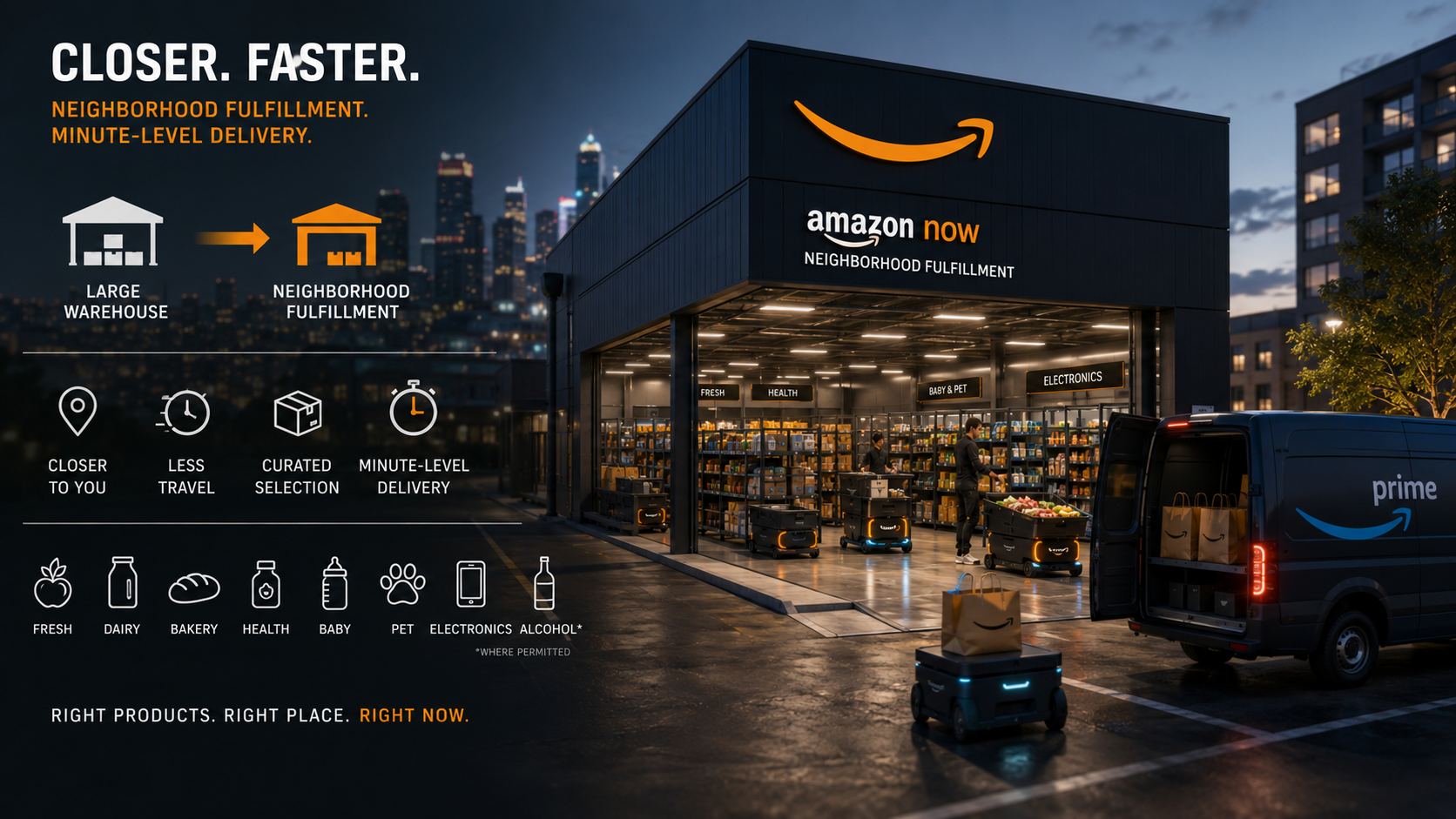
To make these fast orders possible, Amazon taps into a network of smaller fulfillment locations placed closer to where customers live and work, as compared with the company’s larger warehouses. With a more limited selection of items and reduced travel distances, the delivery times can be sped up.
This is the dark store model — compact, neighborhood-proximate fulfillment facilities optimized entirely for rapid order assembly. No customer-facing retail. No checkout lanes. No ambient music. Just inventory organized for one purpose: getting the order out the door in minutes. The elegance of the model is that it trades selection breadth for proximity, accepting a curated catalog in exchange for delivery times that conventional warehousing on the urban periphery can never match.
At launch, Amazon Now orders can include fresh produce, dairy and eggs, bakery items, healthcare and personal care items, baby and pet needs, electronics, and alcohol where permitted. Those categories are not random. They are the highest-urgency, highest-frequency segments of consumer retail — the things people buy when they realize they need something right now. Every category on that list is currently served by a physical retailer whose value proposition rests substantially on proximity and immediacy. Amazon Now just became more proximate and more immediate than any of them.
The Price That Makes It a Platform
The competitive angle of Amazon Now goes beyond speed. While Amazon Now deliveries aren’t free, Prime members still save, as they pay only a $3.99 per-order fee, compared with $13.99 for non-Prime members.
That’s a more straightforward fee structure than competitors — and one that often ends up being cheaper for Prime members, compared with competitors that charge variable delivery fees alongside service fees, expected shopper tips, and sometimes even price markups per item.
This is the structural weapon hiding inside the pricing model. Anyone who has ordered groceries through Instacart or a restaurant through DoorDash knows the experience of watching a $30 order become a $52 order after delivery fees, service fees, suggested tip, and the quiet markup on individual items that appears only when you already know what you want. Amazon Now’s flat $3.99 Prime fee is not just cheaper in many cases — it is psychologically cleaner. Transparent pricing at the moment of purchase removes one of the primary sources of friction and resentment in the current quick-delivery ecosystem. That matters for adoption in ways that pure speed comparisons miss.
An additional small order fee of $1.99 for Prime members, or $3.99 for non-members, is charged on orders below $15.00. That threshold nudges average order values upward and reinforces the bundled purchasing behavior that makes rapid fulfillment economics work — fewer, slightly larger orders rather than a constant stream of single-item deliveries.
The Stack Is Now Complete
Amazon Now does not exist in isolation. It sits at the top of what is now the most comprehensive speed-tiered delivery architecture any retailer has ever assembled. The service joins Amazon’s existing fast-delivery options, including its one-hour and three-hour deliveries available across more than 90,000 products as of March, and its same-day delivery option across millions of items. In eight U.S. locations, Amazon is also experimenting with under-60-minute drone deliveries via Prime Air.
Thirty minutes. Sixty minutes via drone. One to three hours. Same day. Next day. Two days. The entire spectrum of consumer delivery urgency is now covered by a single platform with a single checkout flow and a single membership. No competitor — not Instacart, not DoorDash, not Walmart, not Target — has a stack that spans from impulse to planned purchase with this degree of integration and this level of operational scale behind it.
The numbers behind that scale are staggering. In 2025, Amazon Prime members received over 13 billion total items via either same-day or next-day delivery globally. The U.S. alone accounted for 8 billion of those items, a figure up 30% year-over-year. Amazon Now is the next acceleration layer on top of a logistics machine already operating at a scale that has no historical parallel in retail.
The Displacement Nobody Is Mapping
Here is the question that should be asked more directly than it typically is: what exactly gets displaced when thirty-minute delivery becomes the default infrastructure of daily life?
The answer is not just competing delivery services. It is the spontaneous physical retail visit — the trip to the drugstore for cold medicine at 9 p.m., the dash to the convenience store for a forgotten ingredient, the hardware run for a single bolt. These trips are the economic lifeblood of neighborhood retail formats that employ local people, anchor commercial streets, and generate the incidental foot traffic that keeps small businesses viable. Amazon Now does not compete with the planned shopping experience. It competes with urgency — and urgency is what keeps the lights on at the pharmacies, convenience stores, and quick-service grocery formats scattered across every American neighborhood.
The labor question is equally direct. A dark store serving a zip code where a pharmacy once employed twelve people may employ four pickers. The net employment impact at scale, across hundreds of cities, is not trivial and should be part of the public conversation about what municipalities exchange for the tax base and infrastructure investment Amazon brings.
As Udit Madan, senior vice president of Amazon Worldwide Operations, put it: “Amazon Now is for when you need or want the convenience of getting your Amazon order delivered in 30 minutes or less.” That framing — need or want — is the tell. Amazon is not positioning this as an emergency service. It is positioning it as a preference, a lifestyle default, the new normal for anyone who values time.
What Comes After Thirty Minutes
The honest answer is that thirty minutes is not the destination. It is a milestone on a trajectory that points toward fifteen minutes, then ten, then the ambient fulfillment model where AI anticipates your needs before you articulate them and the delivery arrives before you finish placing the order.
Amazon Now is the infrastructure layer on which that future gets built. The dark store network, the demand prediction models, the hyperlocal delivery fleet, the Prime membership base — each of these compounds in value with every city added, every order placed, every data point collected about what people in a specific neighborhood need at a specific time of day on a specific day of the week.
The last mile has become the last minute. The companies, communities, and regulators who treat that as a logistics story are missing the larger truth: this is a story about who controls the infrastructure of daily life, and that question is being settled right now, city by city, order by order, thirty minutes at a time.
Related Articles
AP News — Amazon Launches Ultrafast 30-Minute Delivery in Dozens of U.S. Cities https://apnews.com/article/amazon-30-minute-delivery-ultrafast-cities-6d22ea18737c99098ff7e6a4ee918bf3
TechCrunch — Amazon Starts Testing Ultra-Fast 30-Minute Deliveries https://techcrunch.com/2025/12/02/amazon-starts-testing-ultra-fast-30-minute-deliveries/
About Amazon — Amazon Rolls Out 30-Minute Delivery on Thousands of Groceries and Essentials https://www.aboutamazon.com/news/retail/amazon-now-30-minute-delivery