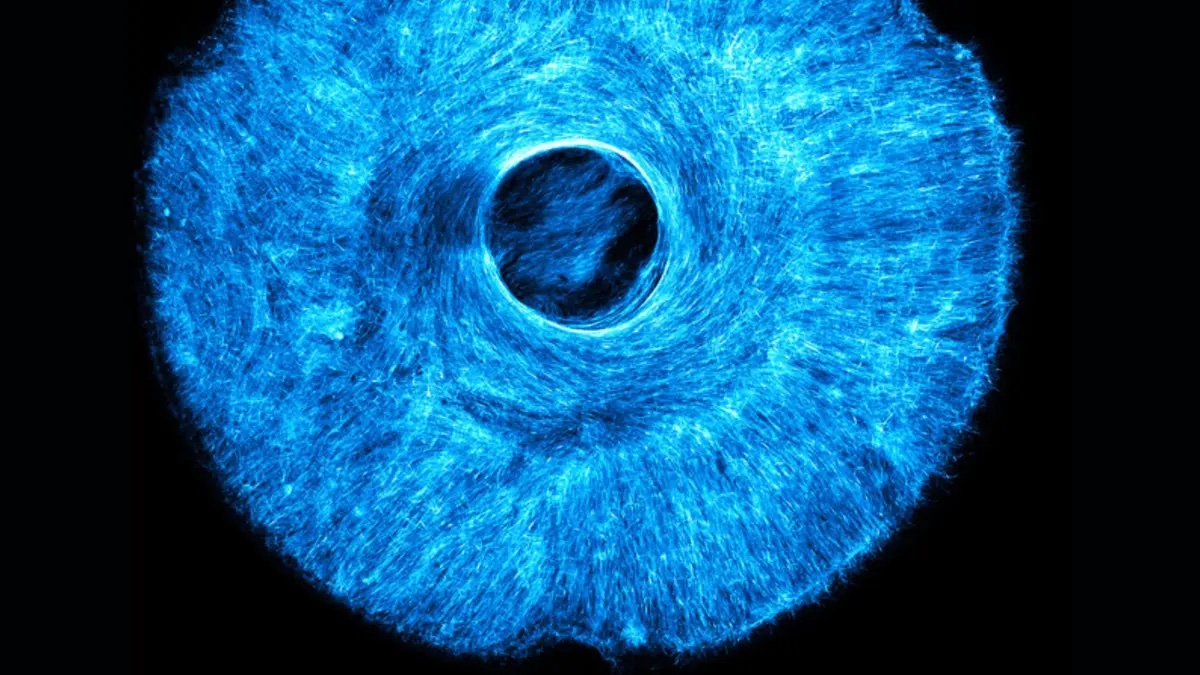
MIT Researchers Unlock Multi-Directional Motion for Biohybrid Robots with Artificial Muscles

Creating biohybrid robots—machines powered by lab-grown muscle tissue—has long been a goal for scientists aiming to build more adaptable, flexible robots. These robots could potentially squeeze and twist through spaces that are too small or complex for traditional machines. However, a significant challenge has stood in the way: existing artificial muscles typically only contract in one direction, limiting their range of motion. Imagine a robot with an arm that can only flex but can never rotate—this limitation has been a key obstacle.

Now, researchers at MIT have cracked the code for creating a new type of artificial muscle capable of complex, multi-directional movement. In a groundbreaking development, they’ve created artificial muscle fibers that can move in multiple directions, mimicking the behavior of the iris in a human eye. To prove their concept, the team designed a muscle-powered structure that contracts both in a circular and outward direction, showcasing a level of motion that previous biohybrid robots couldn’t achieve.

Continue reading… “MIT Researchers Unlock Multi-Directional Motion for Biohybrid Robots with Artificial Muscles”


Carnegie Mellon Team Breaks New Ground with 2D Tellurium for High-Performance Photodetectors

A team of researchers from Carnegie Mellon University has recently developed a groundbreaking method for producing large quantities of a material that could revolutionize the field of two-dimensional (2D) semiconductors. Their work, published in ACS Applied Materials & Interfaces in December 2024, promises to enhance the performance of photodetectors and pave the way for the next generation of light-sensing and multifunctional optoelectronic devices.

Semiconductors are at the heart of modern electronics, powering everything from smartphones and laptops to AI technologies. These materials control the flow of electricity by acting as a bridge between conductors (which allow electricity to flow freely) and insulators (which block it). According to Xu Zhang, assistant professor of electrical and computer engineering at Carnegie Mellon, the work done by his team is vital to advancing electronics and optoelectronics.

Continue reading… “Carnegie Mellon Team Breaks New Ground with 2D Tellurium for High-Performance Photodetectors”

Light Becomes a Supersolid: A Quantum Breakthrough with Potential for Future Technologies

Supersolids, a bizarre and fascinating quantum state of matter, have now taken a new, mind-bending form: light itself. In a groundbreaking experiment, scientists have successfully transformed light into a supersolid, a development that could pave the way for advancements in quantum and photonic technologies.

Supersolids, a state previously only observed in atoms, combine the ordered structure of solids with the free-flowing properties of liquids. These extraordinary materials defy traditional classifications of matter, offering a crystalline arrangement like a solid while also exhibiting the fluid-like ability to flow without losing their shape—something that seems counterintuitive at first glance.

Continue reading… “Light Becomes a Supersolid: A Quantum Breakthrough with Potential for Future Technologies”

Barcelona’s Driverless Minibus Revolution: A Glimpse into the Future of Urban Mobility

Commuters in Barcelona are getting a sneak peek into the future of public transportation, with free rides on a new driverless electric minibus. Launched by Renault as part of an experimental trial, this initiative aims to explore the possibilities of urban mobility in an increasingly automated world.

Two autonomous electric minibuses now travel a 2.2-kilometer (1.36-mile) route through the busy streets of Barcelona, as part of a collaboration between Renault and WeRide. The goal? To test how well driverless shuttles can operate in a dense, complex urban environment. According to Renault, the trial underscores the maturity of autonomous vehicle technology, showing it’s ready to be considered for widespread public transport.

Continue reading… “Barcelona’s Driverless Minibus Revolution: A Glimpse into the Future of Urban Mobility”

The World’s Largest “Water Battery” is Now Fully Operational

The Fengning Pumped Storage Power Station, located just north of Beijing, is officially up and running as of 2025. After over 11 years of construction and an investment of $2.6 billion, the station is now the largest of its kind globally, surpassing the previous record-holder in Bath County, Virginia, according to the International Hydropower Association (IHA).

Pumped-storage hydropower stations are often referred to as “water batteries” because they offer a reliable method for storing renewable energy, such as wind and solar power, which can be intermittent. By storing this excess energy, the grid experiences less stress, reducing the likelihood of blackouts. The Fengning station, for instance, supports a nearby wind and solar farm, contributing to the efficient use of clean energy.

Continue reading… “The World’s Largest “Water Battery” is Now Fully Operational”

D-Wave Quantum Breakthrough: Solving Real-World Problems with Quantum Computing

D-Wave Quantum Inc., a Canadian company based in Vancouver specializing in quantum computing for commercial use, has made a groundbreaking achievement with its D-Wave Advantage 2 prototype annealing quantum computer. The company announced the success of solving a real-world, practical problem and validated its results through a peer-reviewed paper published in a prestigious scientific journal.

For decades, Moore’s Law has driven the rapid growth of microchip performance, with computing power doubling roughly every two years. This relentless advancement has drastically changed the landscape of computing, making devices smaller and more powerful. Despite this progress, however, many complex problems—such as climate change modeling and drug discovery—remain beyond the capabilities of even the most advanced supercomputers. In response to this challenge, quantum computing, which harnesses the principles of quantum mechanics, is poised to offer solutions to problems that could take current supercomputers years to solve.

Continue reading… “D-Wave Quantum Breakthrough: Solving Real-World Problems with Quantum Computing”

Revolutionizing Steel Production: Molten Iron in Just Six Seconds

For centuries, the steel industry has been powered by coal-driven blast furnaces—an energy-intensive and environmentally harmful process. Traditional steelmaking involves crushing iron ore, heating it to extreme temperatures, and mixing it with coke (a refined coal product), all while taking several hours to complete. But now, researchers have uncovered a groundbreaking method that slashes production time from hours to mere seconds, significantly reducing both energy consumption and pollution.

Instead of relying on coal-based reactions, the new process uses ultra-fine iron ore powder, injected into a high-temperature furnace through a specialized vortex lance. This innovative approach triggers a rapid chemical reaction, producing molten iron in just a few seconds.

Continue reading… “Revolutionizing Steel Production: Molten Iron in Just Six Seconds”

A Partial Solar Eclipse to Light Up the Sky on March 29

On the morning of Saturday, March 29, the northeastern coast of North America will witness a rare and striking celestial event—a partial solar eclipse. As the sun rises, a crescent-shaped sun will appear on the eastern horizon, with the eclipse already in progress.

Thirteen U.S. states will experience the March 29 eclipse, though the intensity of the eclipse will vary depending on location. The farther northeast you go, the deeper the eclipse will be, with coastal New England offering the best views. In Maine, observers can expect up to 86% of the sun to be obscured at sunrise. New Hampshire and Massachusetts will see slightly less, with up to 57% and 55% coverage, respectively. In Boston, the eclipse will cover 43% of the sun.

Continue reading… “A Partial Solar Eclipse to Light Up the Sky on March 29”

Breakthrough Hydrogen Sensor Technology Paves the Way for Safer Energy Systems

A new sensor technology developed by Professor Thomas Anthopoulos from the University of Manchester, in collaboration with King Abdullah University of Science and Technology (KAUST), has made significant strides in addressing one of the key challenges to hydrogen adoption as an energy carrier. Published in Nature Electronics, this innovative sensor promises to revolutionize hydrogen safety across industries, homes, and transportation.

Hydrogen, while promising as a clean energy source, presents unique safety challenges. It is colorless, odorless, and highly flammable, making it difficult to detect using human senses. Efficient and reliable hydrogen detection systems are crucial for implementing hydrogen technologies safely, particularly as the world looks to transition away from fossil fuels.

Continue reading… “Breakthrough Hydrogen Sensor Technology Paves the Way for Safer Energy Systems”

Breakthrough Imaging Technique Tracks Cancer Medicine with Unmatched Precision

Imagine if doctors could track exactly where cancer medicine goes inside your body, how long it stays, and whether it effectively reaches the tumor. This level of precision could make cancer treatments safer and more targeted, improving outcomes for patients. Now, scientists in Japan have developed a groundbreaking method to do just that, using tiny gold particles and a special technique called neutron activation.

Conventional imaging methods often rely on external tracers, like fluorescent dyes and radioisotopes, to track nanoparticles inside the body. While these methods can be useful, they often fall short because the tracers can detach from the nanoparticles during circulation. This detachment leads to inaccurate results and limits the ability to visualize the nanoparticles’ full journey.

Continue reading… “Breakthrough Imaging Technique Tracks Cancer Medicine with Unmatched Precision”

Breakthrough in Chip-Based Amplification Sets a New Standard for Optical Communication Networks

Modern communication networks rely heavily on optical signals to transmit massive amounts of data. However, just like weak radio signals, these optical signals need amplification to travel long distances without degrading. For decades, erbium-doped fiber amplifiers (EDFAs) have been the go-to solution, extending transmission ranges without requiring frequent signal regeneration. While effective, EDFAs are limited by their narrow spectral range, which has hindered the expansion of optical networks.

With the increasing demand for high-speed data transmission—driven by advancements in AI accelerators, data centers, and high-performance computing—the limitations of traditional optical amplifiers are becoming more apparent. As a result, researchers are turning their attention to developing more powerful, flexible, and compact amplifiers to meet the rising data needs.

Continue reading… “Breakthrough in Chip-Based Amplification Sets a New Standard for Optical Communication Networks”

Breakthrough in 3D Printing: Scientists Achieve High-Resolution Microstructures with MXene Technology

In an exciting advancement, scientists have successfully developed a method to print high-resolution 3D microstructures using MXene, a revolutionary two-dimensional nanomaterial composed of alternating metal and carbon layers. Discovered in the U.S. in 2011, MXene has earned the nickname the “dream material” due to its exceptional electrical conductivity and powerful electromagnetic shielding properties. Despite its promise, MXene had never been applied to 3D printing due to several technical challenges.

The breakthrough comes from the Smart 3D Printing Research Team at KERI (Korea Electrotechnology Research Institute), led by Dr. Seol Seung-kwon. The team introduced a novel technique called the Meniscus method to overcome the hurdles associated with using MXene in 3D printing. The primary challenge was finding the right ink viscosity for printing; a high concentration of MXene would clog the nozzle, while a lower concentration made the ink ineffective. Furthermore, the addition of binders typically weakened the material’s intrinsic properties, limiting its potential.

Continue reading… “Breakthrough in 3D Printing: Scientists Achieve High-Resolution Microstructures with MXene Technology”
Discover the Hidden Patterns of Tomorrow with Futurist Thomas Frey
Unlock Your Potential, Ignite Your Success.

By delving into the futuring techniques of Futurist Thomas Frey, you’ll embark on an enlightening journey.

Learn More about this exciting program.