By Futurist Thomas Frey
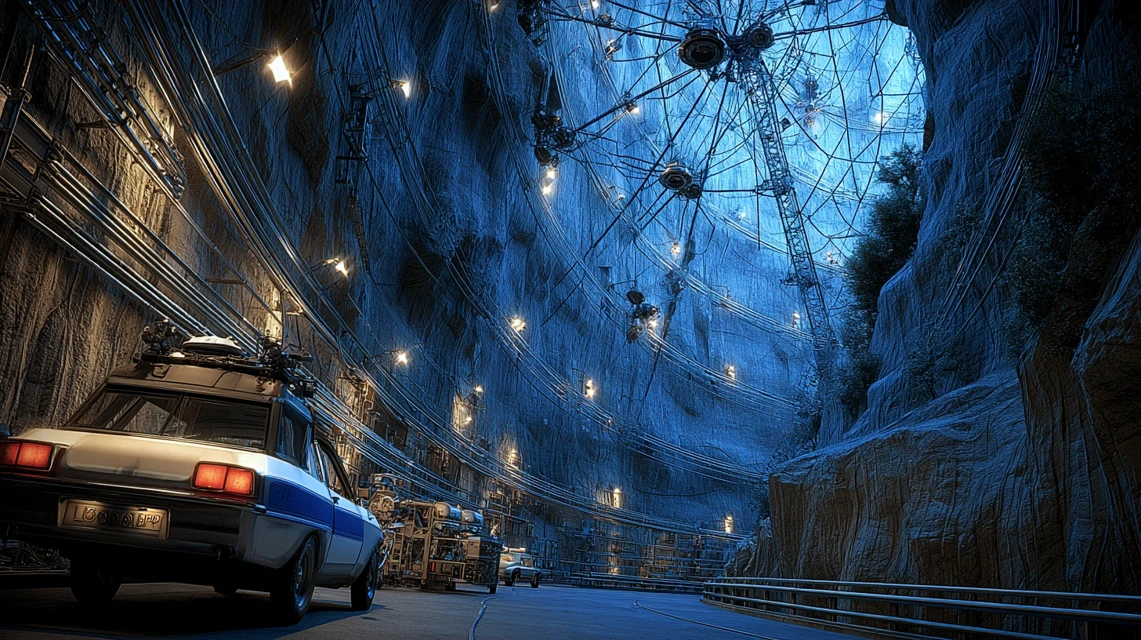
By 2040, the most advanced homes won’t expand outward—they’ll expand downward. As robotic businesses become a normal part of residential life, the surface-level home becomes a sanctuary for people, while an entire network of underground tunnels becomes the circulation system for the machines that work nonstop beneath our feet.
This isn’t science fiction. It’s the logical solution to a problem that becomes unavoidable once homes run multiple robot businesses: you don’t want delivery drones buzzing past windows, laundry robots rolling across living rooms, or 3D-printing carriers moving parts through the kitchen while you’re trying to live.
So architects solve the problem the same way cities solved traffic congestion a century earlier: by separating flows. The human world stays above ground—quiet, open, calm. The mechanical world moves underground—efficient, invisible, continuous.
What Digger-Bot Tunnels Actually Are
Each robot-enabled home connects to a subsurface robotics corridor: a series of reinforced tunnels roughly 3-5 feet in diameter running beneath the foundation and extending outward to connect garages, workshops, drone bays, hydroponic farms, and neighborhood distribution nodes.
Inside these tunnels, robots travel like freight trains on a private network. Laundry bots move from washers to folding chambers. Meal-prep robots shuttle ingredients from cold storage to automated kitchens. 3D-printing arms deliver custom parts to neighborhood lockers. Drone payloads drop into underground chutes rather than landing on noisy pads above.
The tunnels are climate-controlled, sensor-rich, and optimized for robot navigation—smooth curves instead of right angles, friction-reduced flooring, ceiling-mounted wireless charging strips. Every section is modular, allowing homeowners to expand their robotic infrastructure just as they’d add rooms or remodel a kitchen.
In busy households, the subsurface system looks like an ant colony—robots scurrying efficiently from one chamber to another, never interfering with human life. Parents read in quiet living rooms while dozens of machines operate silently below. Teens eat breakfast while the house assembles 40 subscription meal boxes underground. Visitors marvel at how serene everything feels, unaware that the home is producing income in every direction.
Why Underground Makes Sense
Noise isolation: Robots aren’t quiet. Motors whir, wheels click, drone rotors buzz, 3D printers hum. When these sounds fill living spaces, homes become factories psychologically. Moving robot operations underground eliminates noise pollution, preserving homes as peaceful human environments.
Temperature management: Robots generate heat. Multiple printers, cooking systems, charging stations, and mechanical operations raise ambient temperatures significantly. Underground spaces naturally maintain cooler, more stable temperatures—reducing cooling costs while preventing human living areas from becoming uncomfortably warm.
Space efficiency: Surface space is expensive. Excavating downward—particularly in suburban areas with deep foundations already—costs less per square foot than building outward or upward. Digger-bot tunnels maximize usable space without increasing the home’s visible footprint or property tax assessment based on square footage.
Safety separation: Robot operations involve risks—mechanical failures, fires from printers or charging systems, chemical exposures from manufacturing processes. Keeping these underground contains accidents away from human living spaces, making homes safer overall.
Aesthetic preservation: Neighborhoods don’t want homes that look like warehouses. Underground robot infrastructure allows homes to maintain traditional residential appearance while functioning as commercial operations. From the street, nothing looks different.
The Underground Architecture
Main circulation tunnel: The primary corridor runs 4-5 feet in diameter beneath the home’s perimeter, forming a loop or grid that connects all major robot work zones. Robots travel this main artery continuously.
Branch tunnels: Smaller 3-foot diameter tunnels branch from the main corridor to specific work areas—hydroponic farms, 3D printing workshops, storage chambers, drone launch silos. Think subway lines with branch routes.
Vertical shafts: Robots move between underground and surface levels through vertical shafts with ramps or elevators. These connect tunnels to garages, kitchens, and delivery access points where interaction with the surface world is necessary.
Work chambers: Enlarged underground rooms house major robot operations—meal prep kitchens, fabrication workshops, packaging stations. These chambers are 8-12 feet in diameter, excavated from the tunnel system like subway stations on a line.
Storage vaults: Climate-controlled chambers store inventory, materials, and supplies robots need. These connect directly to work chambers via short tunnels, allowing robots to retrieve items without surfacing.
Charging stations: Alcoves along tunnel walls provide wireless charging. Robots dock briefly while traveling between tasks, maintaining battery levels without returning to central charging facilities.
Emergency access: Human-accessible maintenance tunnels run parallel to robot corridors, allowing homeowners to inspect, repair, or override robot systems when necessary. These are tall enough for crouching humans but rarely used.
Neighborhood Tunnel Networks
The revolutionary aspect: entire neighborhoods build shared digger-bot tunnel grids, allowing fleets of robots to travel between homes to deliver goods, share resources, or maintain each other.
A meal-prep robot in House 17 can deliver directly to customers in Houses 22, 34, and 41 via underground tunnels, emerging only at delivery points. Laundry robots travel between homes picking up and delivering without ever appearing on streets. Maintenance robots move through the network servicing multiple homeowners’ equipment.
Streets remain peaceful, with no visible robot traffic. All movement happens below the surface. From above, neighborhoods look quiet and traditional. Below, a bustling mechanical economy operates continuously.
This shared infrastructure dramatically increases efficiency. Instead of every home needing full robot capabilities, neighborhoods pool resources—shared fabrication centers, centralized storage, distributed delivery networks. The tunnel grid becomes communal infrastructure like roads or sewers.
The Economics of Going Underground
Initial costs: Excavating and reinforcing digger-bot tunnels costs $150-300 per linear foot depending on soil conditions. A basic home system with 100 feet of tunnel costs $15,000-30,000. Comprehensive systems with 300+ feet of tunnels and multiple chambers cost $60,000-120,000.
Property value impact: Robot-ready underground infrastructure increases home values 15-25% in markets where robot businesses are common. The investment pays back through increased resale value plus income from robot operations the tunnels enable.
Retrofitting challenges: Adding tunnels to existing homes requires foundation work, soil analysis, and careful engineering to avoid damaging structures. New construction incorporates tunnels during initial building, dramatically reducing costs.
Shared infrastructure economics: Neighborhood-scale tunnel networks split costs among multiple homeowners. Instead of $80,000 per home for isolated systems, shared networks cost $30,000-50,000 per home while providing better connectivity.
How Digger-Bots Actually Build Tunnels
The tunnels themselves are excavated by specialized digger-bot systems—autonomous boring machines scaled down for residential use. These aren’t the massive tunnel boring machines used for subways. They’re compact, remotely-operated or autonomous robots about the size of riding lawnmowers.
Digger-bots work slowly but continuously, excavating soil, reinforcing tunnel walls with sprayed concrete or prefabricated segments, and creating smooth finished passages. A single digger-bot can excavate 10-20 feet of tunnel per day in typical soil conditions. Homeowners rent or lease these systems for weeks or months while tunnel networks are constructed.
The excavated soil becomes a resource rather than waste—distributed across yards to create landscaping features, sold to neighbors for gardening, or removed for projects requiring fill dirt. The digger-bot operation becomes nearly cost-neutral when excavated material has value.
The Regulatory Battles
Underground construction faces legal hurdles:
Property rights: Do homeowners own the space beneath their property indefinitely downward? Can they tunnel under streets to connect with neighbors? These questions lack clear legal precedent in many jurisdictions.
Safety regulations: Building codes for residential underground construction barely exist. Fire codes, structural requirements, ventilation standards—all need development specific to digger-bot tunnels.
Utility conflicts: Tunnels must avoid water lines, sewer pipes, electrical conduits, gas lines, and fiber optic cables. Coordinating with utilities adds complexity and cost.
Neighborhood approval: Shared tunnel networks require collective agreement. HOAs and municipal governments will debate extensively whether to permit underground robot infrastructure, creating early-adopter versus resistant communities.
What This Changes
By 2040, the most valuable square footage in a home isn’t the primary bedroom or the kitchen—it’s the robotic underworld: the digger-bot tunnels where an entire subterranean workforce keeps life running smoothly without ever stepping into the light.
Homes transform from two-dimensional structures into three-dimensional platforms with distinct above-ground and below-ground zones. Real estate listings describe tunnel systems like they currently describe basements—finished versus unfinished, total linear footage, number of work chambers, connection to neighborhood grid.
The separation between human and robot spaces becomes architectural. Families inhabit peaceful above-ground environments while robots operate in purpose-built below-ground infrastructure. The two worlds intersect at specific points—delivery access, control rooms, maintenance shafts—but otherwise remain distinct.
This isn’t every home by 2040. But it’s the high-end model that serious robot entrepreneurs adopt when space, noise, and efficiency matter. Once built, underground robot infrastructure provides decades of utility—longer-lasting than most above-ground construction because it’s protected from weather, temperature fluctuations, and visible aging.
Final Thoughts
The digger-bot tunnels of 2040 represent infrastructure thinking applied to residential properties. Instead of forcing robots and humans to share inadequate space, we build purpose-specific environments for each.
Above ground: human sanctuary. Below ground: robot workforce.
The home doesn’t just expand downward for space—it expands downward for separation. And that separation makes both humans and robots more effective in their respective domains.
The future of housing isn’t just bigger—it’s deeper.
Related Stories:
https://www.architecturaldigest.com/story/underground-home-extensions-future
https://www.builderonline.com/technology/underground-residential-infrastructure_o
https://www.technologyreview.com/2024/10/22/robot-infrastructure-residential-tunnels/